
Imitation vs. Observational Learning: Crucial 6th Edition TCO Distinctions
Under the BACB 6th Edition Test Content Outline (TCO), behavior analysis moves past superficial topographies to enforce strict functional boundaries within generative and model-evoked learning[cite: 1, 2]. A major source of active friction for advanced candidates is the clinical discrimination between true Imitation and the broader umbrella of Observational Learning[cite: 1, 2].
Historically treated by surface-level study guides as interchangeable terms, the 6th Edition codifies these concepts into distinct behavioral mechanisms. Tearing these apart on exam day requires analyzing the immediacy of the response, the presence of a novel physical model, and the precise history of reinforcement contingencies.
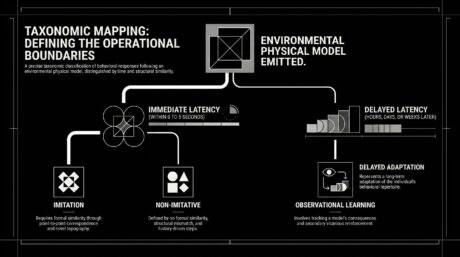
Technical Parameters of Behavioral Imitation
To satisfy the strict scientific definition of true behavioral imitation, an operant sequence must systematically satisfy four precise defining parameters simultaneously:
-
Evoked by a Physical Model: The antecedent stimulus must be a physical movement or vocal model displayed by another organism that serves as the immediate discriminative stimulus for the matching topography.
-
Formal Similarity: The target response must resemble the antecedent model topographically. The behavior must physically match the physical dimensions of the model (e.g., clapping hands in response to a physical hand-clap model, or emitting an exact vocal typography in response to an echoic model).
-
Point-to-Point Correspondence: The matching response must feature step-by-step, structural equivalence from start to finish. The beginning, middle, and terminal parameters of the organism’s movement must match the corresponding components of the model.
-
Strict Temporal Immediacy: The matching response class must be emitted closely in time following the model presentation, typically within a compressed 0 to 5-second latency window. If a matching topography occurs minutes or hours later, it is controlled by an alternative conditioning history or discriminative stimulus array, rendering it non-imitative.
Technical Parameters of Observational Learning
In distinct contrast to imitative behavior, Observational Learning centers entirely on learning from the environmental reinforcement or punishment contingencies applied to another organism. The observer actively tracks the model’s action alongside its structural fallout. This alters their own future probability of emitting that topography under relevant motivating operations without requiring an immediate physical copy:
Observational learning does not require structural point-to-point correspondence, nor does it demand strict temporal immediacy. Instead, it describes a cognitive-behavioral alteration where a learner watches a peer’s hand-raising behavior receive a positive reinforcement consequence (e.g., praise or tokens), thereby modifying their own subsequent probability of raising their hand days later.
Level-3 Applied Discrimination Assessment
Question 1
During a localized vocabulary group session, a behavior technician points to an illustrative icon of a lion and says, “Lion.” Student A immediately points to the same icon and says, “Lion,” perfectly matching the structural vocal topographies and physical orientations of the technician within 2 seconds. The following morning, Student B observes a peer receive a generalized conditioned reinforcer (a star sticker) from the teacher for organizing their desk materials before the terminal recess bell rings. Student B makes no immediate movement, but when arriving at their workspace three days later, Student B systematically organizes their desk materials prior to the bell.
Applying a strict 6th Edition TCO conceptual breakdown to these two learner profiles, which taxonomic designation sequence is actively demonstrated?
A) Student A demonstrates Observational Learning; Student B demonstrates Behavioral Imitation.
B) Student A demonstrates Behavioral Imitation; Student B demonstrates Observational Learning.
C) Student A demonstrates an Echoic Mand chain; Student B demonstrates an Unconditioned Autoclitic.
D) Student A demonstrates Response Effort Bias; Student B demonstrates a Fixed-Time Schedule Artifact.
Question 2
To meet the strict behavioral definition of Imitation under modern behavior-analytic parameters, a matching response topography must be evoked by a physical model, display formal similarity, occur closely in time after the model presentation, and preserve point-to-point correspondence. Which clinical scenario successfully fulfills the parameter of point-to-point correspondence?
A) A learner watches a supervisor spell a target sight word on a whiteboard, and then writes a synonymous word inside their notebook 30 seconds later.
B) A participant observes a parent execute a multi-step motorized assembly sequence, and then executes the exact identical physical steps in identical chronological sequence 3 seconds later.
C) An adult client tracks an instructional presentation on vocational soft skills, and then attends an independent job interview two weeks later to obtain employment.
D) A child witnesses a peer receive a timeout consequence for non-compliance, and immediately runs out of the room to escape the demand context.