
A behavior drops the week treatment starts. Did the treatment work? On the BCBA exam, the honest answer is “we can’t tell yet,” and that answer depends on understanding the A-B design. It is the starting point of Domain D, Experimental Design, and nearly every item about reversal and multiple baseline designs assumes you know exactly what an A-B comparison can and cannot show.
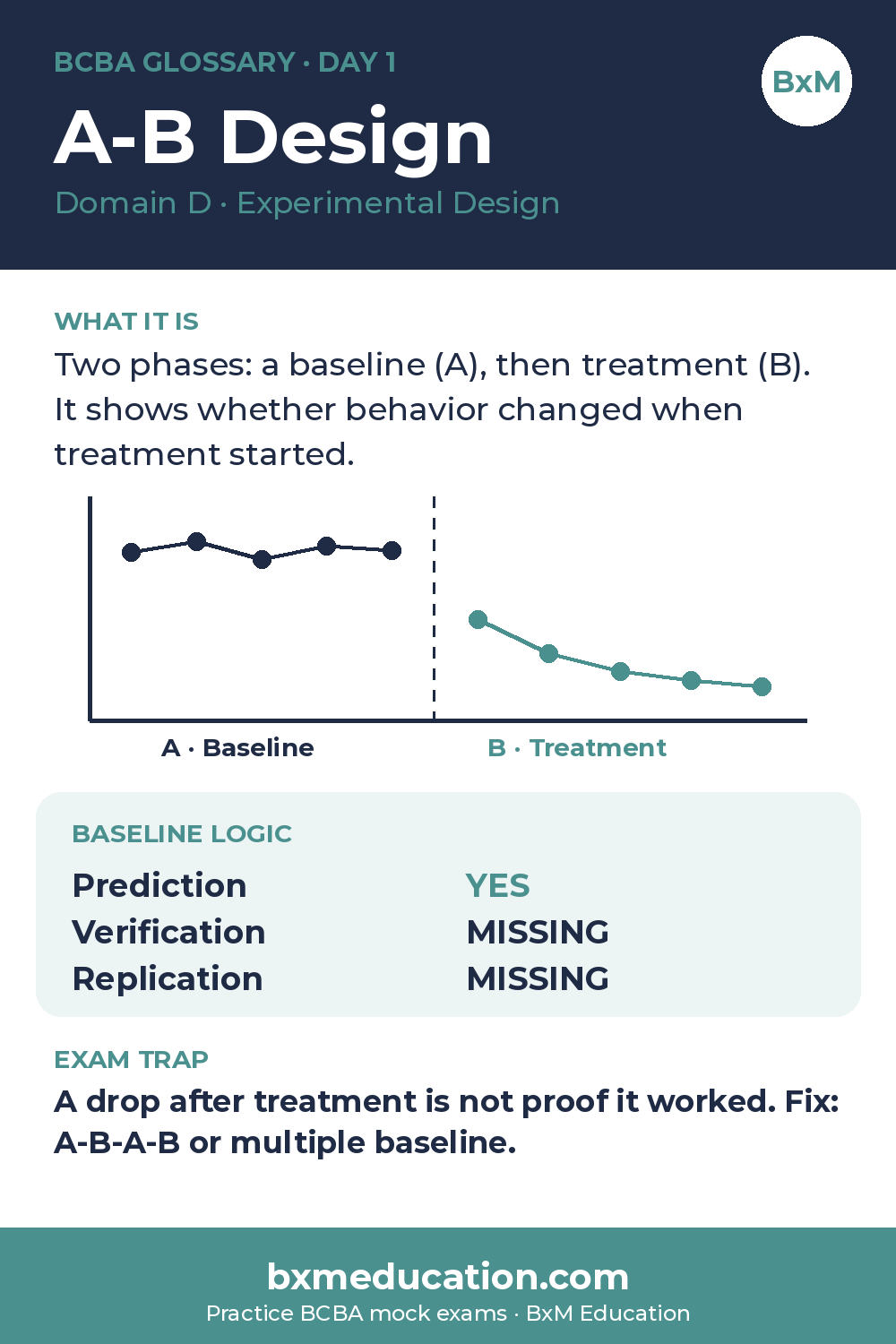
Cooper, Heron, and Heward (2020) describe the A-B design as a two-phase design: a pretreatment baseline condition (A) followed by a treatment condition (B). Data are collected repeatedly in baseline until responding is stable, then the intervention begins and measurement continues. If the level, trend, or variability changes when B starts, the change is visible on the graph. What the graph cannot tell you is why it changed.
That gap comes from baseline logic. A strong single-case design needs three elements: prediction, verification, and replication. An A-B design gives you only the first. Stable baseline data predict what would happen if nothing changed; the B phase shows that responding departed from that prediction. Concluding that the treatment caused the departure is an example of affirmation of the consequent: the result fits the hypothesis, but other explanations still fit too.
The Mechanics: What an A-B Design Shows and What It Doesn’t
- It shows a correlation in time. Behavior changed when the condition changed.
- It does not verify the prediction. No phase shows that baseline responding would have continued unchanged without treatment.
- It does not replicate the effect. The change happened once. One change can be a coincidence.
- It cannot rule out confounds. History (a new staff member, a medication change, a holiday), maturation, and other events that happen at the same time as the phase change all remain possible explanations.
For that reason, Cooper and colleagues treat the A-B design as a weak basis for claims about functional relations. It is often described as quasi-experimental.
Clinical Applications
- Accountability data in everyday practice. Many clinical cases run as A-B comparisons. They are useful for tracking progress and making decisions, as long as nobody claims they prove the intervention caused the change.
- When withdrawal is not acceptable. If the behavior is dangerous, returning to baseline (A-B-A-B) may be unethical. The way to strengthen an A-B design is then to stagger the intervention across behaviors, settings, or people, which turns it into a multiple baseline design.
- Building toward experimental control. Adding a return to baseline and a second treatment phase gives verification and replication: see our guide to A-B vs. A-B-A vs. A-B-A-B experimental control.
- Reading the graph correctly. Use visual analysis of level, trend, and variability within each phase before judging the change between them.
Research Consulting & APA Citation Reference
Clinical & Methodological Recommendation: Report A-B data as “behavior changed following the introduction of the intervention,” not “the intervention reduced the behavior.” Keep baseline long enough to show stable responding or a counter-therapeutic trend, note any events that coincided with the phase change, and, when the decision matters (funding, continuing a restrictive procedure), plan a design that adds verification and replication.
APA Reference Citation (7th Edition):
Cooper, J. O., Heron, T. E., & Heward, W. L. (2020). Applied behavior analysis (3rd ed.). Pearson.
Advanced Applied Reasoning Quiz
Question 1
A BCBA records an adult client’s self-injury for ten sessions. Baseline data are high and stable. After a function-based intervention starts, self-injury drops immediately and stays low. The clinical director asks whether a functional relation has been demonstrated. What is the best answer?
A) Yes, because the change was immediate when the phase changed
B) Yes, because the baseline was stable before treatment began
C) No, because the design provides prediction only, without verification or replication
D) No, because an A-B design requires at least three participants
Question 2
A team is using an A-B design to reduce aggression in a day program. Withdrawing the intervention would put staff at risk. Which change would best allow the team to demonstrate experimental control?
A) Return to baseline for one week, then reintroduce the intervention
B) Introduce the same intervention in a staggered way across two more settings
C) Extend the intervention phase for another month
D) Collect more baseline sessions before starting treatment
Check Your Answers
Replay the video above to review the logic behind each scenario, then test yourself under exam conditions in the BCBA Mock Exam System.