
Test your clinical discrimination skills with these three exam-style questions built specifically around the heavy-hitting domains of the 6th Edition Test Content Outline.
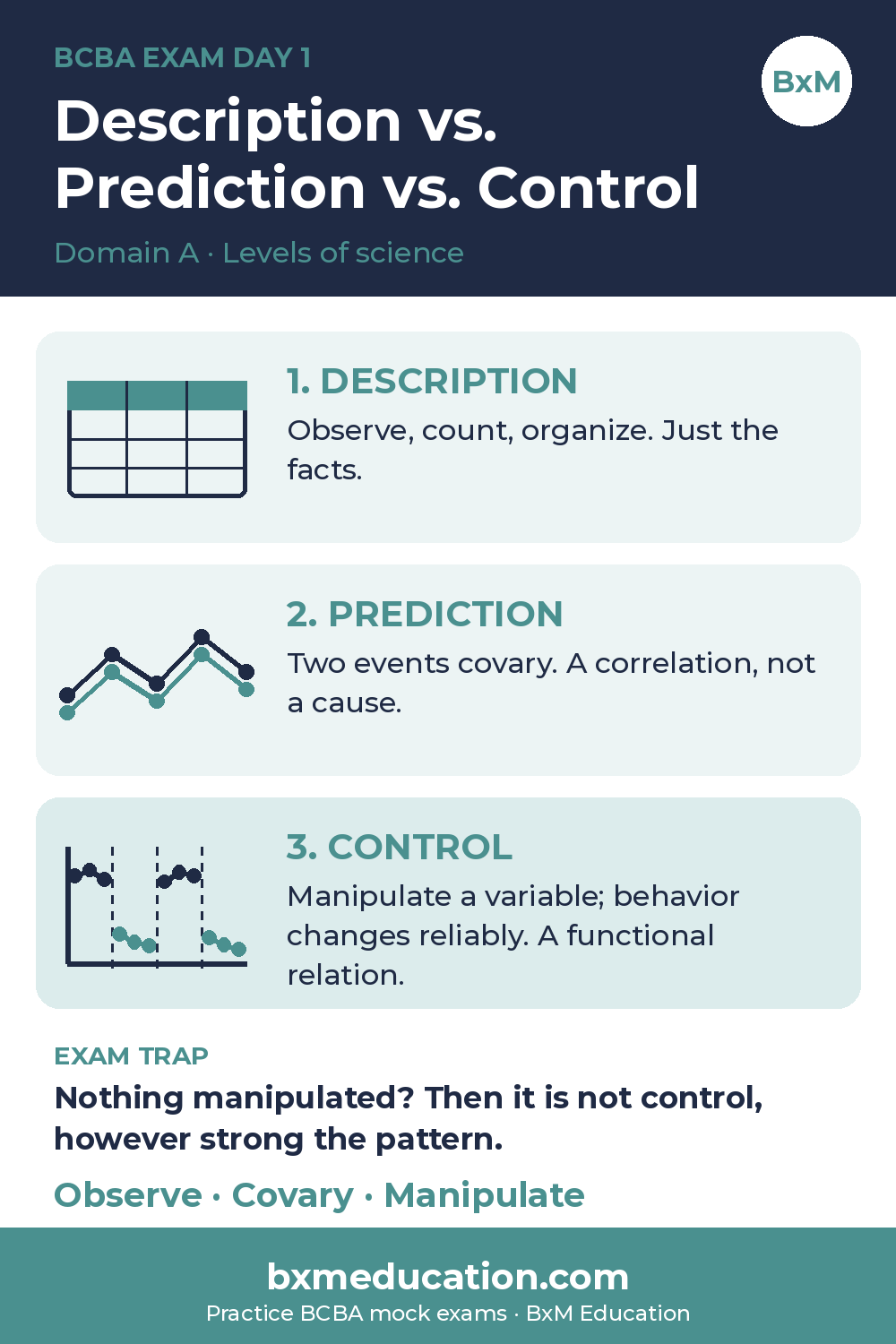
Behavior analysis, like every science, works toward three levels of understanding. Cooper, Heron, and Heward (2020) describe them as description, prediction, and control. Each level builds on the one before it, and exam items test whether you can tell which level a set of observations has actually reached.
Question 1 (Domain A: Levels of scientific understanding)
A behavior technician working with an adult client in a day program records every instance of self-talk across three settings for two weeks. She summarizes the counts in a table by setting and time of day. No changes have been made to the client’s routine. Which level of scientific understanding do these data represent?
A) Prediction
B) Control
C) Description
D) Replication
Question 2 (Domain A: Levels of scientific understanding)
After a month of observation, a team notices that an adult client’s verbal aggression occurs far more often on days when his morning break is skipped. Staff can now anticipate which afternoons will be difficult, but they have not changed anything about the break schedule. Which level of understanding has the team reached?
A) Prediction
B) Control
C) Description
D) Functional analysis
Question 3 (Domain A: Levels of scientific understanding)
A BCBA introduces a scheduled morning break, withdraws it, and introduces it again using a reversal design. Verbal aggression drops each time the break is in place and returns each time it is removed. Which level of scientific understanding does this demonstrate?
A) Description
B) Prediction
C) Covariation
D) Control
Watch before you check your answers: the three levels in one minute
Written Answer Explained
Question 1 Breakdown (Domain A: Levels of scientific understanding)
Core Scenario Summary: The technician systematically observes, counts and organizes behavior without manipulating anything or identifying any relation between events.
Correct Answer: C) Description
Clinical Analysis & Distractor Rationales:
- Why C is Correct: Description is the first level: a collection of facts about observed events that can be quantified, classified and examined for possible relations. Counting self-talk by setting and time is exactly that.
- Why A is Incorrect: Prediction requires evidence that two events reliably covary, so that one can be anticipated from the other. The table shows counts, not a demonstrated relation between events.
- Why B is Incorrect: Control requires an experimental manipulation that produces a reliable change in behavior. Nothing was manipulated.
- Why D is Incorrect: Replication means repeating a condition or an entire experiment to show that an effect is reliable. It is a feature of experimental designs, not a level of understanding, and no condition was repeated here.
Question 2 Breakdown (Domain A: Levels of scientific understanding)
Core Scenario Summary: Repeated observation shows that two events covary (skipped break and aggression), allowing staff to anticipate behavior, but no variable has been manipulated.
Correct Answer: A) Prediction
Clinical Analysis & Distractor Rationales:
- Why A is Correct: Prediction is the second level: repeated observations show that two events systematically covary, so the occurrence of one can be predicted from the other. This is a correlation, not proof of cause.
- Why B is Incorrect: Control would require the team to manipulate the break schedule and show that aggression changes reliably as a result. They have not manipulated anything.
- Why C is Incorrect: The data go beyond description because a reliable relation between two events has been identified and used to anticipate behavior.
- Why D is Incorrect: A functional analysis is an assessment in which antecedents and consequences are experimentally manipulated to identify a behavior’s function. Observation alone is not a functional analysis.
Question 3 Breakdown (Domain A: Levels of scientific understanding)
Core Scenario Summary: The BCBA manipulates the break schedule and replicates the effect within a reversal design: behavior changes reliably each time the variable is introduced or withdrawn.
Correct Answer: D) Control
Clinical Analysis & Distractor Rationales:
- Why D is Correct: Control is the highest level of scientific understanding. It is reached when a specific change in the environment reliably produces a specific change in behavior, demonstrating a functional relation. Introducing and withdrawing the break, with aggression changing each time, is an experimental demonstration of control.
- Why A is Incorrect: Description stops at observing and quantifying events. Here a variable was manipulated.
- Why B is Incorrect: Prediction relies on observed covariation without manipulation. Experimental manipulation with replicated effects moves past prediction to control.
- Why C is Incorrect: Covariation describes two events changing together, which is the basis of prediction. It does not by itself show that one causes the other.
Keep building the foundation: see why a simple A-B design can show change but not control, how baseline logic gets you from prediction to verification, and what makes applied behavior analysis a science of socially significant change. Replay the video above, then test yourself under exam conditions in the BCBA Mock Exam System.