
Positive reinforcement is the tool you will use more than any other as an RBT, and the exam expects you to know exactly when it is (and isn’t) happening.
What It Means (in Plain Language)
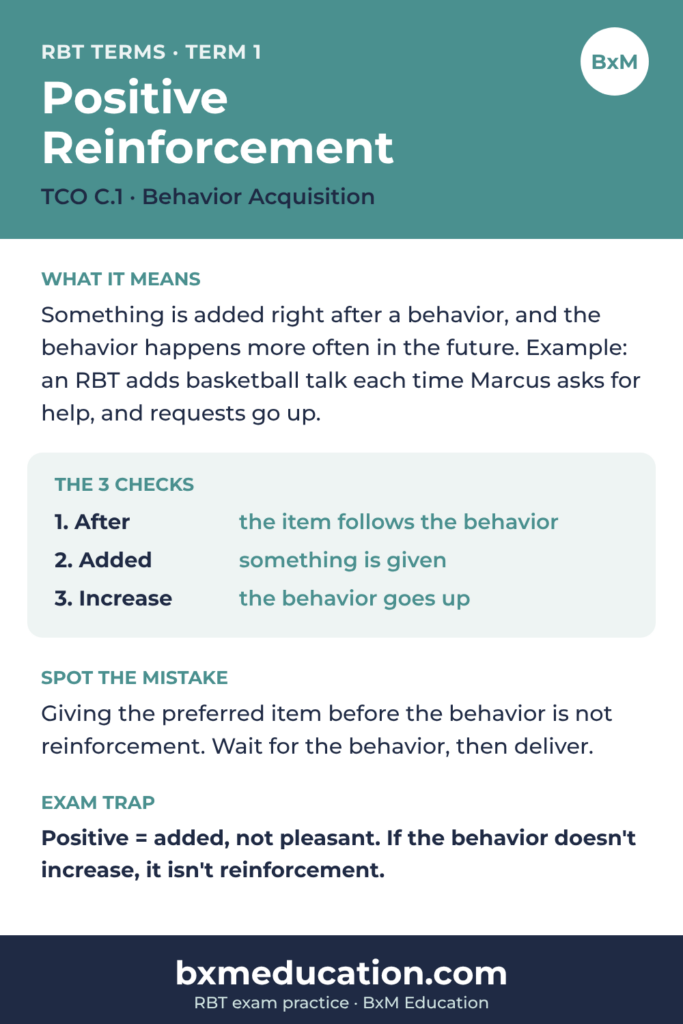
Positive reinforcement happens when something is added right after a behavior, and because of that, the behavior happens more often in the future.
Two words do all the work:
- Positive = something is added (not “good” or “nice”).
- Reinforcement = the behavior increases later on.
If nothing was added, it isn’t positive. If the behavior doesn’t go up, it isn’t reinforcement, no matter how pleasant the item seemed.
The 3 Checks
Before you call anything positive reinforcement, run three quick checks:
- After: did the item come after the behavior, not before?
- Added: was something given (praise, a token, a preferred item, an activity)?
- Increase: is the behavior happening more often over time?
All three are yes → positive reinforcement. Any no → it’s something else.
Application: Done Right
Marcus is a 24-year-old adult learner at a day program working on asking for help instead of leaving his work area. His RBT, Dana, knows from the preference assessment that Marcus loves talking about basketball.
Each time Marcus raises his hand and says “help, please,” Dana comes over right away, helps, and adds 30 seconds of basketball talk. Over two weeks, Dana’s data show hand-raises going from 2 per session to 9 per session, and leaving the work area dropping.
Why it works: the basketball talk is added, it comes immediately after the request, and the requests increased. All three checks pass.
Misapplication: Spot the Mistake
Same program, different RBT. Before the work session starts, Jordan tells Marcus, “Here’s 5 minutes of basketball talk, and then you’ll ask for help when you need it, okay?” Jordan logs it as “positive reinforcement for requesting.”
Spot the mistake: the preferred activity came before the behavior. Nothing was delivered contingent on asking for help, so it can’t strengthen asking for help. (This pattern is often called bribery.) The fix: wait for the request, then deliver the reinforcer right away.
How It Shows Up on the RBT Exam
- Questions often use the word “positive” to tempt you into thinking “pleasant.” Read it as added.
- Watch the timing in the scenario: reinforcers delivered before the behavior, or long after it, are red flags.
- A question may describe an item the client “loves” but data show no increase. That’s not reinforcement yet.
Keep Studying
- Compare it with the BCBA-level version: Positive vs. Negative Reinforcement | BCBA Exam Day 3
- Start or finish your hours: RBT 40-Hour Training
- Test yourself under exam conditions: RBT Practice Exam Pack
Quick Check (2 Questions)
Question 1. An RBT gives Lena, an adult client, a sticker on her chart each time she clocks in on time at her job-training site. Over three weeks, on-time clock-ins rise from 2 to 5 days a week. What happened?
A) Negative reinforcement, because late arrivals were removed
B) Positive reinforcement, because a sticker was added and on-time clock-ins increased
C) Positive punishment, because a stimulus was added
D) Extinction, because lateness stopped being reinforced
Show answer
B. A stimulus (sticker) was added after the behavior, and the behavior increased. A is wrong: nothing aversive was removed after clocking in. C is wrong: punishment would make clocking in decrease. D is wrong: extinction means withholding a reinforcer that used to follow the behavior.
Question 2. An RBT praises a client with an enthusiastic “Amazing job!” every time he greets a coworker. After a month, greetings have not changed from baseline. Which statement is most accurate?
A) Praise is always a positive reinforcer, so greetings are being reinforced
B) This is positive reinforcement because something pleasant was added
C) Praise is not functioning as a reinforcer for greetings, because the behavior did not increase
D) This is negative reinforcement because praise ended a silence
Show answer
C. Reinforcement is defined by its effect: the behavior must increase. Something added that doesn’t increase the behavior is not a reinforcer for that person (yet). A and B confuse “pleasant” with “reinforcing.” D misreads the scenario; nothing aversive was removed. Report the flat data to your supervisor so the plan can be adjusted.
Reference
Miltenberger, R. G. (2016). Behavior modification: Principles and procedures (6th ed.). Cengage Learning.
Behavior Analyst Certification Board. (2024). RBT Test Content Outline (3rd ed.). https://www.bacb.com