
BxM SPED Materials
Every student. Every way of responding.
Math and language intervention books for special education, grades 1–10. 15 minutes a day, ready for any teacher or SECA, with IEP data built in.
Join early accessSee what’s insideCreated by a licensed special educator · Common Core aligned · SECA-ready · Instant PDF download
Two subjects
Math and language, one skill at a time
Every book teaches one skill in short daily sessions that start with lots of support and build to independence. Pick the subject, then the level your student needs — by skill, not by grade.
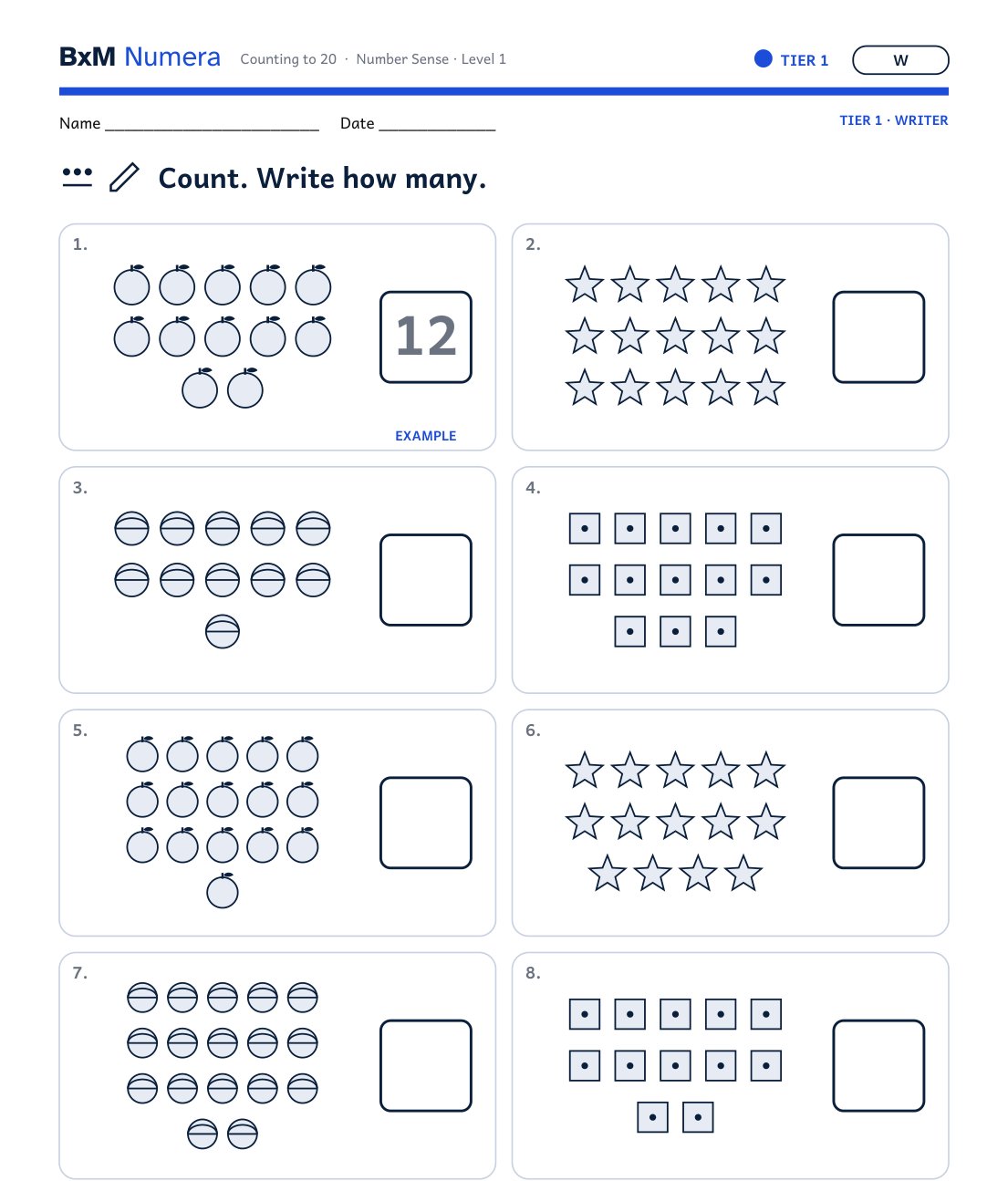
BxM Numera
Math
Number sense, place value, adding and subtracting, money and more. Level 1 starts with Counting to 20.
Get BxM Numera updates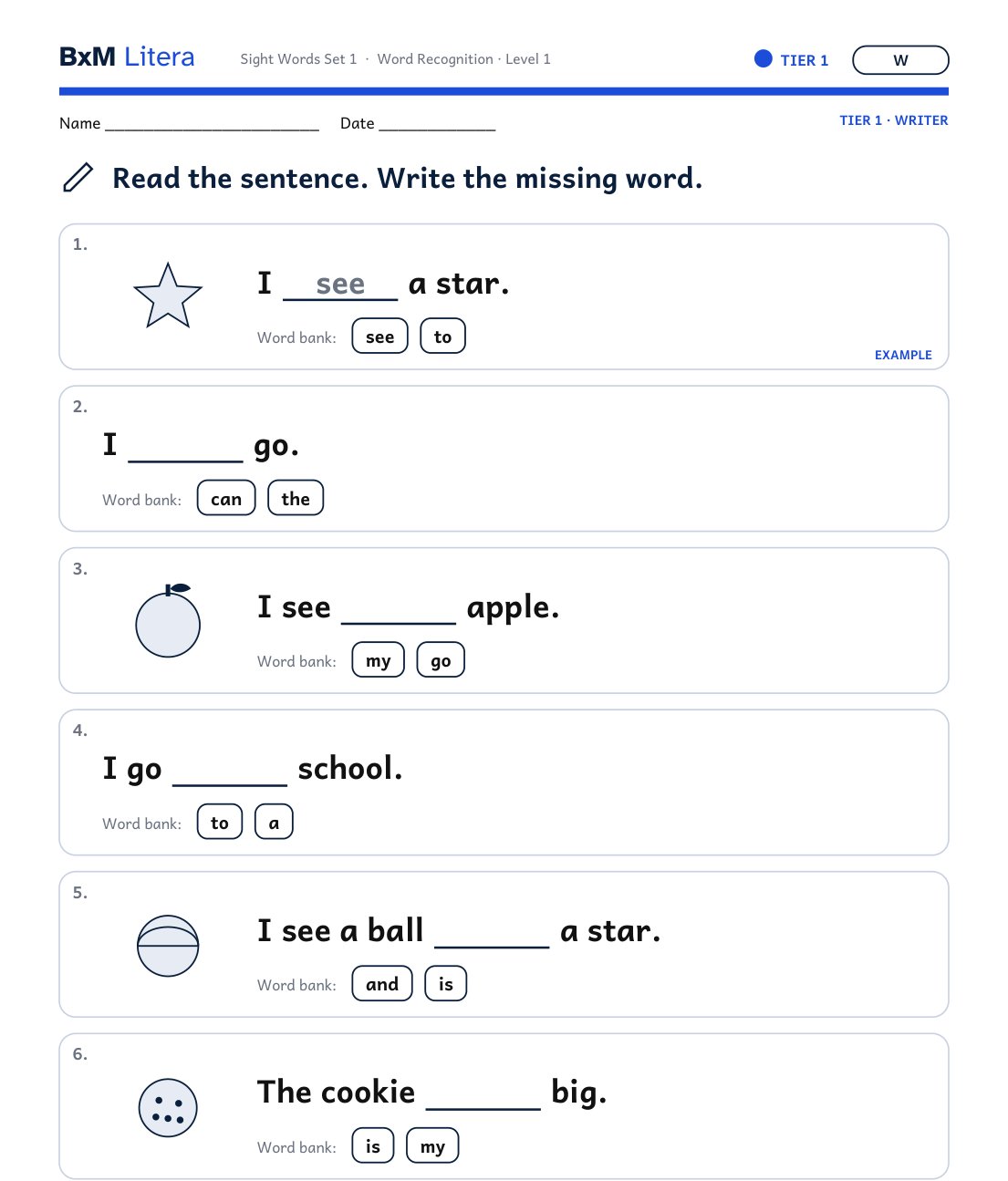
BxM Litera
Language
Sight words, word reading and writing sentences, and more. Level 1 starts with Sight Words Set 1.
Get BxM Litera updatesShop by learner profile
Start with the student in front of you
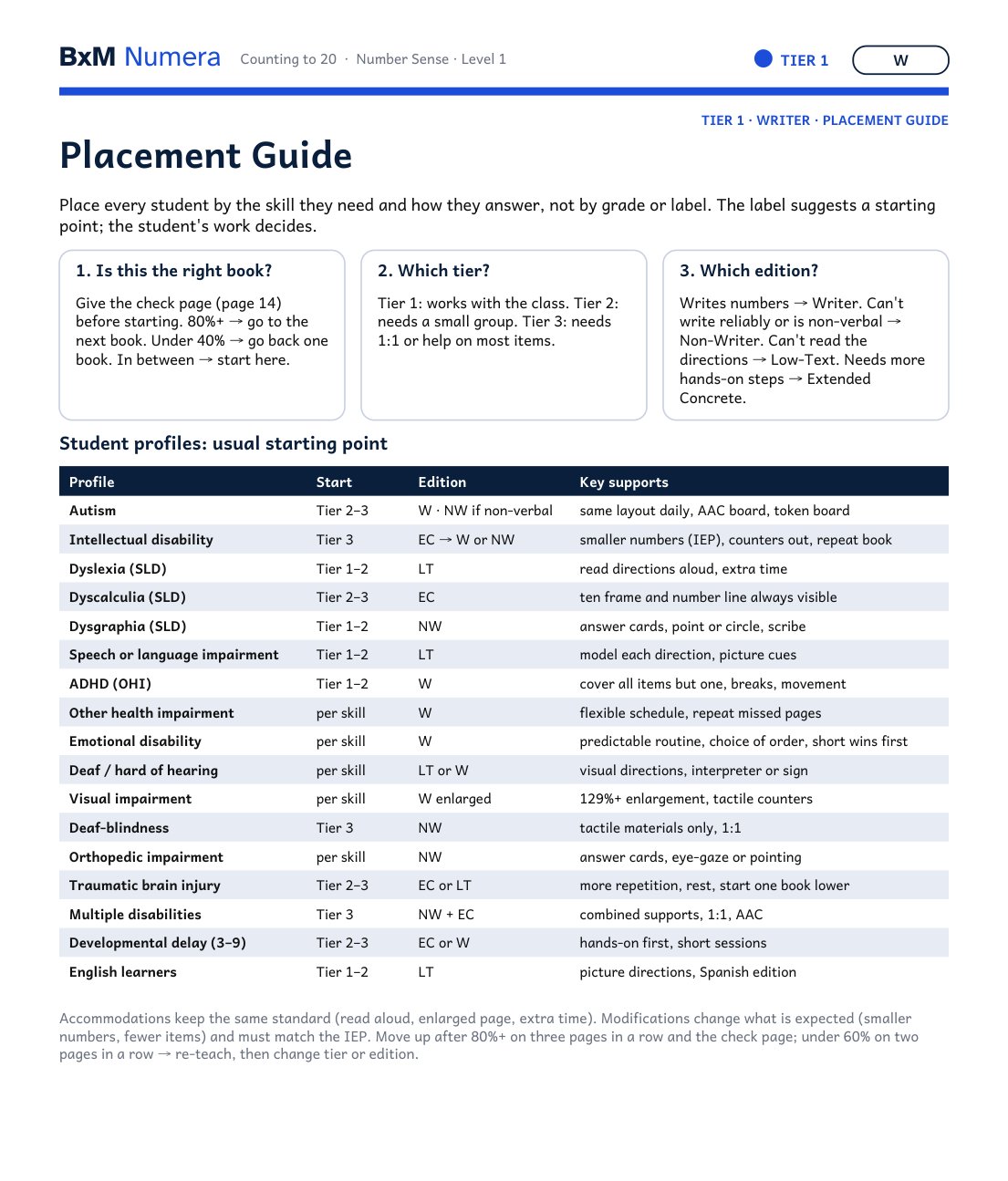
Each profile shows the usual starting tier and edition for math and for reading. It is a starting point, not a label: the placement guide in every book confirms the right book, tier and edition from the student’s own work.
Autism
Math: Tier 2–3 · Writer, or Non-Writer if non-verbal
Reading: Tier 2–3 · Writer, or Non-Writer if non-verbal
Same layout every day, AAC board, visual schedule
Get notified when ready →Intellectual disability
Math: Tier 3 · Extended Concrete, then Writer or Non-Writer
Reading: Tier 3 · Extended Concrete, then Writer or Non-Writer
Smaller steps, materials always out, repeat a book before moving on
Get notified when ready →Dyslexia
Math: Tier 1–2 · Low-Text
Reading: Tier 2–3 · Low-Text or Extended Concrete
Directions read aloud, say-trace-write, letter tiles
Get notified when ready →Dyscalculia
Math: Tier 2–3 · Extended Concrete
Reading: Tier 1 · Writer
Ten frames and number line always visible; reading stays the same
Get notified when ready →Dysgraphia
Math: Tier 1–2 · Non-Writer
Reading: Tier 1–2 · Non-Writer
Answer cards, point or circle, scribe if needed
Get notified when ready →Speech or language impairment
Math: Tier 1–2 · Low-Text
Reading: Tier 1–2 · Low-Text
Model each direction, picture cues, more showing than talking
Get notified when ready →ADHD
Math: Tier 1–2 · Writer
Reading: Tier 1–2 · Writer
Cover all items but one, short breaks, movement
Get notified when ready →Other health impairment
Math: By skill · Writer
Reading: By skill · Writer
Flexible schedule, repeat missed sessions, rest breaks
Get notified when ready →Emotional disability
Math: By skill · Writer
Reading: By skill · Writer
Predictable routine, choice of order, short wins first
Get notified when ready →Deaf or hard of hearing
Math: By skill · Low-Text or Writer
Reading: By skill · Low-Text or Writer
Visual directions, model on the board, the student’s sign language
Get notified when ready →Visual impairment
Math: By skill · Writer, enlarged
Reading: By skill · Writer, enlarged
Enlarge to 129% or more, high contrast, tactile materials
Get notified when ready →Deaf-blindness
Math: Tier 3 · Non-Writer
Reading: Tier 3 · Non-Writer
Tactile materials, braille or raised cards, 1:1
Get notified when ready →Orthopedic impairment
Math: By skill · Non-Writer
Reading: By skill · Non-Writer
Answer cards, eye-gaze or pointing, adapted grip
Get notified when ready →Traumatic brain injury
Math: Tier 2–3 · Extended Concrete or Low-Text
Reading: Tier 2–3 · Extended Concrete or Low-Text
Memory supports, more repetition, start one book lower
Get notified when ready →Multiple disabilities
Math: Tier 3 · Non-Writer + Extended Concrete
Reading: Tier 3 · Non-Writer + Extended Concrete
Combined supports, 1:1, AAC, smallest steps
Get notified when ready →Developmental delay
Math: Tier 2–3 · Extended Concrete or Writer
Reading: Tier 2–3 · Extended Concrete or Writer
Hands-on first, short sessions
Get notified when ready →English learners
Math: Tier 1–2 · Low-Text
Reading: Tier 1–2 · Low-Text
Picture directions; Spanish edition planned (not a disability — same need)
Get notified when ready →One skill, four editions
Every student can answer
Editions are grouped by how the student responds, not by diagnosis. The Writer edition comes first; the other editions are in development.
W
Writer
Standard write-in pages for students who write their answers.
NW
Non-Writer
Point, place or circle. Includes an AAC response board for non-verbal students.
LT
Low-Text
Icon directions, a read-aloud script and dyslexia-friendly pages.
EC
Extended Concrete
Extra hands-on steps before the paper work.
Built for MTSS
Tier 1, Tier 2 and Tier 3
Each tier has its own shape as well as its name, so it still reads when you print in black and white.
●
Tier 1
Whole class
Light support and more items per page.
▲
Tier 2
Small group
Guided examples and visual supports.
■
Tier 3
Intensive or IEP
Fewer items per page, the most support, trial-by-trial data.
Look inside
What’s inside every topic
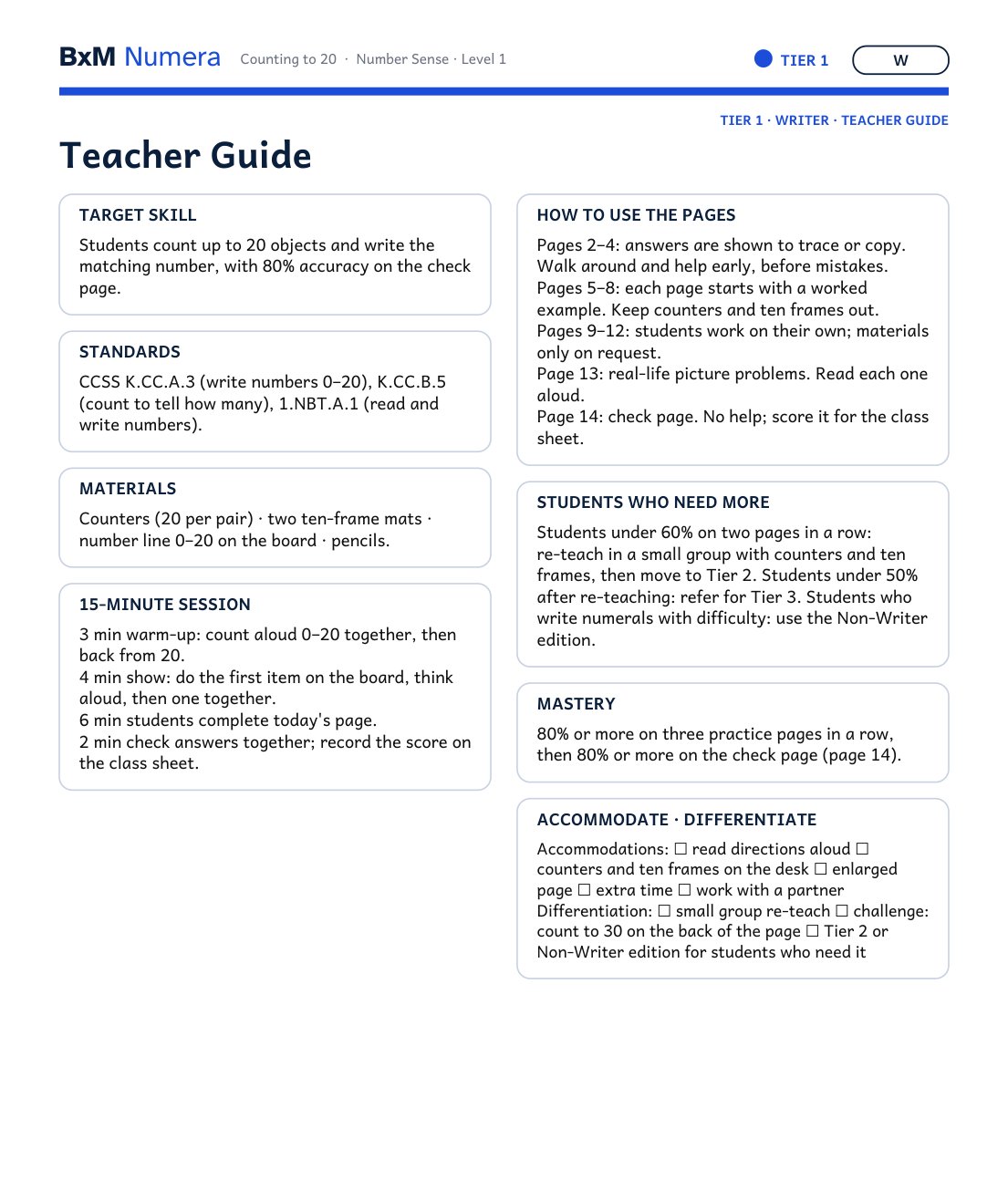
- ✓Teacher guide on page 1: skill, standards, materials and the 15-minute session plan
- ✓Placement guide: the right book, tier and edition for each student
- ✓12 practice pages, with worked examples where new work starts
- ✓Real-life page that uses the skill in everyday situations
- ✓Check page to show what the student can do alone
- ✓Class progress sheet and answer key
Mastery rule: 80% or more on three practice pages in a row, then 80% or more on the check page.
Two ways to buy
One skill, or the whole year
Topic Pack
One skill, about 3 weeks
- ✓13 sessions of 15 minutes
- ✓Teacher and placement guide
- ✓Progress sheet and answer key
- ✓Instant PDF download
Price at launch
Join early accessBEST VALUE
Full Book
One subject, one grade, the whole year
- ✓All 14 topics (about 180 days)
- ✓About 250 pages
- ✓Everything in every Topic Pack
- ✓Costs less than buying every pack
Price at launch
Join early accessSchool or district
Licenses for teams and buildings
- ✓Use across classrooms
- ✓Teachers, SECAs and interventionists
- ✓Invoice / purchase order
Contact us
Contact usWhat’s ready
Level 1 first, then up to grade 10
Now in field test
BxM Numera Level 1: Counting to 20. BxM Litera Level 1: Sight Words Set 1. Tier 1, Writer edition.
Coming next
The rest of Level 1 for math and language, Tier 2 and Tier 3, and the Non-Writer, Low-Text and Extended Concrete editions.
Later
Levels 2 to 10, and Spanish, French and Italian editions.
Early access
Be first when the books open
Join the list and we will email you when the first books, new topics and editions are ready, and send you a free sample.
FAQ
Questions teachers ask
Which grades is it for?
Grades 1–10, organized by skill level. Level 1 is available first; higher levels follow.
Do I need to know the student’s disability?
No. You place the student by the skill they need and how they answer. The learner profiles are only a suggested starting point.
What about students who can’t write?
Use the Non-Writer edition: students point, place or circle their answers. It is in development; the Writer edition comes first.
What about non-verbal students?
The Non-Writer edition includes an AAC response board so students can answer by pointing.
Will it look babyish for older students?
Higher levels are being designed with an age-respectful picture style, so a teenager working on an early skill does not get little-kid pages.
How long does one topic take?
13 sessions of 15 minutes — about 3 weeks. A full book covers about 180 school days.
How does it help with IEP data?
Every topic has a class progress sheet, a check page and a clear mastery rule, so you have scores ready for progress reports.
Can my whole school use it?
Yes, with a school or district license. Contact us and we will set it up.
How do I get the books?
Instant PDF download after checkout. US Letter, ready to print.
Every student. Every way of responding.
15 minutes a day, with IEP data done.
Join early accessShop by learner profile