
Growth, maturation and development sound like the same thing, but the APENS exam treats them as three different ideas, and only one of them is something a PE teacher can change.
What It Means (in Plain Language)
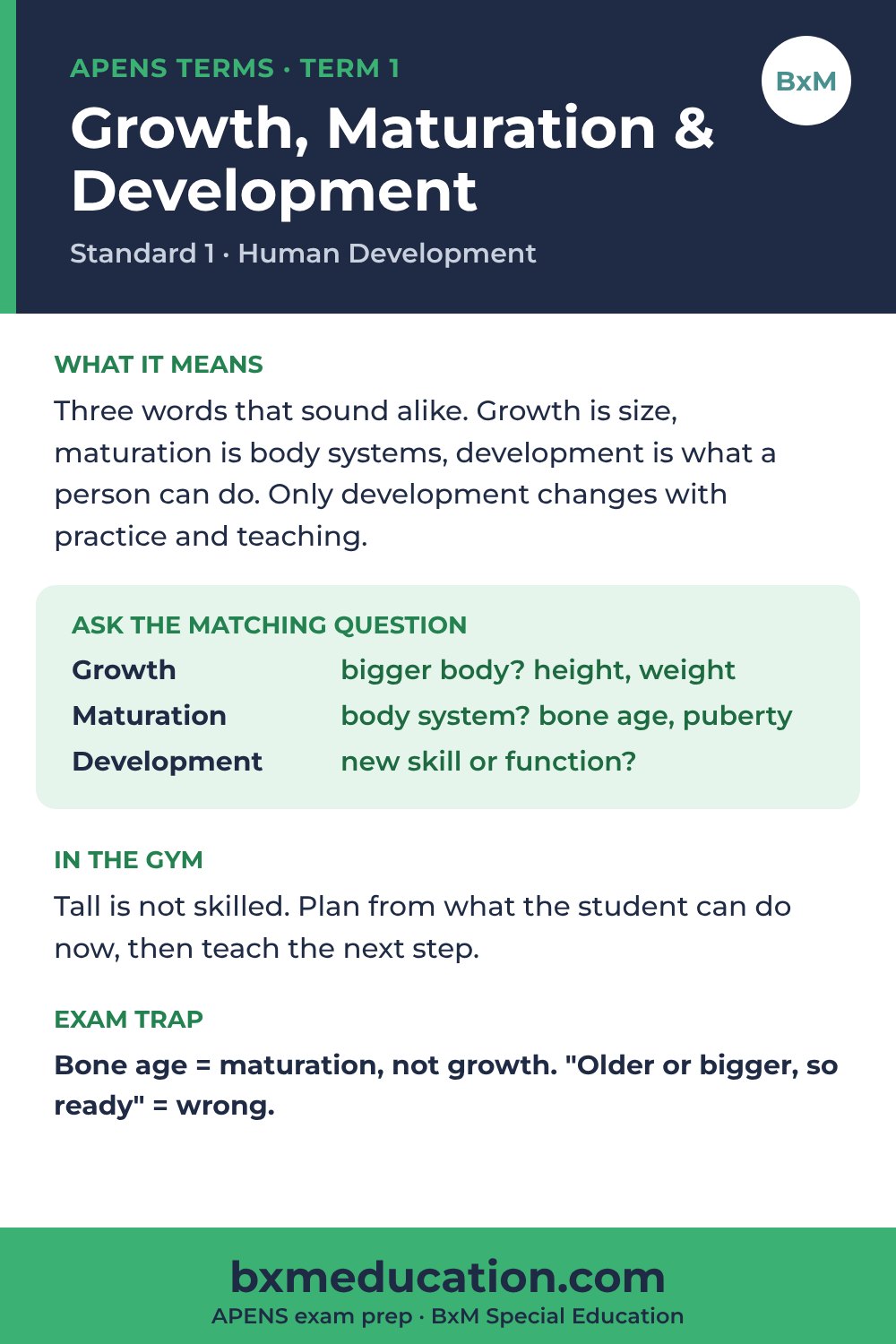
Growth is a change in body size: height, weight or limb length. Maturation is a change in body systems as they move toward their adult form, such as bones that harden, changes in hormones and a nervous system that works more efficiently. Development is the widest term: a change in what a person can do across the life span, including motor, cognitive, social and emotional change.
Two ideas do most of the work on the exam:
– Match the word to what is being measured. Height is growth. Bone age or puberty is maturation. Skill and function are development.
– Biology drives growth and maturation; biology and experience together drive development. A PE teacher cannot change a student’s height, but practice, good instruction and a rich movement environment change what the student can do.
Three Words, Three Questions
When an item uses one of these words, ask the question that goes with it:
1. Growth: did the body get bigger? (height, weight, limb length)
2. Maturation: did a body system move toward its adult form? (bone age, puberty, a more efficient nervous system)
3. Development: can the person now do something new? (a skill, a function, a social behavior)
In the Gym: Done Right
Sam is 10 and tall for his age. His adapted PE teacher notes his height as a growth fact, but she plans from what he can do: he skips with an uneven, step-hop pattern. She breaks the skip into small steps, models it, and gives him short practice blocks with specific feedback, counting how many smooth skips he links in a row each week.
Why it works: she keeps size and skill separate. Being tall does not mean Sam already has a mature skip, and teaching and practice are what move the skill forward.
Misapplication: Spot the Mistake
A teacher looks at a seventh grader who grew a lot this year and says, “He’s big now, so he should be ready for the full-speed game.” The student trips during fast direction changes and starts avoiding the activity.
Spot the mistake: body size (growth) was treated as skill (development). During a growth spurt, a student can look less coordinated for a time while the body adjusts. The fix: check what the student can actually do, adjust the task, give extra practice on the running pattern, and group by size and skill for fast or contact games.
How It Shows Up on the APENS Exam
- Answer choices often mix growth, maturation and development. Pick the one that matches exactly what the question measures: a question about bone age is about maturation, not growth.
- Watch for choices that say a student will gain a skill just by getting older or bigger. Development depends on experience and instruction too.
- Choices that give an exact age for every child are usually wrong. Development is age-related, not age-dependent; look for words like usually, about or on average.
Quick Check (2 Questions)
Question 1. An adapted PE teacher records that a student is 4 centimeters taller than at the start of the year. Which term describes this change?
A) Development
B) Maturation
C) Growth
D) Motor learning
Show answer
C. Growth is a change in body size, such as height. Development is a change in what the student can do, maturation is a change in body systems such as bone hardening, and motor learning is a change in skill from practice.
Question 2. A doctor’s report says a student’s bone age is ahead of his chronological age. Which idea does this describe?
A) Growth
B) Maturation
C) Development
D) A developmental delay
Show answer
B. Bone age shows how far a body system has moved toward its adult form, which is maturation. Growth would be a change in size, development a change in skill, and a delay describes skills reached later than peers.
Keep Studying
- Full APENS exam prep, all 15 standards: APENS Exam Prep
- Study Guide, Flashcards and Graphic Organizers: APENS Study Materials
- How this looks with a classroom assistant in the gym: How to Guide Your SECA in PE: Size Is Not Skill
Prepare for the APENS exam, one standard at a time
Plain-language lessons, original practice questions and study tools for all 15 APENS standards.
Explore APENS Exam PrepSource: BxM APENS Exam Prep, Standard 1 (Human Development) lesson and study guide. Independent BxM study material. Not affiliated with or endorsed by NCPEID or Human Kinetics. Does not make anyone eligible for CAPE.