
The person standing closest to your student in PE is often the classroom assistant, so teach your SECA to look at what the student can do, not at how big or how old the student is.
Why It Matters for Your SECA
On the APENS exam, growth is a change in body size, maturation is a change in body systems, and development is a change in what a person can do. Only development changes with practice and good teaching. In the gym, assistants often judge by size or age: “He’s big, he should be able to do it” or “She’s in fifth grade, she’s too old for that.” Those comments sound reasonable, but they skip the only question that guides teaching: what can the student do right now?
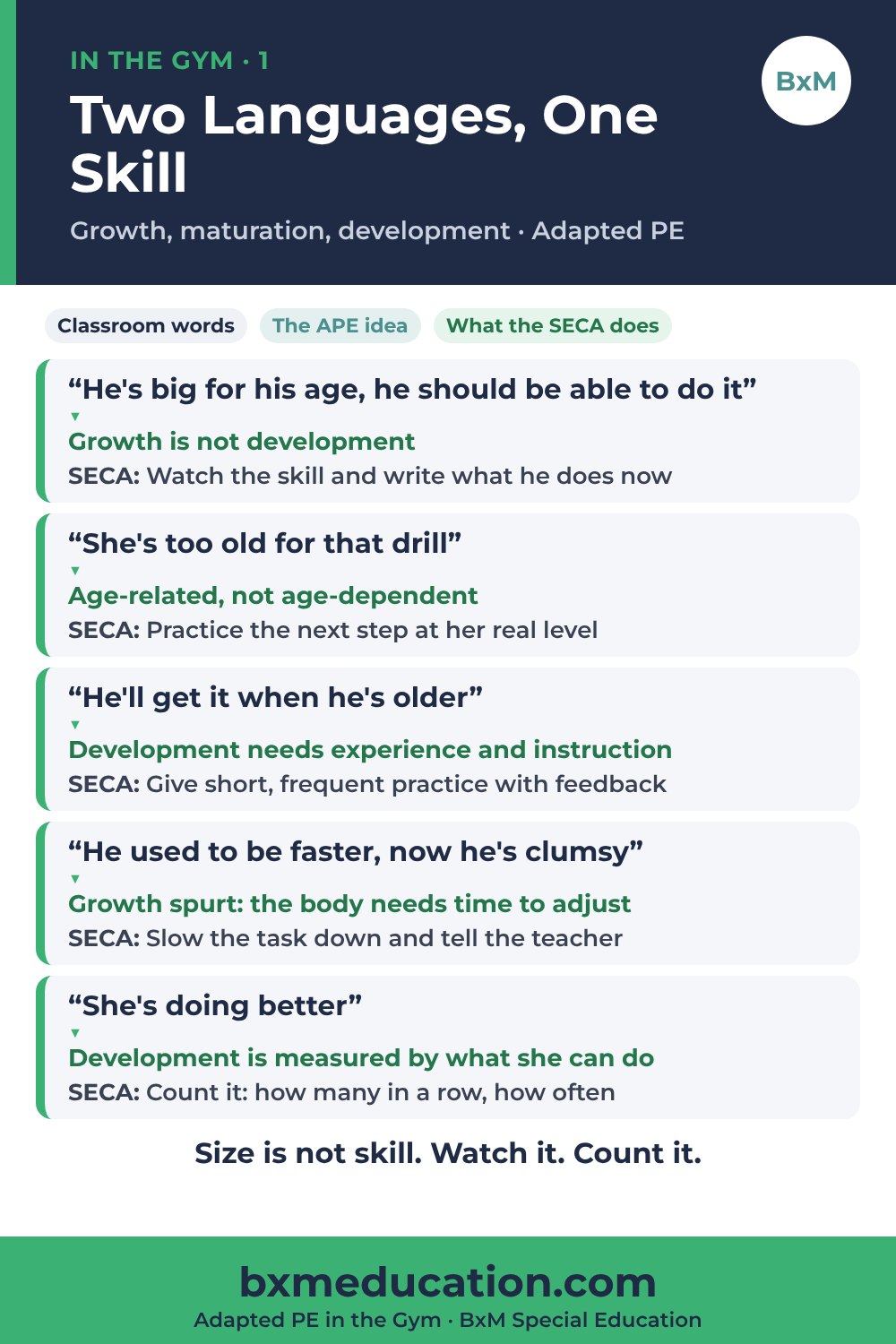
Two Languages, One Skill
| What the SECA might say | The APE idea | What the SECA does instead |
|---|---|---|
| “He’s big for his age, he should be able to do it.” | Growth is not development | Watch the skill and write what he does now |
| “She’s too old for that drill.” | Age-related, not age-dependent | Practice the next step at her real level |
| “He’ll get it when he’s older.” | Development needs experience and instruction | Give short, frequent practice with feedback |
| “He used to be faster, now he’s clumsy.” | Growth spurt: the body needs time to adjust | Slow the task down and tell the teacher |
| “She’s doing better.” | Development is measured by what she can do | Count it: how many in a row, how often |
A Gym Scenario
Before. During a throwing unit, the SECA working with Mia, a fourth grader, keeps saying, “She’s not trying, she’s old enough to throw.” Mia throws with her arm only and steps with the same-side foot, and she is starting to sit out.
The teacher coaches the SECA using behavioral skills training:
1. Instruction: “Look at her feet and her arm, not her age. Tell me which step she does now.”
2. Model: the teacher watches five throws out loud: “Same-side step, arm only. That’s our starting point.”
3. Rehearsal: the SECA watches the next five throws and marks each step on a simple checklist while the teacher observes.
4. Feedback: “Great, you caught the opposite-foot step on throw four. That’s the step we teach next.”
After. Two weeks later, the SECA’s checklist shows Mia stepping with the opposite foot on 6 of 10 throws. Nobody said “she’s not trying.” The team planned from her real level and saw progress.
What to Teach Your SECA
- Size and age are not skill. Watch what the student does.
- Write the skill step the student shows now, not what is missing.
- Give short practice with specific praise right after the target movement.
- If a student who grew fast suddenly looks clumsy, slow the task and tell the teacher.
- Use the same checklist each time so progress is easy to see.
The Takeaway
Growth and maturation happen on their own schedule. Development is the part you and your SECA can change, one practiced step at a time. For the exam version of this idea, read Growth, Maturation and Development | APENS Standard 1.
Teach your team the language of adapted PE
Study guides, flashcards and graphic organizers you can share with your SECA and use on exam day.
Source: BxM APENS Exam Prep, Standard 1 (Human Development). Classroom scenarios are fictional. Independent BxM study material. Not affiliated with or endorsed by NCPEID or Human Kinetics. Does not make anyone eligible for CAPE.