
“She lacks focus.” “He has a bad attitude.” Coaches say it every day, and none of it can be coached. Applied behavior analysis starts somewhere else: performance is behavior.
What It Means (in Plain Language)
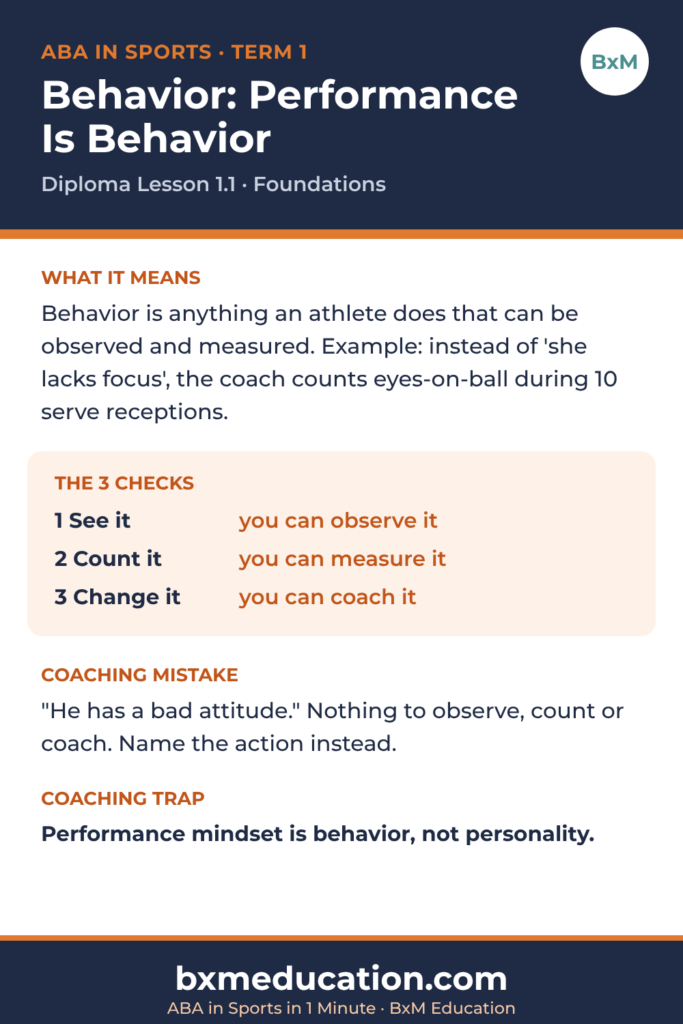
In ABA, behavior is anything a person does that can be observed and measured. For an athlete, that means the actions you can see on the court or field: the first step after the whistle, the eyes tracking the ball, the shot taken, the sprint back on defense. Labels like “focus,” “confidence,” and “attitude” are not behaviors. They are summaries of behavior, and you can’t coach a summary.
Two ideas do the work:
- Observable: you can see or hear it happen.
- Measurable: you can count it, time it, or score it.
The BxM Performance Mindset program puts it in one line: performance mindset is behavior, not personality.
The 3 Checks
Before you try to change anything in an athlete, run three checks:
- See it: can you observe the action?
- Count it: can you measure it (count, time, percentage)?
- Change it: now that it’s defined, can you coach and reinforce it?
All three are yes → you have a behavior you can work on. If you can’t see it or count it, rewrite it until you can.
Application: Done Right
Maya, 24, is an outside hitter on an adult club volleyball team. Her coach, Daniel, used to tell her she “loses focus on serve receive.” This season he defined it instead: eyes on the server’s hand before contact, platform set, and the first step taken before the ball crosses the net.
Daniel’s assistant scored 20 serve receptions per practice. In week 1, Maya met all three parts on 9 of 20 receptions (45%). Daniel gave short, specific feedback after each rep (“eyes early, nice”) and praised every rep that met the definition. By week 4 she was at 17 of 20 (85%), and her passing rating in matches rose with it.
Why it works: Daniel could see each part, the assistant could count it, and once it was defined Daniel could change it with feedback and praise. All three checks pass.
Misapplication: Spot the Coaching Mistake
Same team, different coach. Assistant coach Rob tells Jordan, a 27-year-old setter, “You need a better attitude at practice.” He repeats it for three weeks, and nothing changes. Jordan doesn’t know what to do differently, and Rob has no data to show progress either way.
Spot the mistake: “attitude” fails the first two checks. Nobody can see it or count it, so nobody can coach it.
The fix: name the actions behind the label, for example “arrives with knee pads on by 6:00 PM and calls the ball on every set.” Count those, then reinforce them.
How It Shows Up in Practice and on Exams
- Coaching trap: describing personality (“lazy,” “unfocused”) instead of actions. If you can’t count it, you can’t track whether your coaching worked.
- BCBA/RBT exam angle: behavior is what an organism does. A response is one instance (one serve receive), and a response class is a group of responses with the same function. Exams test whether you can tell the general category from the single measurable event.
- Dead-man test: if a person who couldn’t move could still “do” it (for example, “not talking back”), it isn’t behavior. Write what the athlete will do.
Go Deeper
This is Lesson 1.1 of the BxM Professional Diploma in Behavioral Sport Training. In the full lesson you also work through the three-term contingency (antecedent → behavior → consequence) in your own drills and the BxM Behavioral Performance Cycle: observe, measure, analyze, intervene, evaluate, modify.
Keep Studying
- The BCBA glossary series: BCBA Terms Explained in 1 Minute
- The RBT series: Positive Reinforcement Explained
- Watch every sports term: ABA in Sports in 1 Minute playlist
Quick Check (2 Questions)
Question 1. A track coach writes a goal for a 22-year-old sprinter: “Improve her mental toughness.” Which rewrite turns it into a behavior?
A) Increase her confidence before races
B) Finish all 6 × 200 m repeats at or under 29 seconds
C) Stop being nervous at meets
D) Develop a winning mindset
Show answer
B. It is observable (she runs the repeats) and measurable (seconds, number completed). A and D are labels, not actions. C fails the dead-man test: it describes something not happening and can’t be counted.
Question 2. During one practice a basketball player makes 3 hustle plays: a dive for a loose ball, a sprint back on defense, and a box-out. In ABA terms, each single play is best called:
A) A response
B) A personality trait
C) A response class
D) A motivating operation
Show answer
A. Each play is one specific, measurable instance, a response. C is the group of responses that share a function. B isn’t a behavioral term. D is a variable that changes how valuable a consequence is, not an action.
Reference
BxM Education & Consulting. (2026). Professional Diploma in Behavioral Sport Training, Lesson 1.1: Behavior analysis as the foundation of sports performance. BxM Education.
BxM Education. (2024). BxM Education BCBA 6th Edition Study Guide (Domain B, B.1). BxM Education.
Cooper, J. O., Heron, T. E., & Heward, W. L. (2020). Applied behavior analysis (3rd ed.). Pearson.