
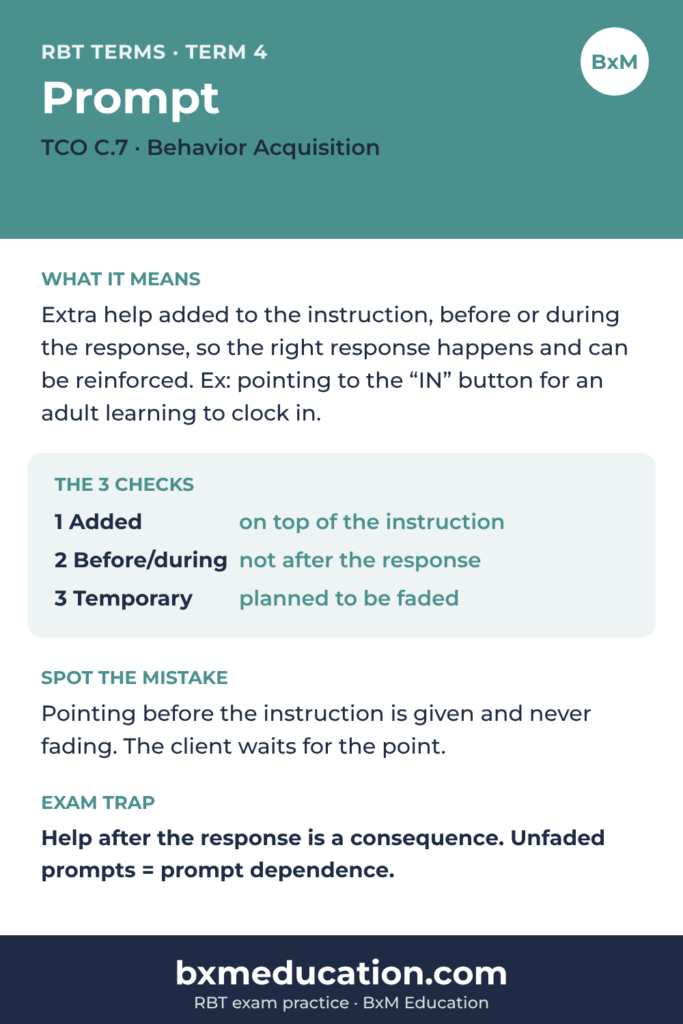
A prompt is extra help, given with the instruction, so the right response happens and can be reinforced. It’s a temporary bridge, not the goal.
What It Means (in Plain Language)
A prompt is an extra cue an RBT adds before or during a response so the client is more likely to respond correctly when the instruction (the SD) is given. The goal is to get a correct response that can be reinforced, then remove the help over time so the instruction alone does the job.
Two kinds show up most:
- Response prompts = help from the RBT’s own behavior: a verbal hint, a gesture (pointing), a model (showing it), or physical guidance.
- Stimulus prompts = changes to the materials: making the correct card bigger, brighter, or closer, or adding a picture cue.
A prompt always works alongside the SD. It never replaces it.
The 3 Checks
Before you call something a prompt, run three quick checks:
- Added: is it extra help on top of the instruction (the SD)?
- Before or during: does it come before or during the response, not after it?
- Temporary: is the plan to fade it out so the instruction alone works?
All three are yes → it’s a prompt. Help that comes after the response is feedback or a consequence, not a prompt.
Application: Done Right
Rosa is a 34-year-old adult at a vocational program learning to clock in on a touchscreen. Her BCBA’s plan calls for a gestural prompt: after the job coach says, “Clock in, please,” the RBT, Kevin, points to the green “IN” button if Rosa hasn’t started within 3 seconds. Kevin records each trial as independent or prompted, and praises every correct clock-in.
In week 1, Rosa needs the point on 8 of 10 days. By week 3, Kevin’s data show she clocks in independently on 7 of 10 days, and the plan’s next step is to fade the gesture (reported to the BCBA).
Why it works: the point is added to the instruction, it comes during the response window, and the data track progress toward a temporary prompt being faded.
Misapplication: Spot the Mistake
Same program, different RBT. Each morning, Tasha points to the “IN” button before the job coach even gives the instruction, and she never records whether Rosa was prompted. After a month, Rosa stands at the screen and waits for Tasha’s point every day.
Spot the mistake: the prompt was given in place of the instruction and never tracked or faded, so Rosa’s clocking in came under control of the point, not “Clock in, please.” That’s prompt dependence.
The fix: follow the plan: give the instruction first, wait the planned time, prompt only as written, record prompted vs. independent, and report to the supervising BCBA.
How It Shows Up on the RBT Exam
- A prompt is help given with the SD. Anything delivered after the response (praise, a token, “Nice!”) is a consequence.
- Know the response-prompt types: verbal, gestural, model, physical. Physical guidance is usually the most intrusive.
- Prompt dependence is the classic trap: if the client waits for help, the prompt was not faded as planned. Fading is RBT Term 5.
Keep Studying
- Review RBT Term 3: Discriminative Stimulus (SD) Explained
- Review RBT Term 1: Positive Reinforcement Explained
- Start or finish your hours: RBT 40-Hour Training
- Test yourself under exam conditions: RBT Practice Exam Pack
Quick Check (2 Questions)
Question 1. During a laundry task, an adult client stops before adding detergent. Following the plan, the RBT taps the detergent bottle, and the client pours it in. What type of prompt did the RBT use?
A) Verbal prompt
B) Model prompt
C) Gestural prompt
D) Physical prompt
Show answer
C. Tapping or pointing to the item is a gesture that cues the response without words or hands-on help. A is wrong: nothing was said. B is wrong: the RBT didn’t show the whole action for the client to copy. D is wrong: the RBT didn’t guide the client’s hands.
Question 2. An adult client now waits for the RBT to point before starting any task, even familiar ones. What is the most likely explanation?
A) The client has extinction-induced aggression
B) Prompt dependence: the prompts were not faded as planned
C) The instruction is a strong SD
D) The client is on a continuous reinforcement schedule
Show answer
B. When prompts stay at the same level and aren’t faded, responding comes under control of the prompt instead of the instruction. A is wrong: no extinction or aggression is described. C is wrong: if the instruction were a strong SD, the client would start without the point. D is wrong: the reinforcement schedule doesn’t explain waiting for the point.
Reference
Miltenberger, R. G. (2016). Behavior modification: Principles and procedures (6th ed.). Cengage Learning.
Behavior Analyst Certification Board. (2024). RBT Test Content Outline (3rd ed.). https://www.bacb.com