
A brutal practice feels like progress. In ABA, it only counts as learning if the athlete’s behavior changes, and the change sticks.
What It Means (in Plain Language)
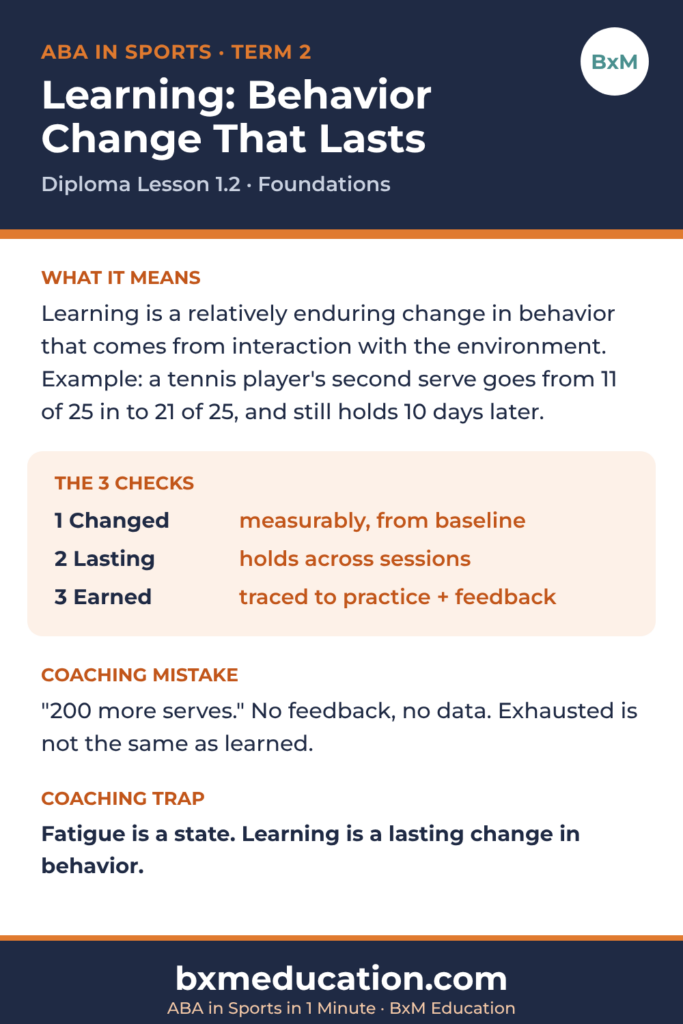
Behavior analysis defines learning as a relatively enduring change in behavior that results from interaction with the environment. “Getting better” is not enough. You need to see a measurable change in what the athlete does, and that change has to hold up across sessions. The environment does the teaching: the practice conditions, the feedback, and the consequences that follow each rep.
Two ideas do the work:
- Behavior change: the athlete’s performance moves from a measured starting point (baseline) to a new level.
- Consequences drive it: a consequence that increases the future probability of a behavior is reinforcement. It is defined by its effect on the next reps, not by what the coach meant to do.
The BxM diploma pairs this with the body’s side of the story: athletic performance = biological adaptation + behavioral adaptation. Conditioning changes the body. Learning changes the behavior.
The 3 Checks
Before you call a drill a success, run three checks:
- Changed: did the behavior move measurably from baseline?
- Lasting: does the new level hold across sessions, not just one good day?
- Earned: can you trace the change to practice conditions and feedback, rather than luck, fatigue or a weak opponent?
Three yeses → learning has occurred. If you can’t answer the first one, you didn’t measure.
Application: Done Right
Lena, 31, plays first singles for an adult club tennis team. Her second serve was a liability, and her coach, Marcus, wanted a number, not an impression. He defined the target as a second serve that lands in the service box with a full trophy position before the swing.
Baseline: Lena landed 11 of 25 second serves (44%). Marcus then ran short blocks of 25 with immediate, specific feedback after each serve (“trophy held, good”) and a target zone marked with cones. When she landed 4 of 5 in a row, she picked the next point-play drill, something she reliably works for. Week 1: 14 of 25. Week 3: 21 of 25 (84%). Then the real test: after 10 days away from the court for travel, she landed 20 of 25.
Why it works: the serve changed from 44% to 84%, the change lasted through a 10-day break, and it was earned through feedback and a consequence that increased correct serves. That is learning, by definition.
Misapplication: Spot the Coaching Mistake
Same club, different approach. Assistant coach Paul decides Lena’s doubles partner, Erin, 29, just needs “more reps”: 200 second serves a day, no target, no feedback, no counting. By the end of each session Erin is exhausted, and Paul calls that progress. Two weeks later her match percentage hasn’t moved, and her late-session serves show the same toss error she started with, now repeated hundreds of times.
Spot the mistake: fatigue was treated as proof of learning. Repetition without effective consequences can strengthen the error instead of the skill.
The fix: measure a baseline, cut the volume, give immediate feedback on one observable part of the serve, and check whether the change holds next week.
How It Shows Up in Practice and on Exams
- Coaching trap: “more reps,” “more motivation” and “they’re tired, so they worked” are not learning. Learning is a measured change in behavior that lasts.
- BCBA/RBT exam angle: reinforcement is defined functionally: a consequence follows a behavior and the future frequency of that behavior increases (Study Guide B.4). If the behavior doesn’t increase, it wasn’t reinforcement, whatever the coach intended.
- “Negative” trap: positive and negative refer to adding or removing a stimulus, not good or bad. Both kinds of reinforcement increase behavior.
Go Deeper
This is Lesson 1.2 of the BxM Professional Diploma in Behavioral Sport Training. In the full lesson you work through the BxM Dual Adaptation Model and the five questions every practice session should answer before it starts.
Keep Studying
- Term 1 of this series: Behavior in Sports Explained
- The RBT series: Positive Reinforcement Explained
- Watch every sports term: ABA in Sports in 1 Minute playlist
Quick Check (2 Questions)
Question 1. Which observation is the best evidence that a 25-year-old swimmer has learned a new flip turn?
A) She says she feels much more confident about her turns
B) She completes the new turn correctly on 18 of 20 turns across four practices, including one a week after coaching on it stopped
C) She is exhausted after 300 turns in one session
D) She nails 9 of 10 turns once, during warm-up before a meet
Show answer
B. It shows a measurable change in behavior that lasts across sessions and after coaching ended. A is a report of a feeling, not the behavior. C is fatigue, a temporary state. D is a single good performance with no evidence that it holds.
Question 2. A boxing coach says “great job!” after every correct slip-and-counter, meaning it as a reward. Over three weeks the boxer’s correct slip-and-counters stay at about 5 per round. In ABA terms, the praise is:
A) Positive reinforcement, because the coach intended it as a reward
B) Not functioning as reinforcement, because the behavior did not increase
C) Positive reinforcement, because a stimulus was added
D) Negative reinforcement, because nothing was taken away
Show answer
B. Reinforcement is defined by its effect: the future frequency of the behavior must increase. A confuses intent with effect. C names only half of the definition; adding a stimulus is positive reinforcement only if the behavior goes up. D gets the term backwards: negative reinforcement means a stimulus is removed and behavior increases, and here nothing increased.
Reference
BxM Education & Consulting. (2026). Professional Diploma in Behavioral Sport Training, Lesson 1.2: Learning, adaptation, and behavior change. BxM Education.
BxM Education. (2024). BxM Education BCBA 6th Edition Study Guide (Domain B, B.4). BxM Education.
Cooper, J. O., Heron, T. E., & Heward, W. L. (2020). Applied behavior analysis (3rd ed.). Pearson.