
A favorite snack works beautifully at 10 a.m. and barely works at 12:30, right after lunch. The snack didn’t change. The client’s recent history with food did. On the BCBA exam, the lunch is an abolishing operation (AO), and knowing exactly what it does, and what it doesn’t do, is a reliable Domain B point.
Cooper, Heron, and Heward (2020) define an abolishing operation as a motivating operation that decreases the reinforcing effectiveness of a stimulus, object, or event. Their example is food: eating reduces how effective food is as a reinforcer. Satiation is the classic AO, but anything that temporarily reduces a reinforcer’s value fits, such as a long period of free attention reducing the value of attention.
An AO has two effects that always travel together. Its value-altering effect is the drop in the reinforcer’s effectiveness (the reinforcer-abolishing effect). Its behavior-altering effect is the drop in the current frequency of behavior that has produced that reinforcer, which is the abative effect. The opposite of an AO is an establishing operation (EO), such as deprivation, which raises a reinforcer’s effectiveness and evokes behavior that has produced it. For conditioned MOs built on the same logic, see our guide to the CMO-R vs. the CMO-T.
The Mechanics: AO vs. EO vs. S-delta
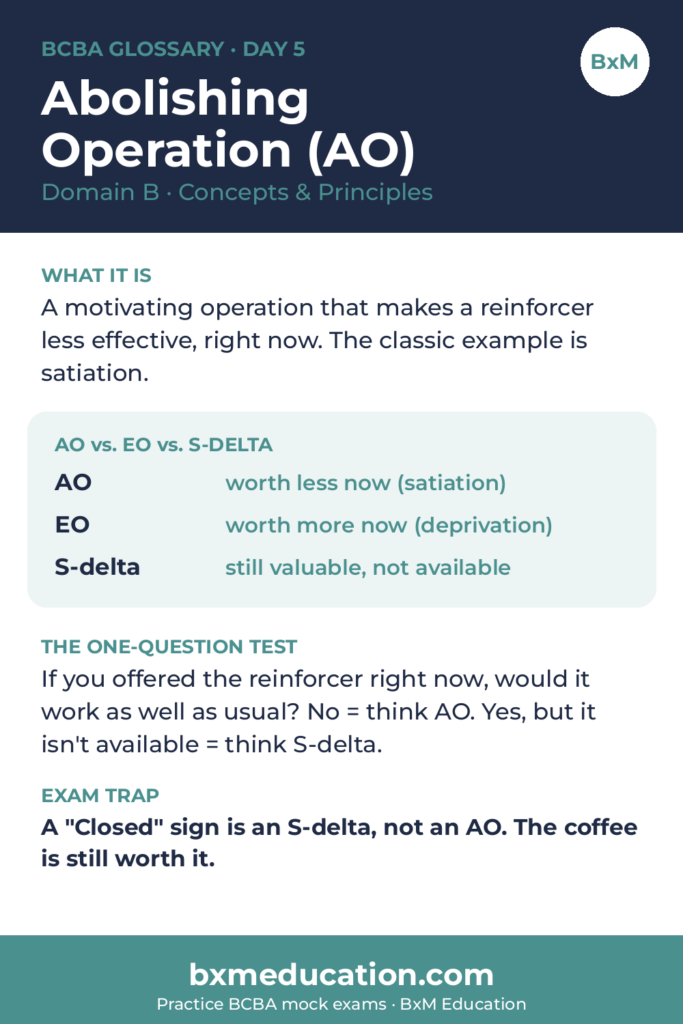
- Abolishing operation (AO): the reinforcer is worth less right now (satiation, recent free access).
- Establishing operation (EO): the reinforcer is worth more right now (deprivation).
- S-delta (SΔ): a stimulus in whose presence the response has not been reinforced. It signals that the reinforcer is not available, but it does not change how much the reinforcer is worth. A “closed” sign on the café door is an SΔ, not an AO.
- Not extinction: extinction is a change in the consequence (reinforcement stops). An AO is a change in an antecedent condition, and its effect fades as deprivation returns.
- Quick test: “If the reinforcer were offered right now, would it work as well as usual?” If no, think AO. If it would work but just isn’t available, think SΔ.
Clinical Applications
- Timing teaching sessions. Run mand training for a preferred item when the client has not had recent access to it, not right after free access to it.
- Rotating reinforcers. Using one edible all session can create an AO during the session. Rotating items and keeping amounts small protects reinforcer effectiveness.
- Antecedent interventions. Noncontingent reinforcement for attention-maintained behavior works partly as an AO: free attention reduces the value of attention, so behavior that has produced attention occurs less.
- Reading preference data. A low-ranked item may only reflect an AO at the time of the assessment. Repeat the assessment at another time before dropping the item.
Research Consulting & APA Citation Reference
Clinical & Methodological Recommendation: Record the client’s recent access to the reinforcer (meals, breaks, screen time, attention) before sessions. When an effective reinforcer suddenly stops working, rule out an abolishing operation before changing the reinforcement schedule or the procedure.
APA Reference Citation (7th Edition):
Cooper, J. O., Heron, T. E., & Heward, W. L. (2020). Applied behavior analysis (3rd ed.). Pearson.
Advanced Applied Reasoning Quiz
Question 1
An adult client usually works hard for 5 minutes of tablet time. On the days his group home gives him an hour of free tablet time before his job-skills session, tablet time no longer works as a reinforcer during the session. What is the hour of free tablet time best described as?
A) An establishing operation
B) An abolishing operation
C) An S-delta
D) Extinction
Question 2
An adult client in a community outing program usually asks staff to stop at a café for coffee. On a day when the café’s door shows a “Closed” sign, he does not ask, although he has had no coffee that day and accepts coffee eagerly later at the center. What does the “Closed” sign most likely function as?
A) An S-delta
B) An abolishing operation
C) An establishing operation
D) A conditioned punisher
Check Your Answers
Replay the video above to review the logic behind each scenario, then test yourself under exam conditions in the BCBA Mock Exam System. Previous term: abative effect. Next term: acceptance and commitment therapy (ACT).