
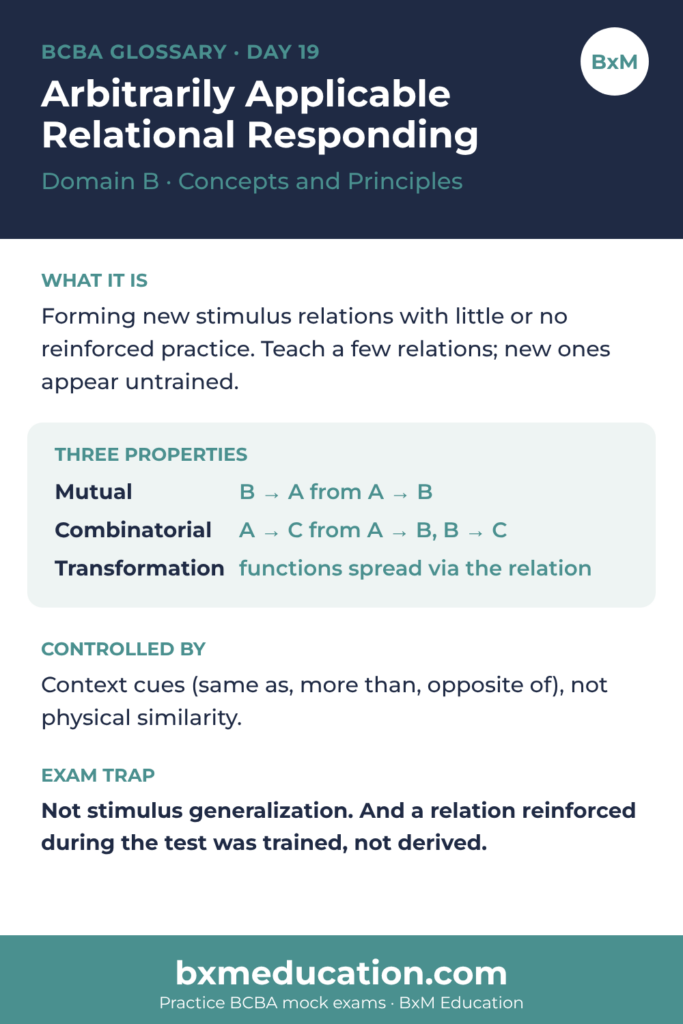
Some of the most useful behavior a learner shows was never directly reinforced. Teach a few relations, and new ones appear on their own. On the BCBA exam this sits in Domain B (Concepts and Principles), and candidates lose points when they call it stimulus generalization or ordinary trained discrimination. The concept that explains it is arbitrarily applicable relational responding (AARR).
Cooper, Heron, and Heward (2020) define AARR as forming new stimulus classes with little or no reinforced practice. In plain terms: after a small number of relations are taught directly, the learner responds correctly to new relations among the same stimuli that were never trained. The relations are “arbitrarily applicable” because they do not depend on what the stimuli look or sound like. The printed word COFFEE, a photo of coffee, and the spoken word “coffee” share no physical features; people relate them because the verbal community taught them to. That is what separates AARR from responding to an antecedent stimulus class built on physical similarity.
AARR matters clinically because it makes teaching efficient: train three relations and you may get six or more for free. It is also the core process in relational frame theory, the account of language behind acceptance and commitment therapy (ACT), and a good example of why applied behavior analysis cares about generative, socially significant change.
The Mechanics: Three Defining Properties
AARR is identified by what the learner does without training:
- Mutual entailment. Teach “A relates to B,” and the learner derives how B relates to A. In stimulus equivalence this is called symmetry.
- Combinatorial entailment. Teach “A relates to B” and “B relates to C,” and the learner derives how A and C relate. In equivalence terms this is transitivity (and equivalence).
- Transformation of stimulus function. A function attached to one stimulus spreads to related stimuli through the relation itself, with no direct pairing.
The relation does not have to be sameness. Learners can derive comparison (more than, less than), opposition, and distinction. Contextual cues such as “same as,” “heavier than,” or “worth more than” tell the learner which relation applies. Stimulus equivalence is one kind of AARR, not all of it.
Clinical Applications
- Equivalence-based instruction. Teach spoken word to picture and picture to printed word, then test for the untaught relations, such as reading the printed word aloud. Useful for adult literacy, money skills, and workplace vocabulary.
- Comparison language. “Which costs more?” and “Which shift starts earlier?” build flexible responding instead of memorized answers.
- Probe before you teach. Test derived relations before adding new training targets; the learner may already show them.
- Spread of avoidance. Transformation of function helps explain why avoidance can spread to stimuli that were never paired with anything aversive, which matters when assessing anxiety-related avoidance in adults.
Research Consulting & APA Citation Reference
Clinical & Methodological Recommendation: Before you claim derived responding, check that the untrained relations were tested without reinforcement and without prompts, after the trained relations met mastery. If correct responses were praised during the test, the relation was being trained, not derived. Report which relations were trained, which were tested, and the contextual cue used for each.
APA Reference Citation (7th Edition):
Cooper, J. O., Heron, T. E., & Heward, W. L. (2020). Applied behavior analysis (3rd ed.). Pearson.
Advanced Applied Reasoning Quiz
Question 1
An adult in a vocational program is taught that Box A is heavier than Box B, and that Box B is heavier than Box C. Without further training, he says Box C is lighter than Box A. Which property of arbitrarily applicable relational responding does this show?
A) Stimulus generalization
B) Mutual entailment
C) Combinatorial entailment
D) Response generalization
Question 2
A clinician teaches an adult client to match spoken words to pictures and pictures to printed words. During the test of printed word to spoken word, she praises every correct answer. What is the main problem with this test?
A) The tested relation was reinforced, so correct answers no longer show derived responding
B) Nothing; praise is required during any test
C) The relations taught were not arbitrary
D) She should have used physically similar stimuli
Check Your Answers
Replay the video above to review the logic behind each scenario, then test yourself under exam conditions in the BCBA Mock Exam System. Previous term: applied behavior analysis. Next term: arbitrary relations.