
“I feel fine, Coach” is not a recovery test. The only way to know an athlete has recovered is to compare today’s behavior with the behavior you measured before the hard work began.
What It Means (in Plain Language)
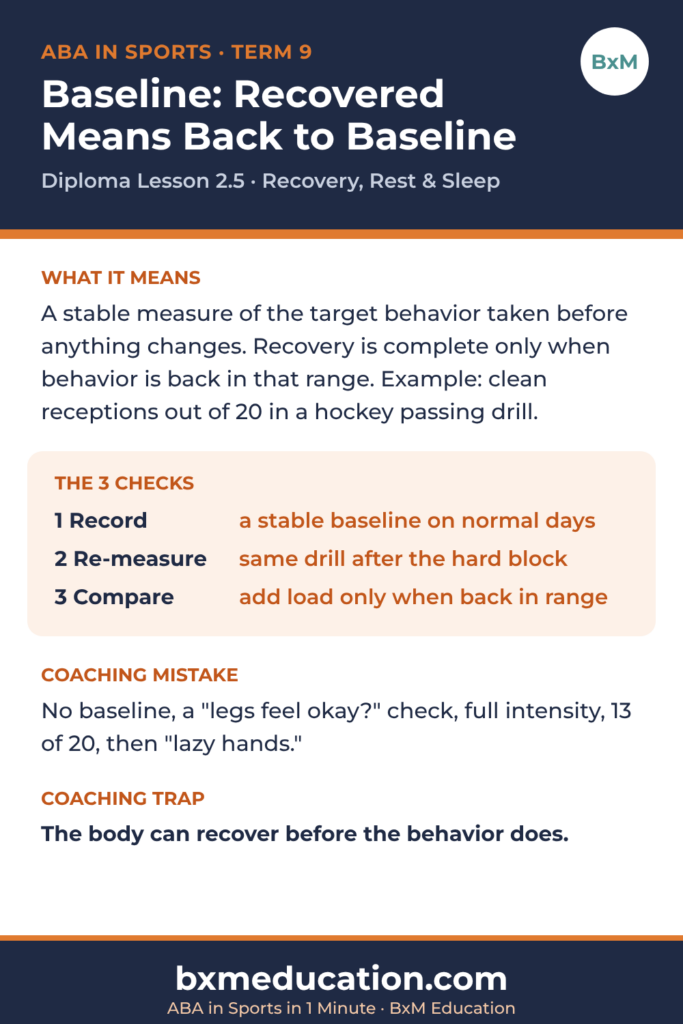
In ABA, a baseline is a measure of the target behavior taken before you change anything, repeated until the data are stable. Every later data point is judged against it. Without a baseline, “better” and “worse” are guesses.
Lesson 2.5 of the BxM diploma applies this to recovery. Training creates the stimulus; recovery restores the systems that support performance. And recovery is complete only when the athlete can perform the target behaviors at their usual standard again:
– Biological restoration: tissue repair, refueled energy, normal heart-rate markers. This creates capacity.
– Behavioral restoration: precision, reaction speed, decisions and communication back to baseline. This is performance.
The body can bounce back before the behavior does. The baseline is how you tell the difference.
The 3 Checks
Before you raise the workload, run three checks:
1. Record: measure the target behavior in a standard drill on normal training days, until it is stable. That’s the baseline.
2. Re-measure: after a hard block, run the same drill the same way.
3. Compare: only call recovery complete when the behavior is back inside the baseline range.
Three yeses → you’re deciding readiness with data, not with the calendar or a thumbs-up.
Application: Done Right
Lina, 24, plays forward on a women’s college ice hockey team. Her coach, Grace, uses a standard 20-pass drill. The target behavior is a clean reception: the puck is controlled on the first touch and Lina’s head is up within 1 second.
Across three normal practice days, Lina scores 17, 18 and 17 out of 20. That’s her baseline: about 17 to 18.
Then the team plays three games in three days. On Monday, Lina’s first drill after the weekend, she gets 12 of 20. Grace keeps Monday as a recovery day. By Tuesday Lina’s resting heart rate is back to her usual number, but the drill shows 14 of 20, still below baseline. Grace keeps Tuesday light. On Wednesday: 17 of 20, back in range. Full-intensity practice resumes Thursday.
Why it works: Grace recorded a stable baseline before the hard block, re-measured with the same drill, and compared before adding load. Her body markers recovered on Tuesday; her behavior caught up on Wednesday.
Misapplication: Spot the Coaching Mistake
Same league. Coach Dennis has Paige, 27, after the same three-game weekend. He never measured a baseline. On Tuesday he asks, “Legs feel okay?” Paige says yes, so he runs a full-intensity practice. She completes 13 of 20 receptions in the passing drill, and Dennis tells her she has “lazy hands.”
Spot the mistake: no baseline, so there was nothing to compare against. Readiness was decided by a yes/no question, and a recovery problem was labeled as effort.
The fix: record a stable baseline in a standard drill on normal days, re-measure after hard blocks and raise the load only when the behavior is back in range.
How It Shows Up in Practice and on Exams
- Coaching trap: using one “good day” as the baseline. A baseline is stable data across several sessions, not the athlete’s best rep ever.
- BCBA/RBT exam angle: baseline is the condition before the independent variable is introduced. If the question asks how to judge whether a change worked, the answer starts with comparing to a stable baseline.
- Extra tip: keep the drill identical every time you measure: same reps, same passer, same rink setup. Change the drill and you change the measure.
Go Deeper
This is Lesson 2.5 of the BxM Professional Diploma in Behavioral Sport Training. The full lesson covers the difference between rest and sleep, the 7 recovery pillars, the Dual Restoration Model and the 5-question recovery audit a performance engineer runs before increasing workload.
Keep Studying
- Term 8 of this series: Data-Based Decision Making in Sports Explained
- Term 6 of this series: Socially Significant Behavior in Sports Explained
- BCBA series: Baseline Logic in Single-Subject Designs
- Watch every sports term: ABA in Sports in 1 Minute playlist
Quick Check (2 Questions)
Question 1. A masters cyclist’s coach wants to know whether the rider has recovered from a hard race weekend. Which approach uses a baseline correctly?
A) Ask the rider whether his legs feel ready
B) Compare today’s drill to the rider’s single best session of the season
C) Compare today’s cadence-drill data to the stable data recorded across several normal training days
D) Wait a fixed 48 hours and then return to full training
Show answer
C. A baseline is stable data on the target behavior collected before the change (here, before the hard weekend), and recovery is judged against it. A relies on self-report only. B uses one peak session, not stable data. D uses the calendar, not the athlete’s behavior.
Question 2. According to Lesson 2.5, an athlete’s resting heart rate is back to normal but her technical errors are still above her usual level. What does that tell the coach?
A) Biological markers have recovered, but behavioral restoration is not complete yet
B) She is fully recovered and ready for maximum load
C) Heart rate is the only recovery measure that matters
D) Technical errors are unrelated to recovery
Show answer
A. The lesson separates biological restoration (capacity) from behavioral restoration (performance); recovery is complete only when target behaviors return to baseline. B ignores the behavioral data. C ignores observable behavior. D contradicts the lesson’s list of behavioral warning signs.
Reference
BxM Education & Consulting. (2026). Professional Diploma in Behavioral Sport Training, Lesson 2.5: Recovery, rest, sleep, and the restoration of athletic behavior. BxM Education.
BxM Education. (2024). BxM Education BCBA 6th Edition Study Guide (Domain D, D.4). BxM Education.
Cooper, J. O., Heron, T. E., & Heward, W. L. (2020). Applied behavior analysis (3rd ed.). Pearson.