
Test your clinical discrimination skills with these three exam-style questions built specifically around the heavy-hitting domains of the 6th Edition Test Content Outline.
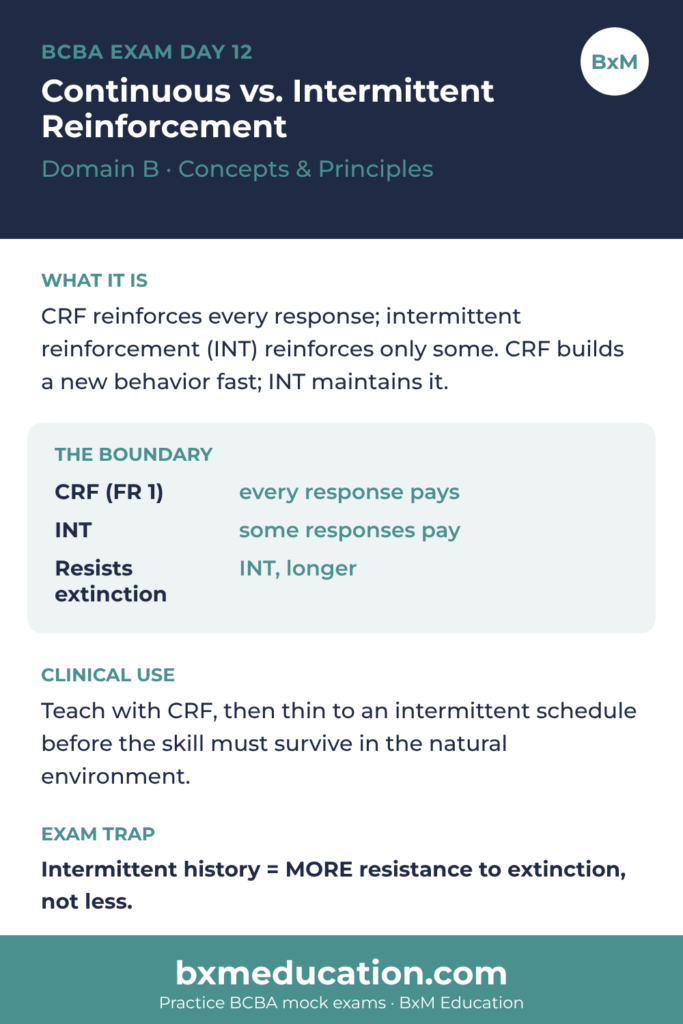
Day 12 opens the schedules-of-reinforcement block. Every schedule you will meet in the days ahead sits on one side of this boundary:
- Continuous reinforcement (CRF, also written FR 1): every occurrence of the target response produces reinforcement. It is the fastest way to strengthen a new behavior, but responding drops quickly once reinforcement stops, and the learner can satiate.
- Intermittent reinforcement (INT): some, but not all, occurrences produce reinforcement (ratio and interval schedules). It is the usual way to maintain a behavior once it is established, and it produces more resistance to extinction: responding continues longer after reinforcement stops.
The test is one question: does every response pay off? If yes, it’s CRF. If only some do, it’s intermittent. Then expect the follow-up item: which history makes the behavior harder to extinguish? Intermittent.
Question 1 (Domain B: Schedules of reinforcement)
An adult client in a day program is learning to request a break by tapping a picture card. During acquisition, the RBT delivers a break every time the client taps the card correctly, with no exceptions. Which schedule is in effect?
A) Fixed-ratio 2 (FR 2)
B) Variable-interval schedule
C) Continuous reinforcement (CRF)
D) Intermittent reinforcement
Question 2 (Domain B: Schedules of reinforcement)
After the break request is mastered, the BCBA thins the schedule so that, on average, only about one in three correct requests is honored right away. Months later, breaks on request are discontinued. Compared with a client whose requests had always been reinforced every time, what is most likely?
A) Requesting will persist longer before it decreases
B) Requesting will stop faster because of ratio strain
C) Requesting will stop immediately because of satiation
D) Requesting will spread to new topographies through response generalization
Question 3 (Domain B: Schedules of reinforcement)
An adult employee in supported employment was taught to assemble kits with a job coach praising every completed kit. On a day the coach is out sick and no one delivers praise, the employee stops assembling within minutes. Which statement best explains how fast the behavior dropped?
A) The thinned schedule produced ratio strain
B) Respondent extinction of a conditioned response occurred
C) An abolishing operation reduced the value of all reinforcers
D) Behavior maintained on continuous reinforcement shows little resistance to extinction
Written Answer Explained
Question 1 Breakdown (Domain B: Schedules of reinforcement)
Core Scenario Summary: Every correct card tap produces a break during acquisition.
Correct Answer: C) Continuous reinforcement (CRF)
Clinical Analysis & Distractor Rationales:
- Why A is Incorrect: FR 2 delivers reinforcement after every second response. Here no correct response goes unreinforced.
- Why B is Incorrect: A variable-interval schedule reinforces the first response after a varying amount of time has passed. Time plays no role in this scenario.
- Why C is Correct: CRF reinforces each occurrence of the target response. It is the schedule of choice while a new behavior is being acquired.
- Why D is Incorrect: Intermittent reinforcement means only some responses are reinforced. “Every time, with no exceptions” rules it out.
Question 2 Breakdown (Domain B: Schedules of reinforcement)
Core Scenario Summary: A mastered request was moved to an intermittent schedule, then reinforcement stopped.
Correct Answer: A) Requesting will persist longer before it decreases
Clinical Analysis & Distractor Rationales:
- Why A is Correct: A history of intermittent reinforcement produces greater resistance to extinction than a history of continuous reinforcement. The learner has contacted many unreinforced responses before, so the change to extinction is harder to discriminate.
- Why B is Incorrect: Ratio strain is a breakdown in responding when a ratio requirement is raised too fast or too far. It describes poorly planned thinning, not what happens under extinction after a well-thinned schedule.
- Why C is Incorrect: Satiation is a drop in a reinforcer’s effectiveness after repeated delivery. It is more of a risk on CRF, and it does not explain responding after reinforcement has stopped.
- Why D is Incorrect: Response generalization is the occurrence of untrained responses that serve the same function. It is not the predicted effect of a schedule history on extinction.
Question 3 Breakdown (Domain B: Schedules of reinforcement)
Core Scenario Summary: A skill praised after every kit collapses on the first day without praise.
Correct Answer: D) Behavior maintained on continuous reinforcement shows little resistance to extinction
Clinical Analysis & Distractor Rationales:
- Why A is Incorrect: Ratio strain requires a ratio schedule that was thinned. This employee was still on CRF; nothing was thinned.
- Why B is Incorrect: Respondent extinction is the weakening of a conditioned response when the conditioned stimulus is presented without the unconditioned stimulus. Kit assembly is operant behavior.
- Why C is Incorrect: An abolishing operation lowers the value of a specific reinforcer and the behavior it maintains. Nothing in the scenario changed the value of praise; praise simply stopped.
- Why D is Correct: When every response has been reinforced, the first unreinforced responses are a sharp change, and responding falls quickly. This is why behavior analysts thin to an intermittent schedule before the skill must survive in the natural environment.
Keep studying: review Exam Day 9: positive vs. negative reinforcement, go back to Exam Day 11: automatic vs. socially mediated contingencies, and see how Exam Day 8: respondent vs. operant separates respondent extinction from operant extinction. Then test yourself under exam conditions in the BCBA Mock Exam System.
APA Reference Citation (7th Edition):
Cooper, J. O., Heron, T. E., & Heward, W. L. (2020). Applied behavior analysis (3rd ed.). Pearson.