
Your athlete got stronger in the weight room. Did she get better at her sport? Only the dependent variable can answer that.
What It Means (in Plain Language)
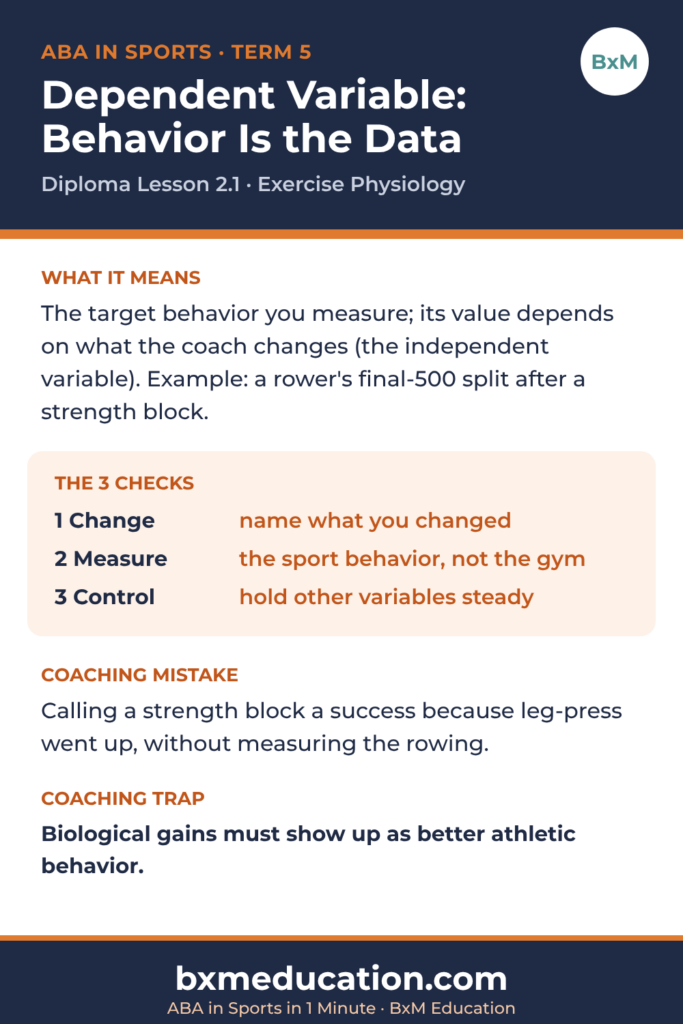
The dependent variable (DV) is the target behavior you measure. It’s called “dependent” because its value depends on the changes you make to the environment. The independent variable (IV) is what you systematically change to see whether it affects that behavior: the drill, the program, the feedback.
Two ideas do the work:
- IV = what the coach does. A new strength block, a different drill, more video feedback.
- DV = what the behavior shows. Split times, first-serve percentage, stroke-rate control, decisions made under pressure.
Module 2 of the BxM diploma adds a layer: behavior happens inside a body. Physiology helps explain why a behavior changed, but observable behavior stays the coach’s primary measure. The test is whether gains in biological capacity show up as measurable improvements in athletic behavior.
The 3 Checks
Before you say a program “worked,” run three checks:
- Change: name the IV. What exactly did you change, and when?
- Measure: name the DV. Which observable behavior should change, and how will you measure it?
- Control: list what else could explain the change, and hold it steady.
Three yeses → you can tell whether your coaching moved the behavior.
Application: Done Right
Elena, 29, rows in a club women’s eight. Her coach, Tomás, added a 6-week strength block: two extra lifting sessions a week. That’s the IV. He knew her leg-press numbers would likely rise, but that’s a biological measure. What he needed to know was whether her rowing changed.
So he picked two behavioral DVs from the same 2,000-meter erg test: her average split in the final 500 meters, and the number of strokes in that final 500 that drifted more than 2 strokes per minute off her target rate. Baseline, two tests a week apart: 1:58.4 and 1:58.6, with 14 and 13 off-rate strokes. He held the extraneous variables steady: same erg, same drag setting, same warm-up, same time of day. After the block: 1:55.1, with 5 off-rate strokes. On the water, the crew’s video showed her holding rate through the last 250 meters of the piece.
Why it works: the change was defined (the strength block), the measure was behavior in her sport, not just the gym number, and control ruled out the obvious alternatives, so the improvement points back to the program.
Misapplication: Spot the Coaching Mistake
Same club, different boat. Coach Ruth runs the same block for Priya, 34. Priya’s leg-press numbers go up, and Ruth tells the crew the block “worked.” But Ruth never measured Priya’s rowing. Two weeks later, Priya’s final-500 split is unchanged and she’s still rushing the slide when the rate goes up.
Spot the mistake: Ruth treated a biological measure as the outcome. Strength is capacity; the DV is the rowing behavior she wanted to improve, and nobody measured it. The fix: pick the behavioral DV before the block starts and measure it at baseline. If capacity rises and the behavior doesn’t, re-evaluate the training, for example by adding technical feedback at race rate.
How It Shows Up in Practice and on Exams
- Coaching trap: “The numbers went up, so it worked.” Ask which numbers. Gym tests and heart-rate data explain; the DV is the sport behavior.
- BCBA/RBT exam angle: IV = intervention (what the BCBA does); DV = data (what the behavior shows). The top trap (Study Guide D.1): if behavior changes while you’re still in baseline, a confounding variable is likely responsible, and you can’t claim a functional relation.
- Extraneous vs. confounding: extraneous variables are the ones you hold constant (same erg, same time of day). A confounding variable is an uncontrolled factor that may have influenced the DV, like a new boat or a tailwind on race day.
Go Deeper
This is Lesson 2.1 of the BxM Professional Diploma in Behavioral Sport Training. The full lesson covers the five biological systems that shape athletic behavior, bioadaptation and how to design training for both biological and behavioral outcomes.
Keep Studying
- Term 4 of this series: Operational Definition in Sports Explained
- Term 1 of this series: Behavior in Sports Explained
- BCBA series: Baseline Logic in Single-Subject Designs
- Watch every sports term: ABA in Sports in 1 Minute playlist
Quick Check (2 Questions)
Question 1. An adult tennis coach adds video feedback after each practice set and tracks the player’s first-serve percentage across 10 sessions. What is the dependent variable?
A) The video feedback
B) The number of practice sessions
C) The coach’s experience level
D) The first-serve percentage
Show answer
D. The first-serve percentage is the behavior being measured; its value depends on the change the coach made. A is the independent variable, the intervention the coach introduces. B is part of the measurement schedule, not the target behavior. C is a characteristic of the coach that isn’t being measured or manipulated.
Question 2. A track coach starts a new sprint-start drill with an adult 100 m sprinter. During the baseline weeks, before the drill begins, her reaction time out of the blocks has already improved. What should the coach conclude?
A) The drill caused the improvement
B) Reaction time is the independent variable
C) A confounding variable may be responsible, so a functional relation can’t be claimed yet
D) Baseline data aren’t needed when the behavior is improving
Show answer
C. The behavior changed before the IV was introduced, so something else is influencing it. A is impossible: the drill hadn’t started. B mixes up the roles: reaction time is what’s measured (DV). D is wrong: a stable baseline is what lets you show the IV made the difference.
Reference
BxM Education & Consulting. (2026). Professional Diploma in Behavioral Sport Training, Lesson 2.1: Biological systems that influence athletic behavior. BxM Education.
BxM Education. (2024). BxM Education BCBA 6th Edition Study Guide (Domain D, D.1). BxM Education.
Cooper, J. O., Heron, T. E., & Heward, W. L. (2020). Applied behavior analysis (3rd ed.). Pearson.