
You don’t need to be a lawyer to use the law. You need to know its name, and what it promises your child.
Why It Matters for You
Meetings move fast and the words can sound like a different language. Knowing that the IEP comes from a federal law, IDEA, changes how you ask: instead of “Could he maybe get help?” you can ask, “Where does the IEP show how this meets his needs?” That question has a written answer.
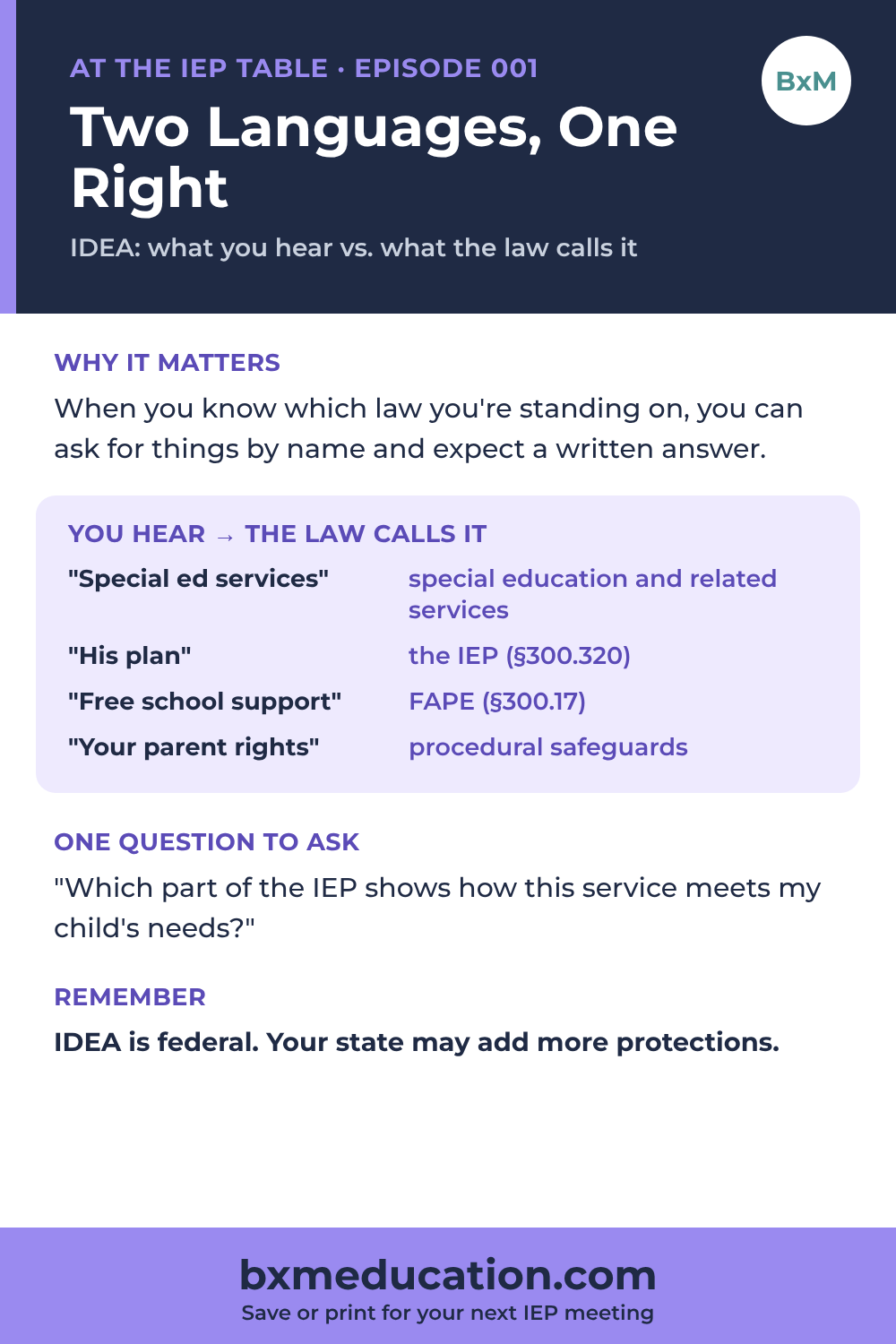
Two Languages, One Right
| What you might hear | What the law calls it | What you can ask or do |
|---|---|---|
| “Special ed services” | Special education and related services | “Which services, how often, and who provides them?” |
| “His plan” | The IEP (34 CFR §300.320) | Ask for a copy, and the date of the next review. |
| “Free school support” | FAPE (34 CFR §300.17) | “How does this plan meet his individual needs?” |
| “Your parent rights” | Procedural safeguards | Ask for the procedural safeguards notice and read it before the meeting. |
A Parent’s Story
Before: Ana’s son had an IEP, but she left every meeting nodding and confused. She signed, took the papers home, and wasn’t sure what he actually received.
What she asked: At the next meeting she said, “Can we go through which services he gets, how many minutes, and who provides them, and where that’s written in the IEP?”
After: The case manager pointed to each service on the page. Ana left with a highlighted copy showing speech therapy twice a week and the date of the annual review written on her calendar.
Questions to Bring
- Which law and which part of it apply to my child?
- Which services will my child receive, how often, and from whom?
- Where in the IEP is each service written?
- When is the next review?
- May I have a copy of the procedural safeguards notice?
The Takeaway
IDEA is the promise; the IEP is the paper that makes it specific. Ask to see the promise on the page.
For the law itself, read What Is IDEA? Special Education Law Explained, and find every episode in IEP & IDEA Law Explained.
Educational information, not individualized legal advice. State-specific requirements may also apply.