
Your outfielder’s first step got slower this week. Before you call it laziness, measure it. It may be the training load talking.
What It Means (in Plain Language)
In ABA, latency is the time between a stimulus and the start of the response. You don’t measure how long the behavior lasts; you measure how long it takes to begin.
- Start of the clock: the stimulus (the whistle, the serve, the crack of the bat).
- End of the clock: the first instance of the response (the first step, the first stroke).
Lesson 2.7 of the BxM diploma applies Hans Selye’s General Adaptation Syndrome to training: a new, demanding load produces an Alarm stage, good recovery leads to Resistance (adaptation), and stress that keeps exceeding recovery leads toward Exhaustion. The lesson’s point for coaches: behavior analysis doesn’t measure stress directly; it measures behavior, and stress shows up in behavior. Slower reactions are one of the first signs, and latency is how you put a number on them.
The 3 Checks
- Define: name the stimulus that starts the clock and the response that stops it, and measure it the same way every time.
- Compare: put this week’s latency next to the athlete’s baseline.
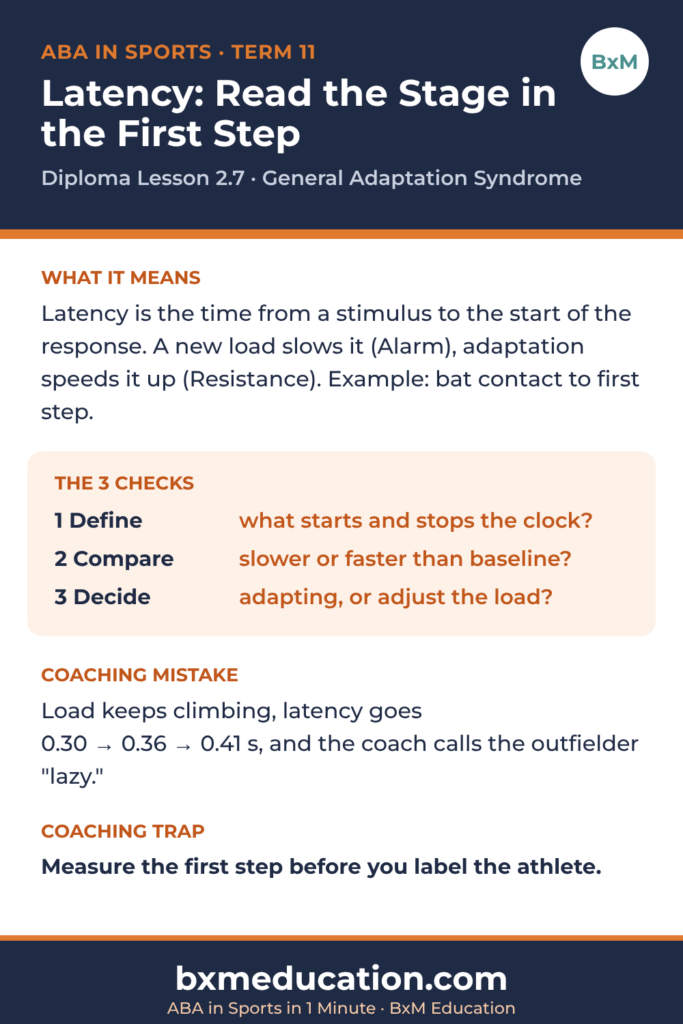
- Decide: slower than baseline right after a new load is expected (Alarm). Back to or faster than baseline means the athlete is adapting (Resistance). Getting slower again while the load keeps climbing is an early warning: look at the other data and adjust the load before performance falls apart.
Application: Done Right
Luis, 21, is a college center fielder. His coach, Dana, runs a reaction drill twice a week: she hits fly balls with a fungo bat and films at 120 frames per second. The measure is latency from bat contact to Luis’s first step, averaged over 10 balls. His baseline during normal training: 0.33 s.
Dana starts a new four-week conditioning block. Weekly averages: 0.38 s in week 1, 0.33 s in week 2, 0.30 s in week 3. She programs a planned lighter week in week 4, and Luis holds at 0.30 s.
Why it works: Dana defined the clock the same way every session, compared each week with the 0.33 s baseline, and decided from the pattern: the week-1 slowdown was the expected Alarm response, the drop to 0.30 s showed adaptation, and the lighter week protected it.
Misapplication: Spot the Coaching Mistake
Same program, different coach. Marcus, 23, has the same 0.33 s baseline and the same first three weeks: 0.38, 0.33 and 0.30 s. Then Coach Rick raises the volume again in week 4 with no lighter week. Marcus’s latency climbs to 0.36 s in week 4 and 0.41 s in week 5, and he starts misjudging balls. Rick says Marcus is “lazy” and adds extra reps after practice.
Spot the mistake: a latency that climbs back above baseline while the load keeps rising is data, not a character flaw. It is the pattern the lesson links to sliding from Resistance toward Exhaustion, and Rick answered it with more load.
The fix: treat the rising latency as an early warning, check it against the other data (errors, session ratings, heart-rate data from the performance staff), reduce the load or program a lighter week, and keep measuring latency until it comes back down.
How It Shows Up in Practice and on Exams
- Coaching trap: confusing latency with duration. How long a sprint lasts is duration; how fast it starts after the signal is latency.
- BCBA/RBT exam angle: questions describe “the time from the instruction to the start of the response” and ask for the measure. That is latency. The time between two responses is inter-response time (IRT).
- Extra tip: one slow day isn’t a trend. Compare weekly averages with the baseline and look at the direction across weeks before changing the plan.
Go Deeper
This is Lesson 2.7 of the BxM Professional Diploma in Behavioral Sport Training. The full lesson covers the behavioral signature of each adaptation stage, the progression and regression pathways, the six-question coaching audit and the Behavioral GAS Model.
Keep Studying
- Term 10 of this series: Level, Trend and Variability in Sports Explained
- Term 8 of this series: Data-Based Decision Making in Sports Explained
- BCBA series: Domain C Measurement Systems: Everything You Need to Know
- Watch every sports term: ABA in Sports in 1 Minute playlist
Quick Check (2 Questions)
Question 1. A volleyball coach films an adult libero and records the time from the opponent’s serve contact to the libero’s first movement. Which measure is this?
A) Duration
B) Inter-response time (IRT)
C) Latency
D) Frequency
Show answer
C. The clock starts with a stimulus (serve contact) and stops when the response begins (first movement): latency. A is how long a response lasts. B is the time between two responses. D is a count of responses.
Question 2. In Lesson 2.7’s adaptation model, which stage is marked by smoother technique and faster decisions after appropriate recovery?
A) Alarm
B) Resistance
C) Exhaustion
D) Baseline
Show answer
B. Resistance is successful adaptation: movement gets more efficient and decisions get faster. A is the short-term dip right after a new load. C is when stress keeps exceeding recovery and errors persist. D is a measurement phase in ABA, not an adaptation stage.
Reference
BxM Education & Consulting. (2026). Professional Diploma in Behavioral Sport Training, Lesson 2.7: General adaptation syndrome: Managing stress to sustain athletic behavior. BxM Education.
BxM Education. (2024). BxM Education BCBA 6th Edition Study Guide (Domain C, C.4). BxM Education.
Cooper, J. O., Heron, T. E., & Heward, W. L. (2020). Applied behavior analysis (3rd ed.). Pearson.