
Negative reinforcement is the term RBT candidates mix up most often, because “negative” sounds like punishment. It isn’t: negative reinforcement always makes a behavior go up.
What It Means (in Plain Language)
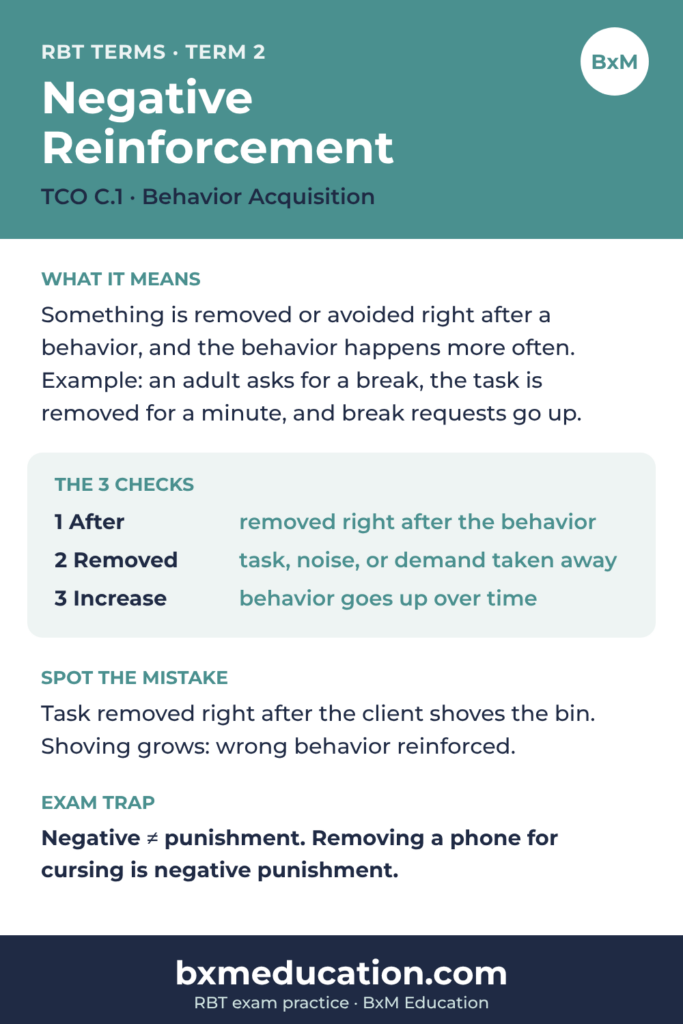
Negative reinforcement happens when something is taken away (or never shows up) right after a behavior, and because of that, the behavior happens more often in the future. The thing removed is usually something the person would rather not have: a hard task, a loud noise, an uncomfortable feeling.
Two words do all the work:
- Negative = something is removed or avoided (not “bad” and not “punishment”).
- Reinforcement = the behavior increases later on.
Escaping something that is already there and avoiding something before it starts both count.
The 3 Checks
Before you call anything negative reinforcement, run three quick checks:
- After: did the removal happen right after the behavior?
- Removed: was something taken away, ended, or avoided (a task, a noise, a demand)?
- Increase: is the behavior happening more often over time?
All three are yes → negative reinforcement. If the behavior goes down, it’s punishment, not reinforcement.
Application: Done Right
Theo is a 31-year-old adult at a supported job site, sorting mail into bins. His behavior plan, written by his BCBA, teaches him to ask for a short break instead of pushing the bins away. His RBT, Priya, follows the plan: each time Theo taps his break card and says “break, please,” Priya takes the sorting tray away for one minute, then brings it back.
Over three weeks, Priya’s data show break requests going from 1 to 6 per shift, and bin-pushing dropping from 8 times to 1.
Why it works: the task is removed right after the request, and the requests increased. All three checks pass, and the behavior being strengthened is the one the plan wants.
Misapplication: Spot the Mistake
Same job site, different RBT. When Theo shoves a bin off the table, Alex quickly takes the sorting tray away “so he can calm down.” By the end of the month, bin-shoving has gone from 2 to 7 times per shift.
Spot the mistake: the task was removed right after the problem behavior, so Alex negatively reinforced bin-shoving. The checks all pass, just for the wrong behavior.
The fix: follow the plan as written (honor the break card, not the shove) and report the increase to the supervising BCBA right away.
How It Shows Up on the RBT Exam
- “Negative” tempts you to think “punishment.” Read it as removed, and remember reinforcement always means the behavior increases.
- Taking away a client’s phone for cursing is negative punishment (removal that makes behavior go down), not negative reinforcement.
- Watch for escape from tasks in the scenario: if a demand ends right after problem behavior and the behavior grows, that’s negative reinforcement of the problem behavior.
Keep Studying
- Next, RBT Term 3: Discriminative Stimulus (SD) Explained
- Compare it with the BCBA-level version: Positive vs. Negative Reinforcement | BCBA Exam Day 3
- Review RBT Term 1: Positive Reinforcement Explained
- Start or finish your hours: RBT 40-Hour Training
- Test yourself under exam conditions: RBT Practice Exam Pack
Quick Check (2 Questions)
Question 1. Ray, an adult client, starts putting on his headphones whenever the break room gets loud. The headphones block the noise, and over a month he puts them on more and more often. What is maintaining the headphone behavior?
A) Positive reinforcement
B) Negative reinforcement
C) Positive punishment
D) Negative punishment
Show answer
B. The loud noise is removed right after he puts on the headphones, and the behavior increases. A is wrong: nothing is added. C and D are wrong: punishment would make the behavior go down.
Question 2. A new RBT says, “Taking away a client’s phone each time he curses is negative reinforcement.” Which statement is most accurate?
A) Correct, because something was taken away
B) Correct, because the goal is a better behavior
C) Incorrect: it’s negative punishment, because something is removed to make cursing decrease
D) Incorrect: it’s positive punishment, because the phone is a stimulus
Show answer
C. Removing something to make a behavior decrease is negative punishment. Negative reinforcement always increases the behavior it follows. A focuses only on “removed” and ignores the effect. B is irrelevant to the definition. D is wrong because nothing is added.
Reference
Miltenberger, R. G. (2016). Behavior modification: Principles and procedures (6th ed.). Cengage Learning.
Behavior Analyst Certification Board. (2024). RBT Test Content Outline (3rd ed.). https://www.bacb.com