
In partial-interval recording, you score an interval “yes” if the behavior happened at any moment during it, even once, even for a second. You don’t count how many times.
What It Means (in Plain Language)
Partial-interval recording is a discontinuous way to collect data. The observation period is split into short, equal intervals (for example, 10 seconds or 1 minute). At the end of each interval, you mark whether the target behavior occurred at any point during that interval. The result is reported as the percentage of intervals with the behavior.
The words do the work: – Interval = the session is cut into equal blocks of time, and you score each block. – Partial = the behavior only needs to fill part of the interval, any part, for the interval to count.
The 3 Checks
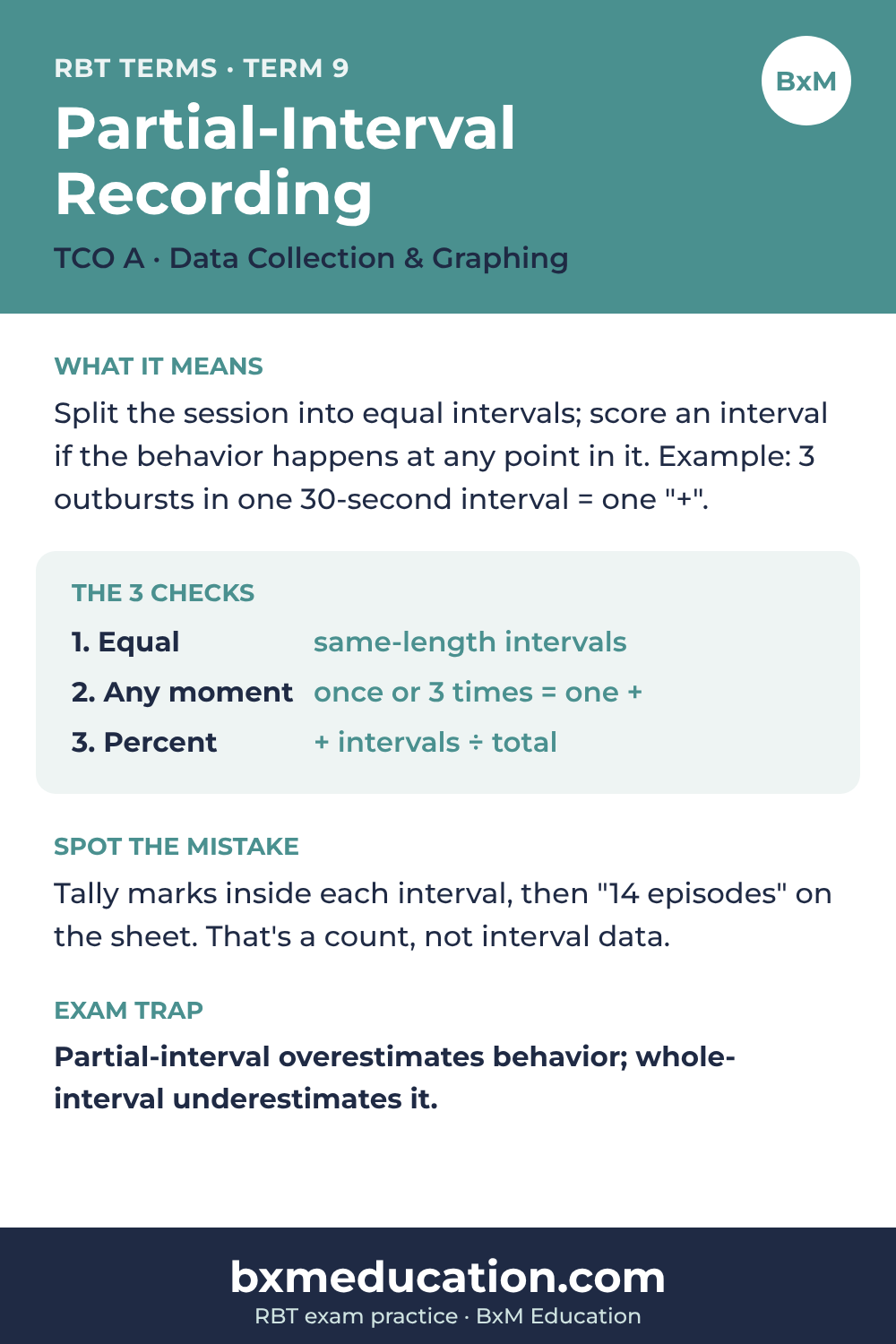
Before you score an interval, run three checks: 1. Equal intervals: is the session divided into the interval length the plan specifies, with a timer or app cueing each one? 2. Any occurrence = yes: did the behavior happen at any point in this interval? One instance is enough. Three instances are still one “yes.” 3. Percent of intervals: at the end, report intervals scored “yes” divided by total intervals, not a count of behaviors.
Partial-interval tends to overestimate how much the behavior happens, which is why supervisors often choose it for behaviors they want to decrease.
Application: Done Right
Daniel is a 34-year-old adult at a supported-employment site. His plan targets loud vocal outbursts during a 10-minute shelving task. The BCBA chose partial-interval recording with 30-second intervals (20 intervals per session).
The RBT, Keisha, uses a vibrating interval timer. When it buzzes, she marks a “+” if any outburst happened in the interval just ended, or a “−” if none did. In interval 4, Daniel has three outbursts; Keisha marks one “+.” Session total: 6 of 20 intervals scored “+” = 30%. She writes the interval length and session time on the sheet and enters the data the same day.
Why it works: Keisha used equal intervals, scored any occurrence as yes (three outbursts = one “+”), and reported the percent of intervals, not a count.
Misapplication: Spot the Mistake
Same site, different client. Lorraine, 51, has a plan for partial-interval recording of off-task talking, 1-minute intervals. A new RBT, Jason, makes tally marks inside each interval box: “///” in minute 2, “/” in minute 5. At the end he writes “14 talking episodes” on the data sheet.
Spot the mistake: Jason turned interval data into a frequency count. In partial-interval recording, each interval gets a single yes/no, no matter how many times the behavior happened. His “14” can’t be compared with the rest of Lorraine’s data, which is in percent of intervals. The fix: score each interval once (+ or −), then report “+” intervals ÷ total intervals × 100. If the team needs a count, the RBT tells the supervisor, and the BCBA decides whether to change the measurement method.
How It Shows Up on the RBT Exam
- Any part of the interval = scored. If the item says “at any time during the interval,” it’s partial-interval.
- Overestimates behavior; whole-interval (Term 10) underestimates it. Expect a question that asks which one.
- The result is a percentage of intervals, never a frequency or rate.
Keep Studying
- Review RBT Term 7: Extinction Burst Explained
- Review RBT Term 1: Positive Reinforcement Explained
- Start or finish your hours: RBT 40-Hour Training
Quick Check (2 Questions)
Question 1. An RBT divides a 5-minute observation into 15-second intervals and marks an interval if the adult client bites his nails at any point during it. Which method is this?
A) Whole-interval recording
B) Momentary time sampling
C) Frequency recording
D) Partial-interval recording
Show answer
D. Scoring an interval when the behavior happens at any point in it is partial-interval recording. A is wrong: whole-interval requires the behavior for the entire interval. B is wrong: momentary time sampling only checks at the exact moment the interval ends. C is wrong: frequency recording counts every instance; it doesn’t use intervals.
Question 2. Using partial-interval recording, an RBT sees an adult client pace three separate times in one 20-second interval. How should the RBT score that interval?
A) Score it once as an occurrence
B) Score three occurrences
C) Leave it blank because the pacing was not continuous
D) Score it as an occurrence only if the pacing lasted the full 20 seconds
Show answer
A. Each interval gets one yes/no; any occurrence makes it a “yes.” B is wrong: partial-interval doesn’t count instances. C is wrong: the behavior doesn’t need to be continuous for partial-interval. D is wrong: that is the rule for whole-interval recording.
Reference
Miltenberger, R. G. (2016). Behavior modification: Principles and procedures (6th ed.). Cengage Learning.
Behavior Analyst Certification Board. (2024). RBT Test Content Outline (3rd ed.). https://www.bacb.com