
Use what the learner does to distinguish Piaget’s four stages and choose a classroom support that fits the task.
What It Means (in Plain Language)
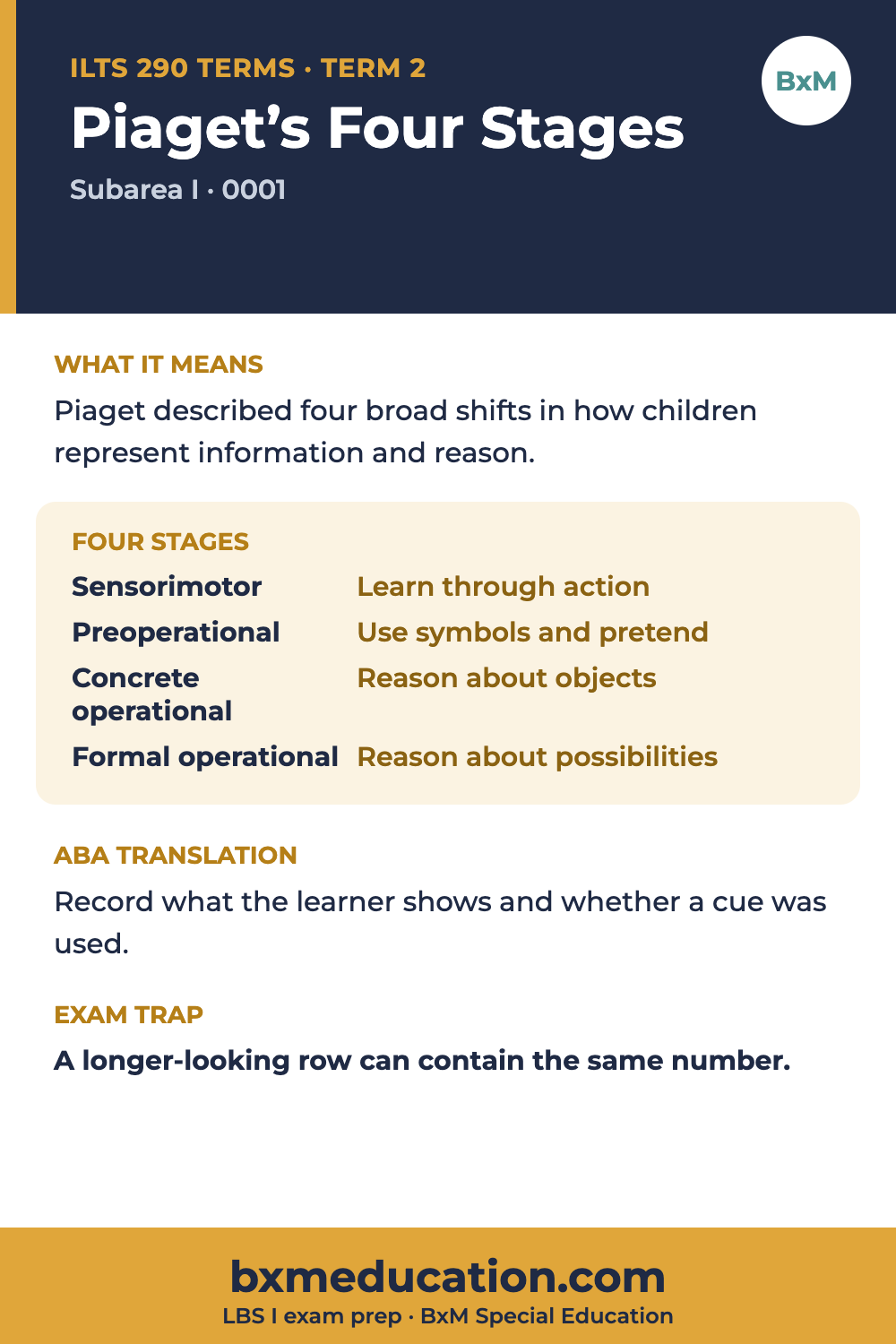
Piaget’s theory describes four broad shifts in how children represent information and reason about it.
- Look for the reasoning the learner demonstrates. The ages below are approximate guides.
- Pay attention to the conditions. A learner may explain a fact with objects in front of them and need more support when the same problem is presented verbally.
The Four Stages
| Stage | Approximate age | What you might observe |
|---|---|---|
| Sensorimotor | Birth to 2 years | A child learns through looking, reaching and acting. Searching for a toy after it is covered illustrates object permanence. |
| Preoperational | 2 to 7 years | A child uses words or objects to stand for other things. A block becomes a pretend phone. The child may also judge a spread-out row of counters as having more. |
| Concrete operational | 7 to 11 years | A child reasons logically about tangible examples. When the same counters are spread out, the child can explain that the number stayed the same. |
| Formal operational | About 12 years onward in the model | A learner can reason about an abstract possibility, such as predicting what would happen if a rule changed and explaining why. |
Classroom Application: Done Right
During a fictional math lesson, an LBS I teacher has a learner match two rows of six counters. The teacher spreads out one row and asks whether either row now has more. Then she asks the learner to show or explain why. She accepts speech, pointing or an agreed AAC response and records whether the learner answered independently, needed a prompt or gave a different answer.
In four trials, the learner explains the unchanged quantity independently once and after a matching cue twice. On the fourth trial, the learner chooses the longer row. The teacher keeps the objects available and checks the same skill with a different set before deciding whether to fade the cue.
Misapplication: Spot the Mistake
A teacher hears one incorrect answer and decides the student cannot reason logically. That answer describes performance on one task. Check access to the directions and response mode, then collect more than one observation before changing instruction.
How It Shows Up on the ILTS 290
- Pretend play and object permanence: using one object to represent another and looking for a hidden object illustrate different developmental ideas.
- Appearance and conservation: a child who explains that the amount stays the same after the arrangement changes is showing conservation.
- Concrete and hypothetical reasoning: explaining a transformation with objects in front of you and reasoning through an imagined rule change draw on different kinds of reasoning.
The ABA Translation
Piaget’s stages and ABA describe different things. There is no one-to-one ABA equivalent for a stage. An ABA-informed teaching team can still define what to observe: after the counters are rearranged, does the learner indicate “same” independently, after a cue, or give a different answer? Record the materials and prompt alongside the response.
▶ ILTS 290 · Term 2: Piaget’s Four Stages
Quick Check
Question 1. A child watches a teacher spread out one of two equal rows of buttons. The child says both rows still have six because the teacher moved the buttons without adding any. Which concept is illustrated?
- Object permanence
- Symbolic play
- Conservation
- Hypothetical reasoning
Show answer
C. Conservation. The child understands that a change in appearance did not change quantity. Object permanence concerns a hidden object, symbolic play uses a stand-in, and hypothetical reasoning considers a possibility.
Question 2. A learner misanswers one conservation task after unfamiliar directions. What should the teacher do next?
- Assign a developmental stage from the answer.
- Check that the directions and response mode are accessible, then collect additional observations.
- Stop teaching quantity until the learner reaches the expected age.
- Move directly to an abstract written task without checking understanding.
Show answer
B. A single response leaves several explanations open. Accessible directions and repeated observations give the teacher better evidence for selecting a support.
Keep Studying
- Full ILTS 290 prep
- ILTS 290 study materials
- How to Train Your SECA: Observe reasoning during a conservation task
References
- Illinois Licensure Testing System, Field 290 test framework, Objective 0001
- OpenStax, Lifespan Development, Major Theories and Theorists
- OpenStax, Lifespan Development, Cognition in Middle Childhood
Independent BxM study material. Not affiliated with ILTS, ISBE, Pearson or ETS. Created by an Illinois LBS I.