
Prompt fading means removing the extra help a little at a time, so the instruction alone gets the right response. The goal is independence, not perfect prompted trials.
What It Means (in Plain Language)
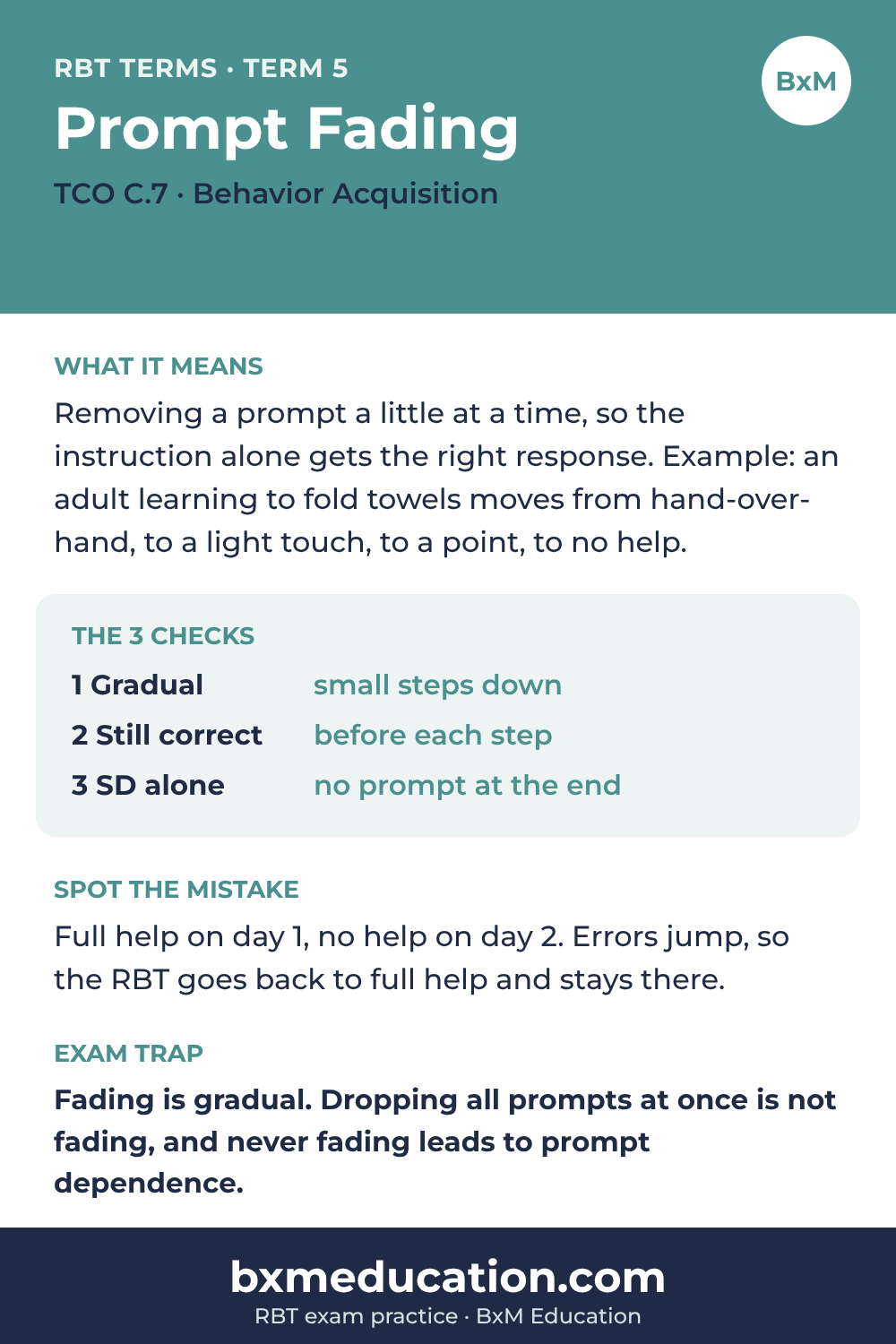
Prompt fading is the planned, step-by-step removal of a prompt while the client keeps responding correctly. Each step gives a bit less help (less intrusive, less of it, or later in time) until the instruction (the SD) alone gets the response. When that happens, we say stimulus control has transferred from the prompt to the instruction.
The words do the work:
- Prompt = extra help given with the instruction (RBT Term 4).
- Fading = taking that help away gradually, not all at once, so errors stay low.
The 3 Checks
Run these three checks on any fading plan:
- Gradual: is the help removed in small steps (for example, full physical → partial physical → gesture → none)?
- Correct responding continues: is the client still mostly correct at each step before moving on?
- Ends with the instruction alone: does the last step leave only the SD, with no prompt at all?
All three are yes → that’s prompt fading. Dropping all help at once, or never reaching “no prompt,” is not.
Application: Done Right
Marcus is a 41-year-old adult in a supported-employment program, learning to fold towels for a hotel laundry contract. His BCBA wrote a most-to-least plan: full physical guidance, then partial physical (a light touch at the wrist), then a gesture, then the instruction alone. The rule: move down one level after 2 sessions at 80% or more correct.
The RBT, Dana, follows the plan and records the prompt level on every trial. Sessions 1–2 at full physical: 90% and 85% correct. She moves to partial physical: 80%, 85%. Then gesture: 80%, 90%. By session 8, Marcus folds 9 of 10 towels after “Fold the towels, please” with no prompt. Dana reports the data to the BCBA.
Why it works: the help is removed gradually, Marcus keeps responding correctly at each step, and the plan ends with the instruction alone.
Misapplication: Spot the Mistake
Same program, different RBT. On day 1, Ben gives full physical guidance. On day 2, he decides Marcus “should know it by now” and stops prompting completely. Marcus makes errors on 7 of 10 towels, gets frustrated, and walks away from the table. Ben goes back to full physical guidance and stays there for the next two weeks.
Spot the mistake: Ben jumped from full help to no help in one step, then stayed at full help. That is not fading. The abrupt drop caused errors, and the long stay at full help risks prompt dependence.
The fix: follow the written fading steps and criteria, record the prompt level each trial, and tell the supervising BCBA if the client is stuck at a level. The BCBA, not the RBT, changes the plan.
How It Shows Up on the RBT Exam
- Fading = gradual removal. A question that drops all prompts at once is describing the wrong answer.
- Know most-to-least (start with the most help, then less) and least-to-most (start with the least help, add more only if needed). Both are planned prompt hierarchies.
- The goal of fading is transfer of stimulus control: the instruction alone gets the response. Waiting for help = prompt dependence.
Keep Studying
- Review RBT Term 4: Prompt Explained
- Review RBT Term 3: Discriminative Stimulus (SD) Explained
- Start or finish your hours: RBT 40-Hour Training
Quick Check (2 Questions)
Question 1. An adult client is learning to wipe tables at a café job. The plan starts with hand-over-hand guidance, then a light touch on the elbow, then a point, then the instruction alone. What is this procedure called?
A) Least-to-most prompting
B) Shaping
C) Extinction
D) Most-to-least prompt fading
Show answer
D. The help starts at the most intrusive level and is removed step by step until only the instruction remains. A is wrong: least-to-most starts with the least help and adds more only when needed. B is wrong: shaping reinforces closer and closer versions of a behavior; here the behavior stays the same and the help changes. C is wrong: extinction means withholding a reinforcer that used to follow a behavior.
Question 2. An RBT gives a model prompt for 3 weeks, then removes all prompts in one session. The client’s correct responding drops from 90% to 20%. What went wrong?
A) The prompt was removed abruptly instead of faded gradually
B) The client needs a new reinforcer
C) The model prompt was the wrong type
D) Nothing; errors always go up when prompts are faded
Show answer
A. Fading means removing help in small steps so correct responding continues. A sudden drop to no help leads to errors. B is wrong: nothing suggests the reinforcer stopped working. C is wrong: the model prompt worked while it was in place. D is wrong: good fading keeps errors low; a large drop is a sign the steps were too big. Report the data to the supervising BCBA.
Reference
Miltenberger, R. G. (2016). Behavior modification: Principles and procedures (6th ed.). Cengage Learning.
Behavior Analyst Certification Board. (2024). RBT Test Content Outline (3rd ed.). https://www.bacb.com