
Your athlete nails it in the drill and freezes in the game. Often the skill is fine. It’s just answering to the wrong cue.
What It Means (in Plain Language)
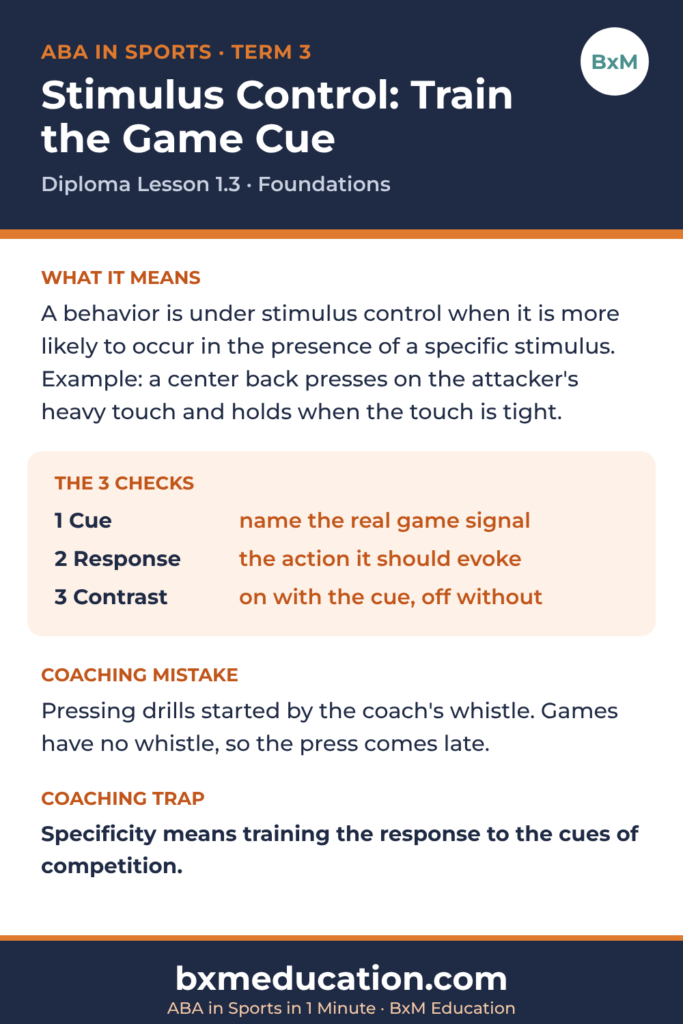
Stimulus control is a situation in which behavior is more likely to occur in the presence of specific stimuli. In the study guide’s technical terms, the rate, latency, duration or amplitude of a response changes when a particular antecedent is present. A discriminative stimulus (SD) signals that reinforcement is available for a specific response; an S-delta (S∆) signals that it isn’t.
Two ideas do the work:
- The cue: something the athlete can see or hear right before the action, like a defender’s hips, a heavy touch, or a whistle.
- The history: the cue gains control because responding in its presence has paid off before.
The BxM diploma uses this to re-frame a classic training rule: specificity is the establishment of stimulus control. Practice works best when athletes learn to act on the same visual, spatial and sound cues they’ll meet in competition.
The 3 Checks
To build stimulus control on purpose, run three checks:
- Cue: what exact game signal should trigger the action?
- Response: what observable action should that signal evoke?
- Contrast: does the action happen when the cue is present and not when it’s absent?
Three yeses → the skill is answering to the game, not to the drill.
Application: Done Right
Sofia, 26, is a center back on an adult amateur women’s soccer team. Her coach, Andre, wanted her to step in and press when an attacker’s first touch runs away from the body (a heavy touch) and to hold her position when the touch is tight. Diving in on a tight touch gets her beaten.
In small-sided games, Andre’s assistant tracked every first touch Sofia faced. Baseline: she pressed on 6 of 15 heavy touches (40%) and dove in on 7 of 12 tight touches. Andre then ran 3v3 games with live attackers told to vary their touch, paused play for a 5-second video replay after key moments, and awarded a team point for every ball won on a correct press. By week 4 she pressed on 13 of 15 heavy touches (87%) and dove in on only 2 of 12 tight ones. Over the next two league matches, the same pattern showed up on the match video.
Why it works: the cue (heavy touch) is the one she’ll see in games, the response (step and press) is observable, and the contrast shows control: she presses when the cue is there and holds when it isn’t.
Misapplication: Spot the Coaching Mistake
Same team, different drill. Assistant coach Lucas runs the pressing drill on his whistle: whistle blows, defenders sprint to press. The reps look sharp, and Sofia’s teammate Kim, 30, presses within a second every time. On match day there’s no whistle for that. Kim waits, presses late, and gets turned twice in the first half.
Spot the mistake: the press came under the control of the coach’s whistle, a cue that never appears in a match. The fix: move control to the natural game cue. Start with the whistle if needed, then fade it and let the attacker’s touch start every rep.
How It Shows Up in Practice and on Exams
- Coaching trap: “practice player vs. game player.” When a skill appears only in drills, ask what cue it’s answering to.
- BCBA/RBT exam angle: SD = reinforcement is available for that response; S∆ = it isn’t. The top trap (Study Guide B.7): an SD signals availability, while a motivating operation (MO) changes the value of the reinforcer. A cue without a reason to want the outcome won’t evoke the behavior.
- Generalization vs. discrimination: loose stimulus control spreads to similar cues (generalization); tight control means the response occurs only with the SD (discrimination). Good sport skills need both: tight to the right cue, broad across venues, opponents and crowd noise.
Go Deeper
This is Lesson 1.3 of the BxM Professional Diploma in Behavioral Sport Training. In the full lesson you re-frame the six classic training principles in behavioral terms, including shaping complex skills and designing practice for transfer to competition.
Keep Studying
- Term 2 of this series: Learning in Sports Explained
- Term 1 of this series: Behavior in Sports Explained
- Watch every sports term: ABA in Sports in 1 Minute playlist
Quick Check (2 Questions)
Question 1. A 23-year-old point guard drives to the rim reliably in practice when the coach yells “Go!” but rarely drives in games, even when the defender’s hips open. What is the most likely explanation?
A) He lacks motivation on game day
B) The drive is under the stimulus control of the coach’s cue, not the defender’s cue
C) The drive is on extinction
D) The coach’s “Go!” is negative reinforcement
Show answer
B. The behavior occurs reliably in the presence of the coach’s cue, which never appears in games; the defender’s open hips haven’t gained control. A explains nothing observable. C would mean reinforcement for driving had stopped, which isn’t described. D misnames an antecedent as a consequence; “Go!” comes before the behavior.
Question 2. On an adult volleyball team, the setter’s shoulders squaring toward the outside hitter reliably tell the middle blocker that jumping to the outside will pay off. That shoulder cue is best called:
A) A discriminative stimulus (SD)
B) An S-delta (S∆)
C) A motivating operation (MO)
D) A reinforcer
Show answer
A. It signals that reinforcement (a successful block) is available for that response. B would signal that reinforcement is not available. C changes how valuable a reinforcer is, not whether it’s available. D follows the behavior; the shoulder cue comes before it.
Reference
BxM Education & Consulting. (2026). Professional Diploma in Behavioral Sport Training, Lesson 1.3: Engineering athletic performance through behavioral principles. BxM Education.
BxM Education. (2024). BxM Education BCBA 6th Edition Study Guide (Domain B, B.7). BxM Education.
Cooper, J. O., Heron, T. E., & Heward, W. L. (2020). Applied behavior analysis (3rd ed.). Pearson.