
An A-B design can show that behavior changed after an intervention started, but it cannot rule out everything else that changed at the same time. The A-B-A design adds one phase to close part of that gap. On the BCBA exam, it sits in Domain D (Experimental Design), and items test whether you know exactly what the third phase adds and what it still leaves unproven.
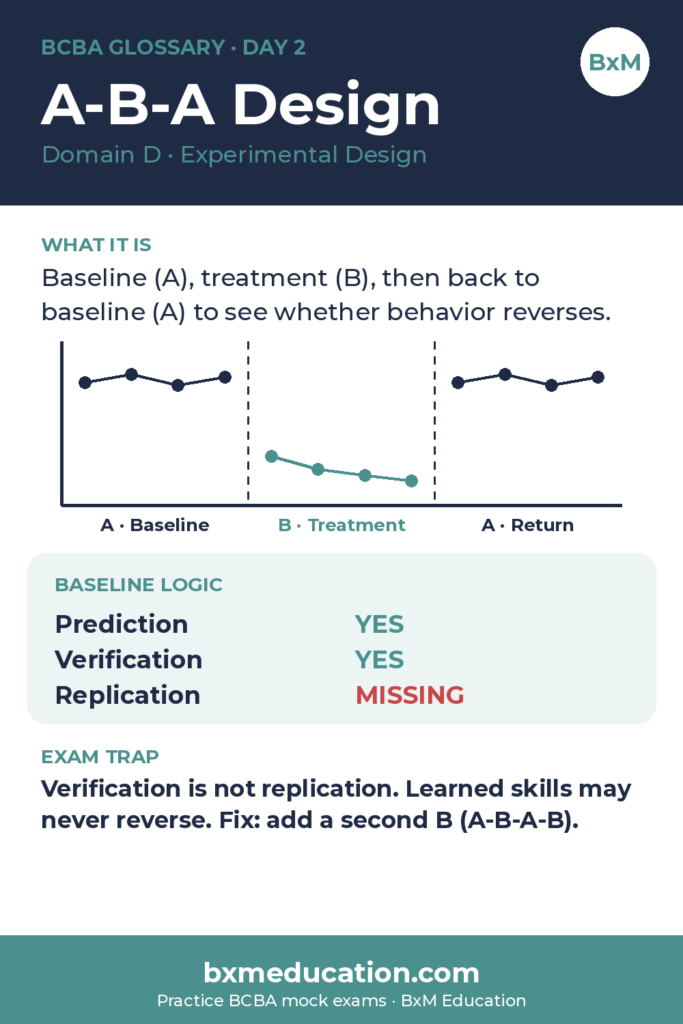
Cooper, Heron, and Heward (2020) describe the A-B-A design as a three-phase sequence. First comes a baseline (A), run until responding is stable. Next comes the intervention (B), run until behavior changes and stabilizes again. Then the independent variable is withdrawn and baseline conditions return (A), to see whether responding “reverses” toward its original level. The A-B-A design is the simplest member of the reversal family of designs, often called withdrawal designs (some authors reserve “withdrawal” for removing the independent variable and “reversal” for applying it to an alternative behavior).
The power of the design comes from baseline logic. Stable baseline data support a prediction of what behavior would look like if nothing changed. When behavior returns toward baseline levels after the intervention is withdrawn, that return verifies the prediction: without the intervention, behavior would have stayed where it was. What the A-B-A design does not provide is replication, because the treatment effect is shown only once.
Mechanics: Prediction, Verification, and the Missing Replication
- Phase 1 (A, baseline): measure until steady state responding (or a countertherapeutic trend) is established. This is the basis for prediction.
- Phase 2 (B, intervention): introduce the independent variable and run until behavior changes and stabilizes.
- Phase 3 (A, return to baseline): withdraw the independent variable. If responding moves back toward the first baseline level, the earlier prediction is verified.
- What is still missing: the effect of B has not been reproduced. One change and one reversal can still be coincidence with an extraneous variable, so the A-B-A is considered a weaker demonstration of experimental control than the A-B-A-B design.
Clinical Applications
- Use it only for reversible behavior. Behavior that depends on the ongoing intervention (for example, task completion supported by a token system) may reverse. Behavior that is learned and then maintained by natural contingencies (a new job skill, a fluent conversation skill) usually will not, so the design cannot show control.
- Watch the ethics of the final phase. The A-B-A ends with the client in baseline, without the treatment that worked. In practice that is rarely acceptable, which is why clinicians and researchers almost always add a second B phase.
- Keep withdrawal brief and justified. A return to baseline should be long enough to show a clear change in level or trend, and no longer.
- Choose another design when withdrawal is unsafe or won’t work. For dangerous behavior or irreversible skills, a multiple baseline design can show control without removing an effective treatment. A changing criterion design fits only when a behavior the client already performs is expected to change gradually, step by step.
Research Consulting & APA Citation Reference
Clinical & Methodological Recommendation: Treat the A-B-A as a teaching step toward the full reversal design, not as an endpoint. When a reversal design is appropriate, plan from the start for a second intervention phase so the study ends with treatment in place and the effect has been replicated. Document why withdrawal was safe, how long it lasted, and what criteria ended it.
APA Reference Citation (7th Edition):
Cooper, J. O., Heron, T. E., & Heward, W. L. (2020). Applied behavior analysis (3rd ed.). Pearson.
Advanced Applied Reasoning Quiz
Question 1
A BCBA records an adult client’s off-task behavior at a vocational center. Off-task behavior is stable and high in baseline, drops sharply when a self-monitoring checklist is introduced, and rises back to near-baseline levels when the checklist is removed. What does the third phase contribute to the experimental logic?
A) Replication
B) Verification
C) Prediction
D) Generality
Question 2
A supervisor proposes an A-B-A design to evaluate a task analysis used to teach an adult employee to assemble a product kit. Once learned, the skill is reinforced by praise and pay at work. What is the most serious weakness of this plan?
A) The skill is unlikely to return to baseline levels when the intervention is withdrawn
B) Sequence effects from alternating two treatments
C) Multiple treatment interference
D) The baseline cannot support a prediction
Check Your Answers
Replay the video above to review the logic behind each scenario, then test yourself under exam conditions in the BCBA Mock Exam System. Previous term: A-B design. Next term: A-B-A-B design.