
Every IEP in the United States traces back to one federal law. Once you know what it promises, the rest of the IEP process starts to make sense.
What the Law Says (in Plain Language)
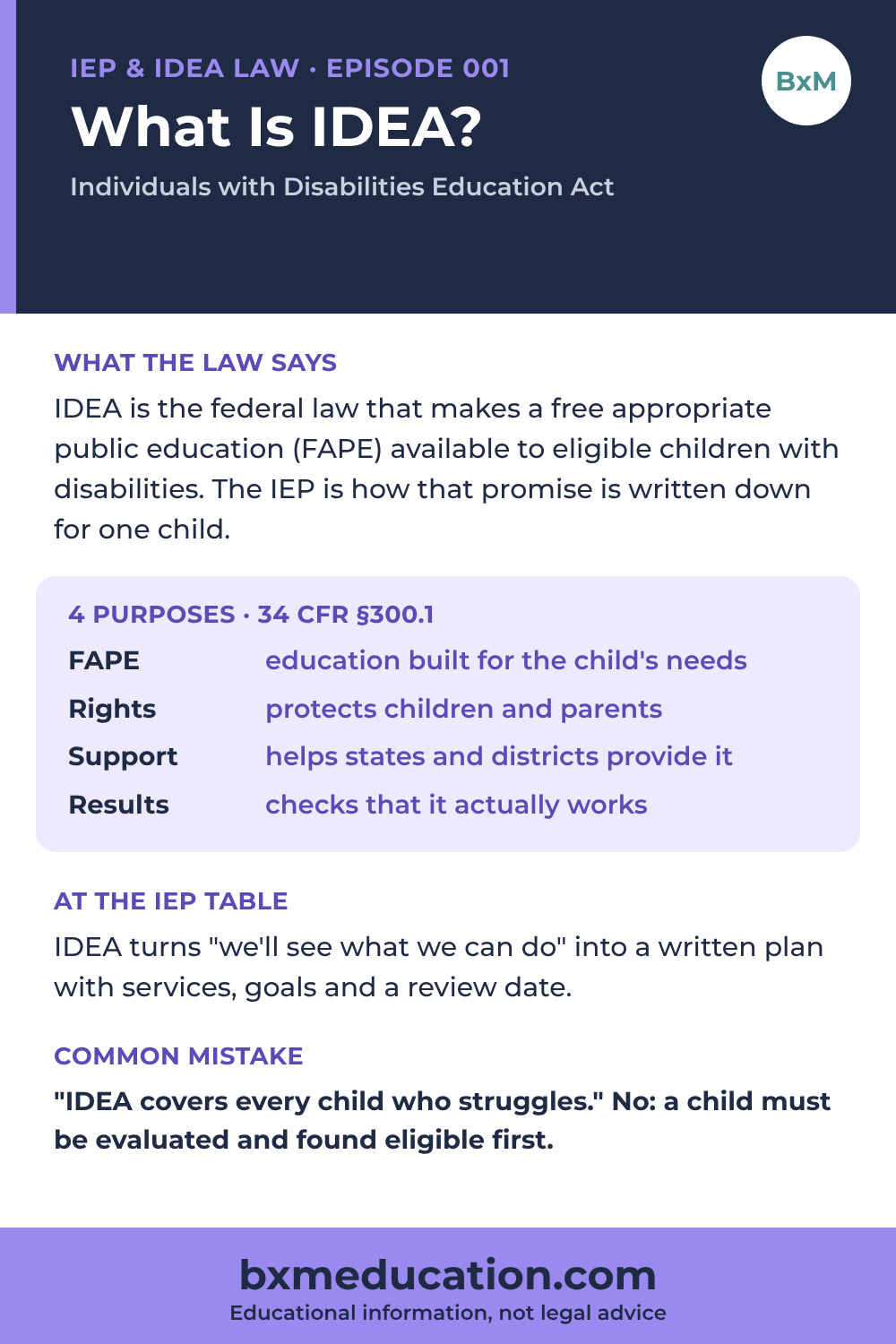
IDEA, the Individuals with Disabilities Education Act, is the federal law behind special education. Its first stated purpose is to make sure every eligible child with a disability has a free appropriate public education (FAPE), built around special education and related services that meet the child’s unique needs and prepare them for further education, employment and independent living (20 U.S.C. §1400(d)(1)(A)).
IDEA serves two age groups. Part C covers early intervention for infants and toddlers from birth through age 2 and their families. Part B covers special education and related services for children and youth ages 3 through 21 (U.S. Department of Education, sites.ed.gov/idea). The IEP, the individualized education program, is the document where Part B’s promise is written down for one child.
Two ideas do the work:
- IDEA is a promise of an appropriate education, not just access to a building. The services must fit the child’s needs.
- The IEP is how the promise becomes specific. Goals, services and supports go in writing, and the team reviews them.
The Citation
34 CFR §300.1: the regulations name four purposes: (a) FAPE, (b) protect the rights of children and parents, (c) assist states, localities and agencies, (d) assess and ensure the effectiveness of these efforts.
Official text: 20 U.S.C. §1400 · 34 CFR §300.1 · Checked Nov 14, 2026.
At the IEP Table: Done Right
At a first IEP meeting, the case manager, Ms. Alvarez, opens with one sentence: “Everything we write today comes from a federal law called IDEA. It says your son is entitled to a free education designed around his needs, and this document is where we write down how.” She hands the parent, Mr. Reyes, the procedural safeguards notice, then walks the team through each section and the date the IEP will be reviewed. Mr. Reyes leaves knowing which law applies, what his son will receive, and when the team will meet again.
Why it works: the parent hears the law named once, in plain words, and sees the promise turned into written services and a review date.
Misapplication: Spot the Mistake
A general education teacher tells a worried parent, “Don’t worry, IDEA covers every student who’s struggling, so he’ll get an IEP.” The parent expects services next week.
Spot the mistake: IDEA covers children who are evaluated and found eligible: a child with a disability in one of the categories the regulations define who, because of it, needs special education (34 CFR §300.8). Struggling alone doesn’t make a child eligible.
The fix: “If you think he may have a disability, you can ask the school in writing for an evaluation. The evaluation decides eligibility.”
Common Misunderstandings
- Myth: IDEA is a state program. The law: it is federal; states carry it out and may add requirements.
- Myth: IDEA guarantees the best possible program. The law: it guarantees an appropriate education (FAPE); Episode 002 covers what “appropriate” means.
- Myth: IDEA starts in kindergarten. The law: Part C begins at birth; Part B begins at age 3.
For Professionals
Case managers, related-service providers and behavior analysts on an IEP team all work under the same federal framework. When a recommendation is tied to the child’s needs and written into the IEP, it carries the weight of the law; when it lives only in conversation, it doesn’t.
Quick Check (2 Questions)
Question 1. A parent asks what IDEA’s main promise is. Which answer matches the statute?
A) Every child who struggles in school gets an IEP
B) Eligible children with disabilities have a free appropriate public education available to them
C) Schools must provide the best program available
D) Parents choose the child’s services
Show answer
B. 20 U.S.C. §1400(d)(1)(A) states the purpose as making FAPE available to children with disabilities. A ignores eligibility (34 CFR §300.8). C overstates “appropriate”. D: services are decided by the IEP team, which includes the parents.
Question 2. A family’s daughter is 18 months old and has a developmental delay. Which part of IDEA applies?
A) Part B
B) Neither; IDEA starts at age 3
C) Part C
D) Section 504 only
Show answer
C. Part C covers early intervention from birth through age 2. Part B begins at age 3. Section 504 is a different law and is not “only” the answer here.
Keep Studying
- For parents: IDEA for Parents: The Law Behind Your Child’s IEP
- Next: Episode 002 · What Does FAPE Mean? (coming next)
- All episodes and parent guides: IEP & IDEA Law Explained
- Watch the series: IEP & IDEA Law Explained playlist
Sources (checked Nov 14, 2026)
Individuals with Disabilities Education Act, 20 U.S.C. §1400 (2004).
Assistance to States for the Education of Children with Disabilities, 34 C.F.R. §§300.1, 300.8, 300.17.
U.S. Department of Education. About IDEA. sites.ed.gov/idea/about-idea/
Educational information, not individualized legal advice. State-specific requirements may also apply.