
An SD is not a command that forces a behavior. It’s a signal that tells the person, “if you do it now, it pays off.”
What It Means (in Plain Language)
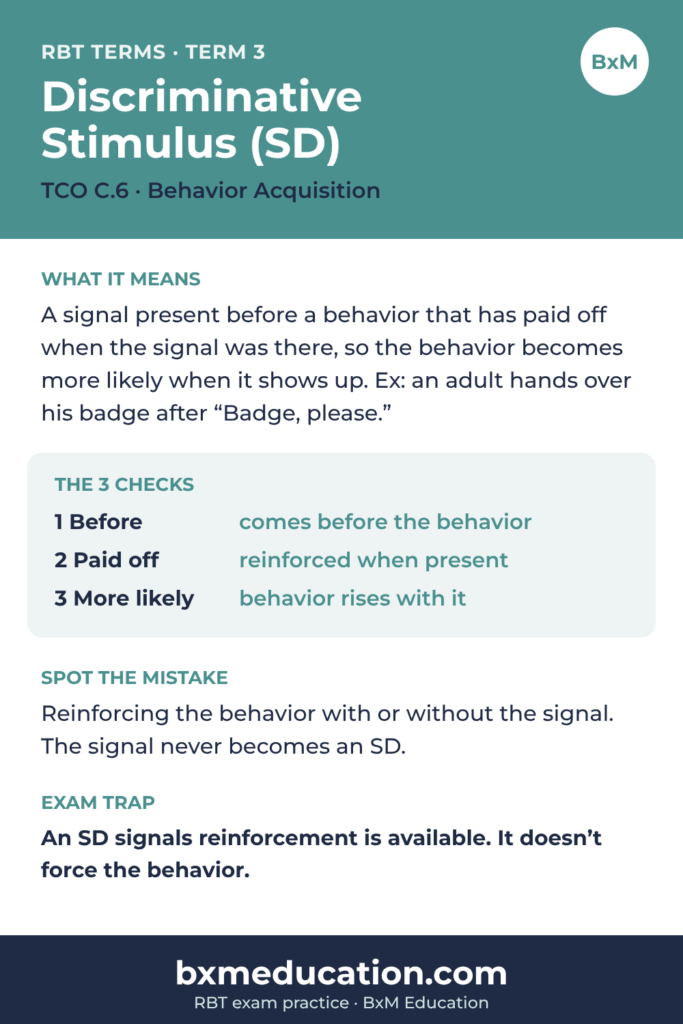
A discriminative stimulus (SD, said “ess-dee”) is something in the situation that is present when a behavior has been reinforced in the past. Because the behavior paid off when that signal was there, the person becomes more likely to do the behavior when the signal shows up and less likely when it’s missing.
Two words do the work:
- Discriminative = the person learns to tell situations apart (“this is when it works”).
- Stimulus = anything they can see, hear or notice: an instruction, a picture, a person, a sign.
When a behavior happens reliably in the presence of the SD and not in its absence, we say the behavior is under stimulus control.
The 3 Checks
Before you call something an SD, run three quick checks:
- Before: does the signal come before the behavior (an antecedent, not a consequence)?
- Paid off: has the behavior been reinforced when this signal was present?
- More likely: is the behavior now more likely when the signal is there than when it isn’t?
All three are yes → it’s working as an SD. If the “signal” comes after the behavior, it’s a consequence, not an SD.
Application: Done Right
Marcus is a 27-year-old adult in a day program learning to hand his ID badge to the front-desk staff when he arrives. His BCBA’s plan sets the SD as the greeter saying, “Badge, please.” His RBT, Dana, follows the plan: each time the greeter says “Badge, please” and Marcus hands it over, Dana gives him specific praise and a check on his token board. If he hands the badge over when no one has asked, she stays neutral.
Over two weeks, Dana’s data show Marcus handing over the badge within 5 seconds of “Badge, please” on 9 of 10 arrivals (up from 3 of 10), and almost never when no one asks.
Why it works: the instruction comes before the behavior, the behavior is reinforced only when it’s present, and the behavior is now much more likely when the instruction is given. That’s stimulus control.
Misapplication: Spot the Mistake
Same day program, different RBT. Jordan praises Marcus and gives a token every time he holds out his badge, whether or not anyone asked. Marcus now waves his badge at staff all day long, but when the greeter says “Badge, please,” he responds no more often than at any other time.
Spot the mistake: reinforcement was delivered with or without the signal, so “Badge, please” never became an SD. Nothing tells Marcus when the behavior pays off.
The fix: follow the plan as written (reinforce only when the SD is given) and report the pattern to the supervising BCBA.
How It Shows Up on the RBT Exam
- The SD comes before the behavior. If an answer choice describes something that happens after the behavior, it’s a consequence.
- An SD doesn’t force behavior; it signals that reinforcement is available. Look for wording like “more likely” or “has been reinforced in the presence of.”
- In discrete trial teaching, the instruction (“Touch red”) is usually the SD. A prompt is extra help added to the SD, not the SD itself (that’s Term 4).
Keep Studying
- Review RBT Term 1: Positive Reinforcement Explained
- Review RBT Term 2: Negative Reinforcement Explained
- BCBA-level background: Antecedent (Stimulus Control) | BCBA Glossary
- Start or finish your hours: RBT 40-Hour Training
- Test yourself under exam conditions: RBT Practice Exam Pack
Quick Check (2 Questions)
Question 1. At a group home, Lena, an adult client, asks staff for her snack only when Ms. Ruiz is on shift, because Ms. Ruiz is the only staff member who gives snacks when asked. Other staff say “snack time is later.” In this example, Ms. Ruiz’s presence is best described as:
A) A consequence
B) A discriminative stimulus (SD)
C) A reinforcer
D) Extinction
Show answer
B. Ms. Ruiz is present before the request, and requesting has been reinforced only when she is there, so requests are more likely when she’s on shift. A and C are wrong: they come after the behavior (the snack is the reinforcer, not Ms. Ruiz’s presence). D is wrong: extinction means no longer reinforcing a behavior that was reinforced before; it doesn’t describe a person or signal that comes before the behavior.
Question 2. An RBT running a matching program says “Match” and a client places the card correctly. The RBT says “Great matching!” and gives a token. Which part of this trial is the SD?
A) “Match”
B) “Great matching!”
C) The token
D) Placing the card
Show answer
A. The instruction comes before the response and signals that matching will be reinforced. B and C are consequences (reinforcers delivered after the response). D is the behavior itself.
Reference
Miltenberger, R. G. (2016). Behavior modification: Principles and procedures (6th ed.). Cengage Learning.
Behavior Analyst Certification Board. (2024). RBT Test Content Outline (3rd ed.). https://www.bacb.com