
Extinction means the reinforcer that used to follow a behavior no longer follows it, so the behavior happens less over time. It is not “ignoring,” and it is not punishment.
What It Means (in Plain Language)
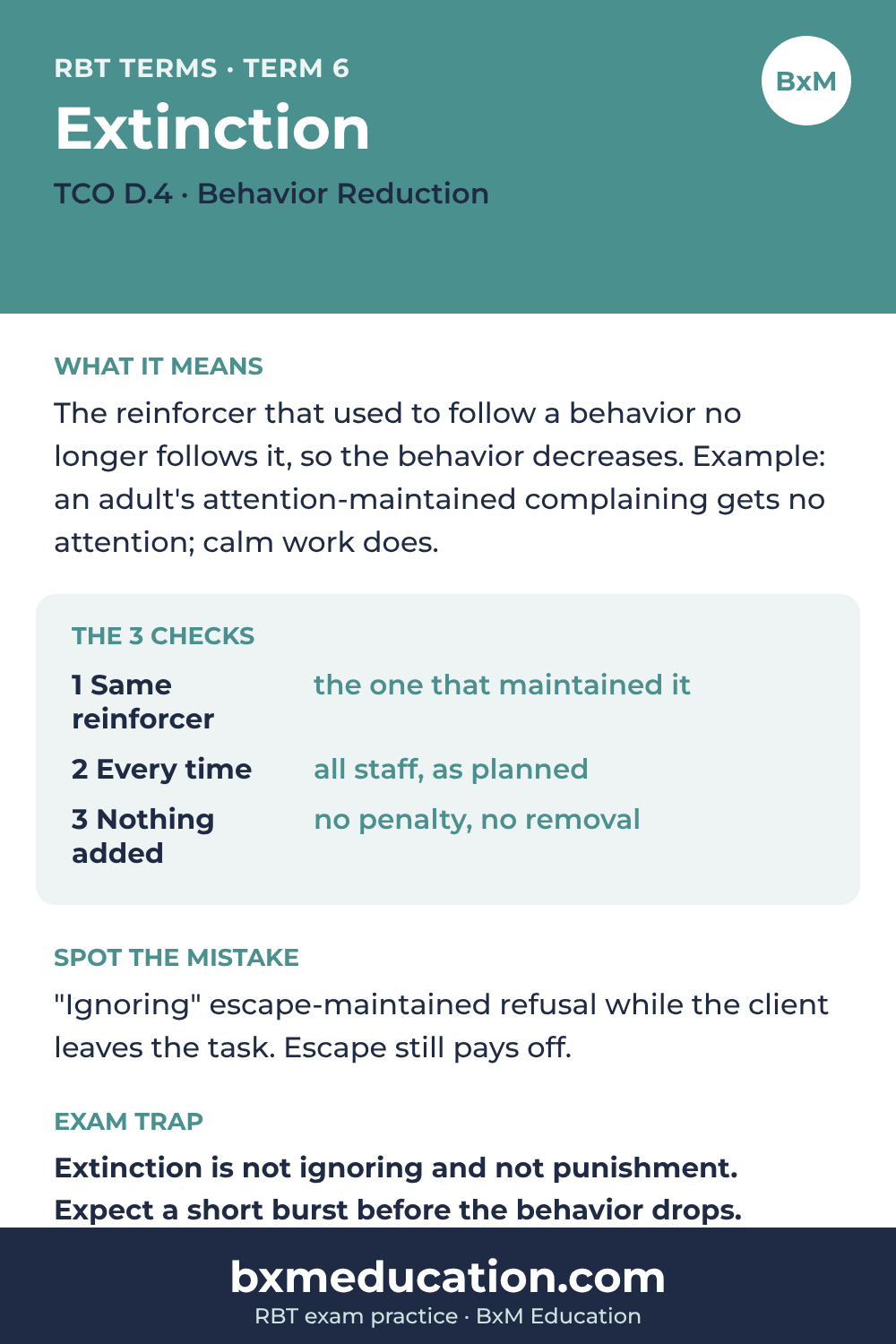
Extinction is a procedure where a behavior that was reinforced stops producing that reinforcer. Because the behavior no longer “pays off,” it gradually happens less often. The key is matching the reinforcer: you withhold the specific consequence that was maintaining the behavior (attention, escape from a task, or access to an item).
The words do the work:
- Previously reinforced = the behavior used to get something.
- No longer reinforced = that same something is now withheld, every time, by everyone.
The 3 Checks
Before you call something extinction, run three checks:
- Same reinforcer: is the consequence that maintained the behavior the one being withheld (attention for attention-maintained, task stays for escape-maintained)?
- Every time: is it withheld consistently, by every staff member, as the plan says?
- Nothing added: is nothing unpleasant added and nothing taken away as a penalty? (Adding or removing to reduce behavior is punishment, not extinction.)
All three are yes → it’s extinction. Ignoring a behavior that is maintained by escape is not extinction.
Application: Done Right
Gloria is a 52-year-old adult at a day program. Her BCBA’s assessment showed that her loud complaining during meal prep is maintained by staff attention: staff usually stop and talk with her. The plan: staff give no attention for complaining, give attention every few minutes when she is working calmly, and prompt her to ask, “Can you help me?” (that request gets attention right away).
The RBT, Luis, follows the plan exactly and counts complaints per 30-minute session. Week 1: 14, 18, 12 (a short rise, which the BCBA warned about). Week 2: 9, 7, 6. Week 4: 2, 1, 2. Luis graphs the data and shares it with the BCBA at supervision.
Why it works: the same reinforcer (attention) was withheld, it was withheld every time by all staff, and nothing was added as a penalty. She still gets plenty of attention for calm work and appropriate requests.
Misapplication: Spot the Mistake
Different client, same program. Paul, 29, pushes his sorting materials away and yells when given a work task. The assessment showed this is maintained by escape: in the past, staff removed the task. A new RBT, Jen, decides to “put it on extinction” by ignoring the yelling and walking away to another table. Paul gets out of the task every time, and the yelling increases.
Spot the mistake: Jen withheld attention, but the behavior is maintained by escape. Walking away still gave Paul the escape, so the behavior was still being reinforced. That is not extinction.
The fix: follow the written plan. For escape-maintained behavior, extinction means the task stays (per the BCBA’s escape extinction procedure). Ask the supervising BCBA before changing anything, and record what happened.
How It Shows Up on the RBT Exam
- Extinction = withholding the maintaining reinforcer. “Ignoring” only works for attention-maintained behavior.
- Expect an extinction burst: a short increase in the behavior when extinction starts (RBT Term 7). Giving in during the burst teaches the client that bigger behavior works.
- Extinction is not punishment. Nothing is added or taken away; the old payoff just stops.
Keep Studying
- Review RBT Term 2: Negative Reinforcement Explained
- Review RBT Term 1: Positive Reinforcement Explained
- Start or finish your hours: RBT 40-Hour Training
Quick Check (2 Questions)
Question 1. An adult client’s yelling is maintained by getting a snack. Under the plan, staff no longer give snacks after yelling. Over two weeks, yelling decreases. What procedure is this?
A) Negative punishment
B) Extinction
C) Negative reinforcement
D) Response cost
Show answer
B. The reinforcer that maintained yelling (the snack) no longer follows it, so yelling decreases. A is wrong: negative punishment removes something the client already has after the behavior; here the snack is simply not delivered. C is wrong: negative reinforcement increases behavior by removing something unpleasant. D is wrong: response cost takes away a reinforcer the client already earned, like a token.
Question 2. An adult client’s task refusal is maintained by escape. An RBT ignores the refusal and lets the client leave the work area. What is most likely to happen?
A) Refusal will decrease because it is on extinction
B) Refusal will stop right away
C) Refusal will continue or increase because escape still follows it
D) Refusal will turn into an extinction burst and then stop
Show answer
C. Leaving the work area is escape, the very consequence that maintains refusal, so the behavior is still reinforced. A is wrong: withholding attention is not extinction for escape-maintained behavior. B is wrong: nothing about the reinforcer changed. D is wrong: an extinction burst only happens when the maintaining reinforcer is actually withheld.
Reference
Miltenberger, R. G. (2016). Behavior modification: Principles and procedures (6th ed.). Cengage Learning.
Behavior Analyst Certification Board. (2024). RBT Test Content Outline (3rd ed.). https://www.bacb.com