
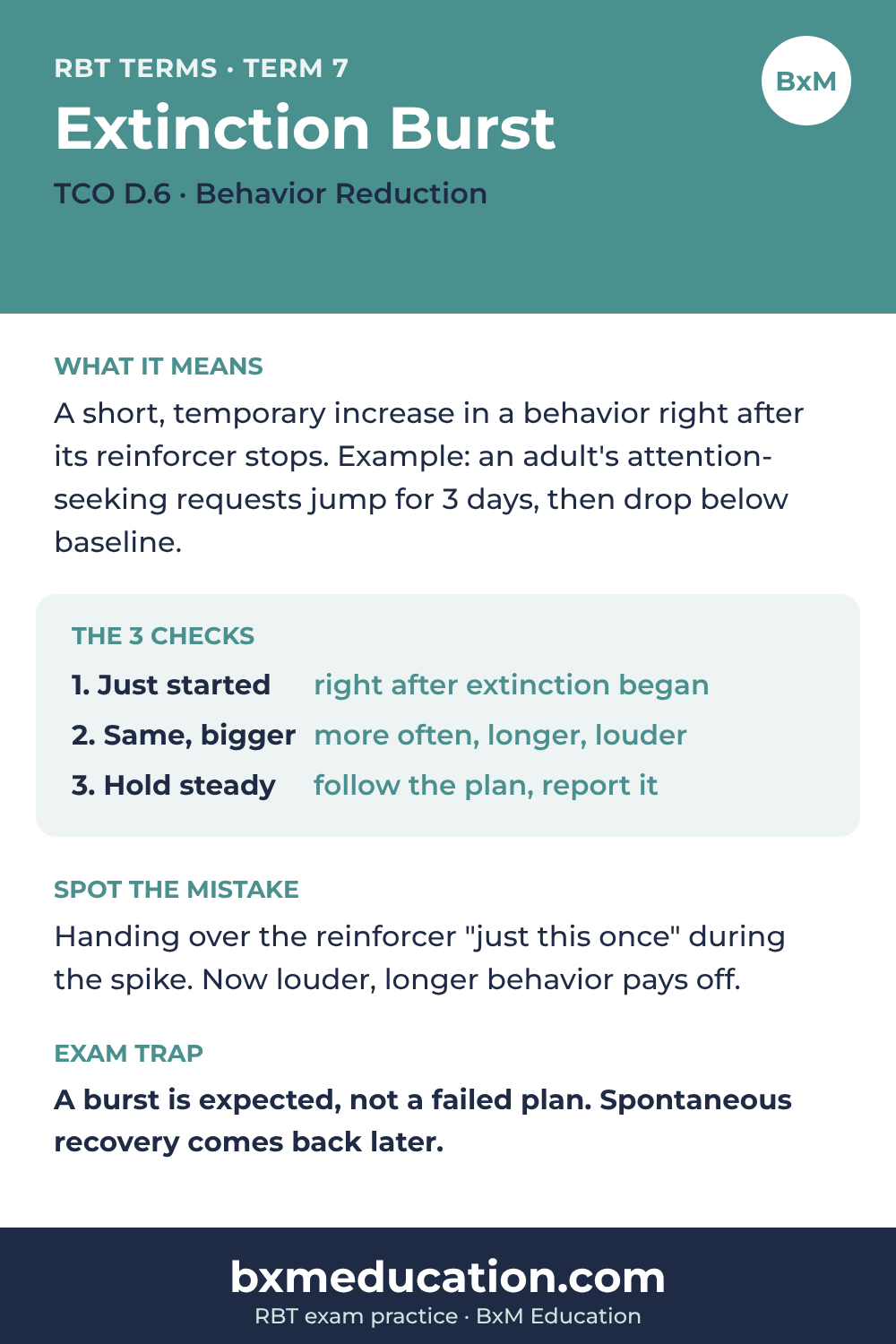
An extinction burst is the short spike in a behavior right after its reinforcer stops. It usually means extinction is working, and giving in during the spike makes the behavior stronger.
What It Means (in Plain Language)
When a behavior that used to pay off suddenly stops paying off, it often gets worse for a little while before it gets better. The person may do the behavior more often, longer, or louder, and may try new behaviors or show frustration. This temporary increase is called an extinction burst.
The words do the work:
- Extinction = the reinforcer that maintained the behavior is now withheld (RBT Term 6).
- Burst = a brief rise in frequency, duration, or intensity at the start of extinction, before the behavior declines.
The 3 Checks
When a target behavior jumps up, run three checks before you call it a burst:
- Just started: did the jump happen soon after extinction began (the first sessions or days)?
- Same behavior, bigger: is it more often, longer, or more intense (possibly with new behaviors or frustration)?
- Hold steady: is the plan still being followed exactly, with the reinforcer still withheld? Then keep going and report it.
All three are yes → it’s most likely an extinction burst. A rise weeks later, or a rise because staff stopped following the plan, is something else. Report either one to your BCBA.
Application: Done Right
Marcus is a 34-year-old adult at a supported-employment job site. His BCBA’s assessment showed that his repeated loud requests to leave his station (“I’m done, I’m done”) are maintained by staff attention, not escape: staff usually stop and chat with him each time. The plan: no attention for the repeated requests, attention every few minutes while he works, and a quick “Break please” card that gets a short, scheduled check-in.
The BCBA warned the team that requests may rise at first. The RBT, Dana, counts requests per 60-minute shift. Baseline: 10, 12, 11. Days 1–3 of extinction: 19, 24, 17 (louder, plus tapping the table, which is new). Dana keeps following the plan, logs the tapping in her notes, and messages the BCBA the same day. Days 4–6: 9, 6, 5. Week 3: 2, 1, 2.
Why it works: the rise came just after extinction started, it was the same behavior, bigger (plus one new behavior), and Dana held steady and reported it. The burst passed and the behavior dropped below baseline.
Misapplication: Spot the Mistake
Same job site, a different client. Renee, 41, repeatedly asks a staff member for her phone during work; the plan puts those repeated requests on extinction (the phone stays in her locker until break). On day 2, Renee asks louder and more often. A new RBT, Kyle, worried about the noise, hands her the phone “just this once” to calm her down.
Spot the mistake: Kyle gave the reinforcer during the burst. Renee just learned that asking louder and longer gets the phone. That is intermittent reinforcement of a bigger version of the behavior, which makes it harder to reduce.
The fix: follow the written plan through the burst, keep everyone safe, record what happened, and contact the supervising BCBA right away if the burst is intense or unsafe. Don’t change the plan on your own.
How It Shows Up on the RBT Exam
- An extinction burst is a temporary increase at the start of extinction. It is expected, not a sign the plan failed.
- Giving in during a burst reinforces a more intense version of the behavior. The exam’s best answer is usually “continue the plan and report to the supervisor.”
- Don’t confuse it with spontaneous recovery: the behavior briefly coming back later, after it had already dropped.
Keep Studying
- Review RBT Term 6: Extinction Explained
- Review RBT Term 2: Negative Reinforcement Explained
- Start or finish your hours: RBT 40-Hour Training
Quick Check (2 Questions)
Question 1. An adult client’s whining was maintained by staff attention. On the first two days that staff withhold attention for whining (per the plan), whining gets louder and more frequent. What is this called?
A) Extinction burst
B) Spontaneous recovery
C) Negative reinforcement
D) Punishment
Show answer
A. A temporary increase in a behavior right after its reinforcer is withheld is an extinction burst. B is wrong: spontaneous recovery is the behavior briefly returning later, after it had already decreased. C is wrong: negative reinforcement removes something unpleasant and increases behavior; nothing was removed here. D is wrong: punishment adds or removes something to decrease behavior; extinction only withholds the old reinforcer.
Question 2. During an extinction burst, an adult client’s repeated requests for a snack become louder. What should the RBT do?
A) Give the snack once so the client calms down
B) Stop the extinction plan for the day
C) Switch to a punishment procedure
D) Keep following the written plan, keep everyone safe, record the data, and tell the supervisor
Show answer
D. The RBT implements the plan as written, documents the burst, and reports it; a burst is expected and usually passes. A is wrong: giving the snack during the burst reinforces louder requests. B is wrong: stopping the plan has the same effect as giving in. C is wrong: an RBT never adds a new procedure; only the BCBA changes the plan.
Reference
Miltenberger, R. G. (2016). Behavior modification: Principles and procedures (6th ed.). Cengage Learning.
Behavior Analyst Certification Board. (2024). RBT Test Content Outline (3rd ed.). https://www.bacb.com