
“He finished all 8 rounds” tells you about effort. It doesn’t tell you whether the session did its job. The athlete’s behavior, round by round, does.
What It Means (in Plain Language)
In ABA, data-based decision making means you decide whether to keep, change or stop a plan by looking at the data, not by gut feeling or by how hard everyone worked. You set the rule for changing course before you start, and you follow it when the data cross the line.
Lesson 2.4 of the BxM diploma explains why this matters in training. Hard training disrupts the body’s internal balance on purpose; that disruption is what triggers adaptation. But there’s a dose:
- Productive disruption: enough to stimulate adaptation while the athlete can still recover and execute well.
- Excessive disruption: behavior breaks down, recovery is incomplete and performance regresses.
The athlete’s observable behavior (decision speed, technical errors, communication, movement quality) is the coach’s earliest signal of which one is happening.
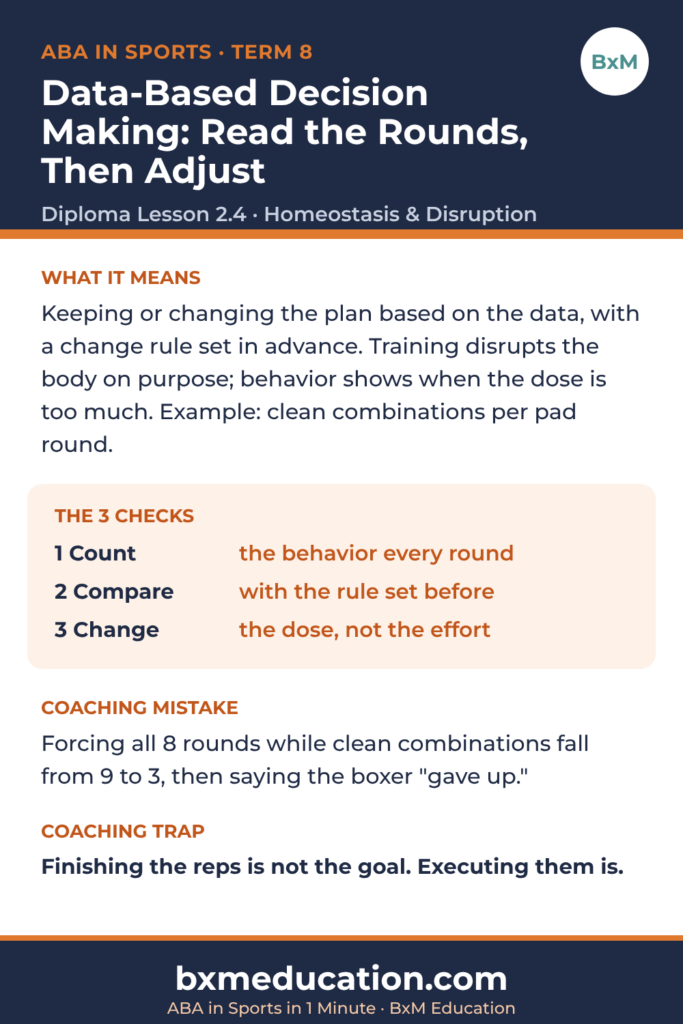
The 3 Checks
During the session, run three checks:
- Count: record the target behavior every round or set, not just at the end.
- Compare: check it against the criterion you wrote down before the session.
- Change: when the data cross the line, adjust the dose (rest, intensity, drill), not the athlete’s effort.
Three yeses → the data drive the session, not the clock.
Application: Done Right
Jamal, 26, is an amateur middleweight boxer. His coach, Rosa, plans 8 hard pad rounds with 60 seconds of rest. The target behavior is clean combinations: on each of 10 combinations Rosa calls in a round, every punch lands on the pad and both hands return to guard.
Before the session, Rosa writes the rule: if clean combinations fall below 7 of 10 for two rounds in a row, switch to slower technical rounds with 90 seconds of rest.
Rounds 1 to 4: 9, 9, 8, 8. Round 5: 6. Round 6: 5. The rule is met. Jamal also rates his effort 9 out of 10, so the internal and external signals match. Rosa switches rounds 7 and 8 to technical work with 90 seconds of rest. Clean combinations: 8, then 9.
Why it works: Rosa counted the behavior every round, compared it with a criterion set in advance, and changed the dose as soon as the data crossed the line, so the session disrupted Jamal enough to train him without drilling sloppy technique.
Misapplication: Spot the Coaching Mistake
Same gym. Coach Victor runs the same 8 rounds with Mateo, 33. Victor’s only goal is that Mateo finishes every round. Clean combinations: 9, 8, 7, 5, 4, 4, 3, 3. Victor keeps the plan and tells the gym afterward that Mateo “gave up at the end.”
Spot the mistake: Victor measured completion, not behavior quality, and had no rule for when to change course. Four rounds of falling data were treated as an attitude problem instead of a dosage problem.
The fix: count clean combinations every round, set a change rule before the session, and adjust rest, intensity or the drill when the data cross it.
How It Shows Up in Practice and on Exams
- Coaching trap: “Did he finish the reps?” Finishing tells you about compliance. The trend in execution quality tells you whether the dose was right.
- BCBA/RBT exam angle: the “Wait and See” trap (Study Guide H.7). When data show no progress or a counter-therapeutic trend, the correct answer is to analyze the data and modify the plan, not to keep going and hope.
- Extra tip: write the change rule on the whiteboard before the session. A rule set in advance protects you from deciding by mood in round 6.
Go Deeper
This is Lesson 2.4 of the BxM Professional Diploma in Behavioral Sport Training. The full lesson covers homeostasis, the Dosage Principle, why recovery is where adaptation happens, and the five diagnostic questions a performance engineer asks during every session.
Keep Studying
- Term 7 of this series: Antecedent Strategies in Sports Explained
- Term 5 of this series: Dependent Variable in Sports Explained
- BCBA series: Level, Trend and Variability
- Watch every sports term: ABA in Sports in 1 Minute playlist
Quick Check (2 Questions)
Question 1. An adult swimmer’s turn errors rise from 1 per set to 4 per set over the last three sets of a hard session. Her coach set a rule before practice: change the set if errors reach 3 per set twice in a row. What should the coach do?
A) Finish the planned sets, since the plan was written in advance
B) Wait until next week’s session to see if the errors continue
C) Tell the swimmer to try harder on the turns
D) Adjust the dose (rest, intensity or the drill) because the data met the change rule
Show answer
D. The criterion was set in advance and the data met it, so the coach changes the dose. A follows the plan but ignores the data, which is the “Wait and See” trap. B delays a decision the data already support. C treats a dosage problem as an effort problem.
Question 2. According to Lesson 2.4, what does controlled disruption of homeostasis do in training?
A) It should be avoided because any disruption harms performance
B) It triggers adaptation, as long as the dose still allows recovery and good execution
C) It improves performance no matter how large it is
D) It only matters for athletes who don’t recover well
Show answer
B. Training disrupts internal balance on purpose to stimulate adaptation, and the dose must allow recovery. A ignores that too little disruption produces no adaptation. C ignores excessive disruption, which leads to regression. D limits a general principle to one group.
Reference
BxM Education & Consulting. (2026). Professional Diploma in Behavioral Sport Training, Lesson 2.4: Homeostasis, biological disruption, and athletic behavior. BxM Education.
BxM Education. (2024). BxM Education BCBA 6th Edition Study Guide (Domain H, H.7). BxM Education.
Cooper, J. O., Heron, T. E., & Heward, W. L. (2020). Applied behavior analysis (3rd ed.). Pearson.