
Test your clinical discrimination skills with these three exam-style questions built specifically around the heavy-hitting domains of the 6th Edition Test Content Outline.
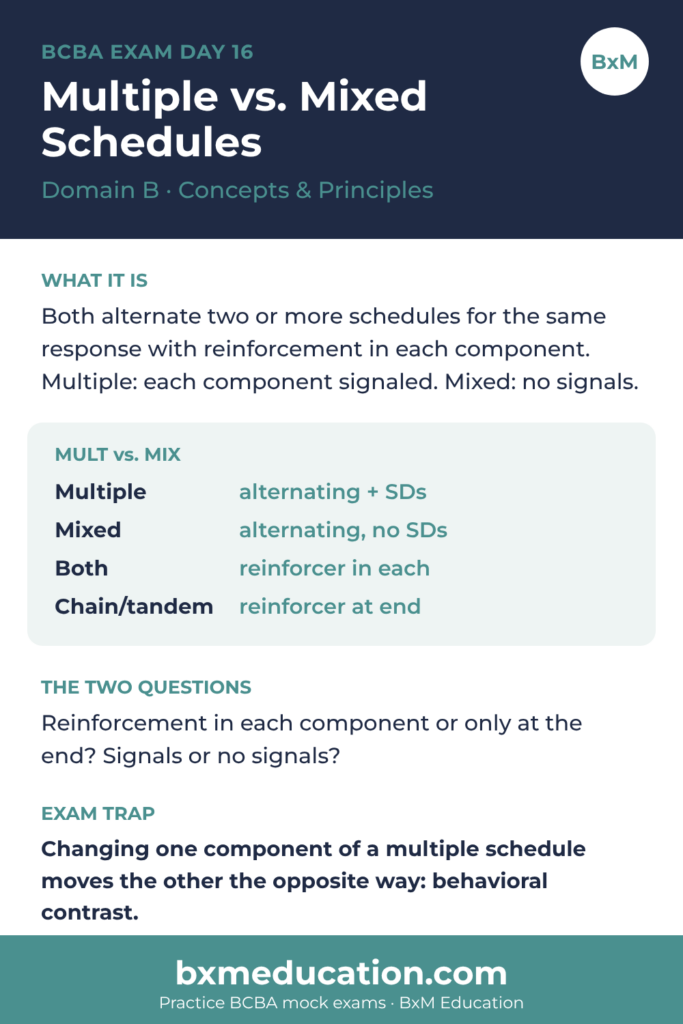
Day 15 covered concurrent and chained schedules. Day 16 finishes the compound schedules with the pair candidates confuse most: multiple and mixed. Both alternate two or more basic schedules for the same response, and reinforcement is available within each component. The only difference is a signal.
- Multiple schedule (mult): the components alternate, and each one has its own discriminative stimulus (a light, a card, a person, a setting), so the learner can tell which schedule is in effect (mult FR 5 FI 2 min). Responding usually comes to differ across components, matching each schedule.
- Mixed schedule (mix): the same alternation without distinct signals (mix FR 5 FI 2 min). The learner can’t tell which component is running, so responding tends to look more similar across components.
Watch the neighbors: in a chained schedule the components are also signaled, but reinforcement comes only after the last component; in a tandem schedule the chain has no signals. Multiple and mixed deliver reinforcement in every component. Multiple schedules are also where behavioral contrast shows up: changing reinforcement in one component changes responding in the opposite direction in the other, unchanged component.
The test is two questions: Is there reinforcement in each component, or only at the end? (each = multiple/mixed; end only = chained/tandem). Does each component have its own signal? (yes = multiple; no = mixed).
Question 1 (Domain B: Schedules of reinforcement)
In a group home, an adult resident earns tokens for folding towels. When a green card is on the table, every 5th towel earns a token. When a red card is on the table, the first towel folded after 2 minutes earns a token. The cards switch every 15 minutes. Which schedule is in effect?
A) Chained FR 5 FI 2 min
B) Mixed FR 5 FI 2 min
C) Concurrent FR 5 FI 2 min
D) Multiple FR 5 FI 2 min
Question 2 (Domain B: Schedules of reinforcement)
The team removes the green and red cards, but the FR 5 and FI 2-minute components keep alternating every 15 minutes, each still earning tokens. Which schedule is now in effect?
A) Mixed FR 5 FI 2 min
B) Tandem FR 5 FI 2 min
C) Multiple FR 5 FI 2 min
D) Chained FR 5 FI 2 min
Question 3 (Domain B: Schedules of reinforcement)
An adult employee works mornings with job coach A and afternoons with job coach B; both praise his work on similar VI schedules, and the coaches work as signals for each component. Coach A stops praising. Morning work rate drops, and afternoon work rate rises even though coach B changed nothing. What is this effect called?
A) The matching law
B) Spontaneous recovery
C) Behavioral contrast
D) An extinction burst
Written Answer Explained
Question 1 Breakdown (Domain B: Schedules of reinforcement)
Core Scenario Summary: Two schedules for the same response alternate; each has its own card; tokens are available in both.
Correct Answer: D) Multiple FR 5 FI 2 min
Clinical Analysis & Distractor Rationales:
- Why A is Incorrect: In a chained schedule, reinforcement comes only after the last component. Here each component earns tokens on its own.
- Why B is Incorrect: A mixed schedule has no distinct signals. The green and red cards signal which schedule is running.
- Why C is Incorrect: Concurrent schedules are available at the same time for different responses. Here one schedule runs at a time, for the same response.
- Why D is Correct: Alternating components, each with its own SD, each with reinforcement: a multiple schedule.
Question 2 Breakdown (Domain B: Schedules of reinforcement)
Core Scenario Summary: Same alternating components with reinforcement in each, but the signals are removed.
Correct Answer: A) Mixed FR 5 FI 2 min
Clinical Analysis & Distractor Rationales:
- Why A is Correct: Alternating components, each with reinforcement, with no distinct signals: a mixed schedule.
- Why B is Incorrect: A tandem schedule is an unsignaled chain: reinforcement only after the last component. Here each component earns tokens.
- Why C is Incorrect: A multiple schedule requires a distinct signal for each component; the cards were removed.
- Why D is Incorrect: A chained schedule is signaled and reinforces only after the final component.
Question 3 Breakdown (Domain B: Schedules of reinforcement)
Core Scenario Summary: Two signaled components (coach A, coach B); extinction in one component; responding rises in the unchanged component.
Correct Answer: C) Behavioral contrast
Clinical Analysis & Distractor Rationales:
- Why A is Incorrect: The matching law describes how responding is distributed among concurrently available options. These components occur at different times.
- Why B is Incorrect: Spontaneous recovery is the reappearance of a previously extinguished behavior after time has passed. Afternoon work was never extinguished.
- Why C is Correct: In a multiple schedule, a change in one component (less reinforcement with coach A) produces an opposite change in responding in the unaltered component (more work with coach B): behavioral contrast.
- Why D is Incorrect: An extinction burst is a temporary increase in the extinguished behavior itself, in the component under extinction. Here the increase is in the other component.
Keep studying: Review Day 15, Concurrent vs. Chained Schedules, then test yourself on the full item bank in the BxM Mock Exam System.