
Test your clinical discrimination skills with these three exam-style questions built specifically around the heavy-hitting domains of the 6th Edition Test Content Outline.
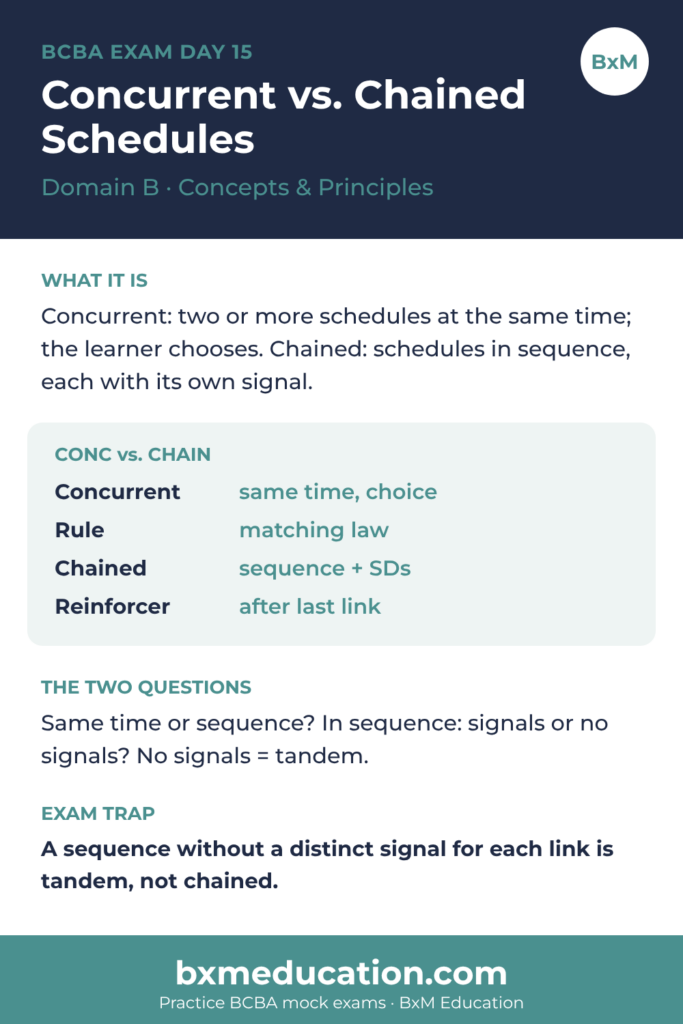
Days 13 and 14 covered the four simple schedules (FR, VR, FI, VI). Day 15 moves to compound schedules, where two or more simple schedules are combined. The two most tested are concurrent and chained:
- Concurrent schedule (conc): two or more schedules are available at the same time, each for a different response, and the learner can choose between them (conc VI 1 min VI 3 min). Concurrent schedules are how behavior analysts study choice, and the matching law describes the result: relative rates of responding tend to match the relative rates of reinforcement each option provides.
- Chained schedule (chain): two or more schedules occur one after another, each with its own discriminative stimulus, and finishing one component produces the next component’s SD; the primary reinforcer comes only after the last component (chain FR 5 FI 2 min). Each SD works as a conditioned reinforcer for the response that produced it.
The test is two questions: Are the schedules available at the same time (concurrent) or in a sequence (chained)? If in a sequence: Does each component have its own signal? If yes, it is chained. If the components run in sequence without distinct signals, it is a tandem schedule.
Question 1 (Domain B: Schedules of reinforcement)
At a supported-employment site, an adult employee can either assemble kits at station A, where a supervisor checks in with praise on a VI 5-minute schedule, or package items at station B, where praise comes on a VI 15-minute schedule. Both stations are open the whole shift and the employee can move between them. Which schedule is in effect?
A) Chained VI 5 min VI 15 min
B) Concurrent VI 5 min VI 15 min
C) Tandem VI 5 min VI 15 min
D) Multiple VI 5 min VI 15 min
Question 2 (Domain B: Schedules of reinforcement)
In the situation from Question 1, the employee earns about three times as much praise at station A as at station B. According to the matching law, which outcome is most likely?
A) The employee will respond only at station A
B) The employee will split responding evenly between the two stations
C) The employee will allocate about three times as much responding to station A as to station B
D) The employee will respond more at station B because praise there is less predictable
Question 3 (Domain B: Schedules of reinforcement)
In a group home, a blue card sits on the counter while an adult resident sorts laundry. After he sorts 10 pieces, the blue card is replaced by a green card, and after 3 minutes have passed, the first fold he completes earns time with his music player. Which schedule is this?
A) Chained FR 10 FI 3 min
B) Tandem FR 10 FI 3 min
C) Concurrent FR 10 FI 3 min
D) Mixed FR 10 FI 3 min
Written Answer Explained
Question 1 Breakdown (Domain B: Schedules of reinforcement)
Core Scenario Summary: Two stations, each on its own VI schedule, both available at once; the employee chooses.
Correct Answer: B) Concurrent VI 5 min VI 15 min
Clinical Analysis & Distractor Rationales:
- Why A is Incorrect: A chained schedule runs components one after another, with the reinforcer only after the last one. Here both options are open at the same time.
- Why B is Correct: Two schedules for two different responses are available simultaneously and the learner can choose: a concurrent schedule.
- Why C is Incorrect: A tandem schedule is a sequence of components without distinct signals. Nothing here is sequential.
- Why D is Incorrect: A multiple schedule alternates components, each with its own SD, for the same response, one at a time. Here both are available together.
Question 2 Breakdown (Domain B: Schedules of reinforcement)
Core Scenario Summary: Station A provides about 3 times the reinforcement of station B.
Correct Answer: C) The employee will allocate about three times as much responding to station A as to station B
Clinical Analysis & Distractor Rationales:
- Why A is Incorrect: Exclusive preference is not what the matching law predicts for two VI schedules; responding is distributed in proportion to reinforcement.
- Why B is Incorrect: An even split would be expected only if both options provided about the same amount of reinforcement.
- Why C is Correct: The matching law states that the relative rate of responding on each alternative tends to match the relative rate of reinforcement on it: roughly 3:1 here.
- Why D is Incorrect: Both options are variable (unpredictable). The richer schedule, not the less predictable one, draws more responding.
Question 3 Breakdown (Domain B: Schedules of reinforcement)
Core Scenario Summary: Blue-card FR 10 sorting produces the green card that signals an FI 3-minute folding component; music follows the last component.
Correct Answer: A) Chained FR 10 FI 3 min
Clinical Analysis & Distractor Rationales:
- Why A is Correct: The components occur in sequence, each has its own signal (blue card for sorting, green card for folding), and the reinforcer follows only the last component: a chained schedule. The green card also works as a conditioned reinforcer for sorting.
- Why B is Incorrect: A tandem schedule has the same sequence but no distinct stimulus for each component. The blue and green cards make this chained.
- Why C is Incorrect: Concurrent schedules are available at the same time for different responses. Here one component must be finished before the next begins.
- Why D is Incorrect: A mixed schedule alternates components for the same response with no signals, and each component ends in reinforcement. Here there is a signal and one reinforcer at the end.
Keep studying: Review Exam Day 14: fixed interval vs. variable interval, Exam Day 13: fixed ratio vs. variable ratio and the matching law, then test yourself on the full item bank in the BxM Mock Exam System.