
An adult client in a supported-employment program shouts at coworkers most afternoons. One team waits for the shouting and then decides what to do. Another team looks at what happens before the shouting and changes it: more frequent check-ins from the job coach, a quieter workstation, a visual schedule for the shift. The second team is using an antecedent intervention, one of the most practical tools in Domain G of the BCBA exam.
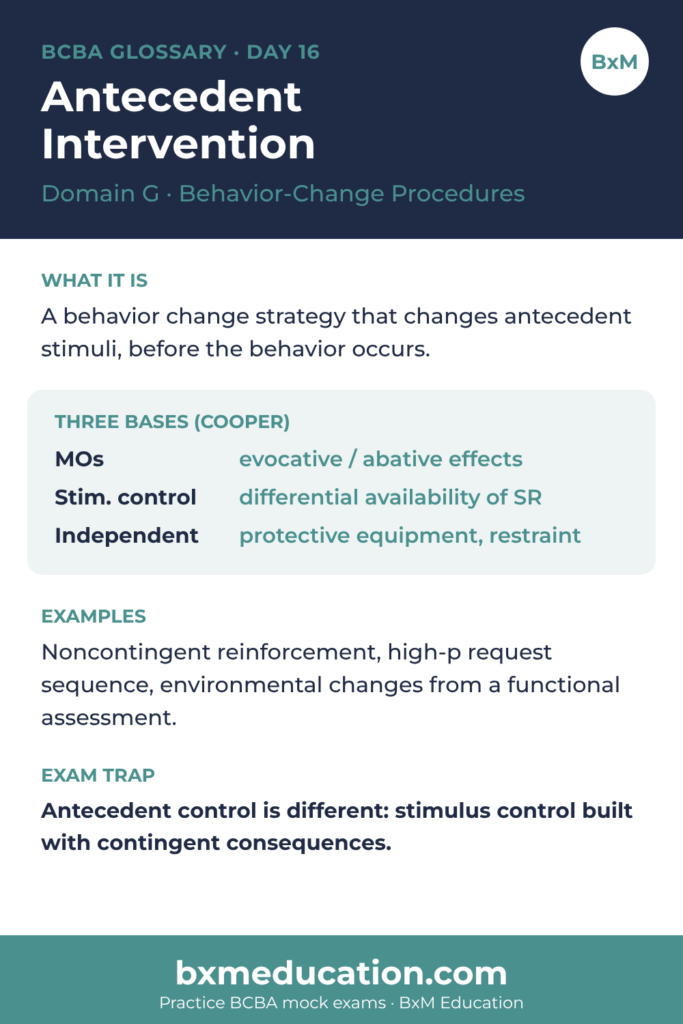
Cooper, Heron, and Heward (2020) define an antecedent intervention as a behavior change strategy that manipulates antecedent stimuli. They name three bases for doing so: (a) motivating operations, using their evocative and abative effects; (b) stimulus control, meaning the differential availability of reinforcement in the presence of certain stimuli; and (c) contingency-independent interventions, such as protective equipment and restraint, which work without any consequence being delivered for the behavior.
In other words, the change happens on the antecedent side of the three-term contingency. Noncontingent reinforcement, the high-probability request sequence, and functional communication training are all discussed alongside this term, and antecedent exercise is one specific example. Cooper contrasts antecedent intervention with antecedent control, a behavior change intervention that changes stimulus control by manipulating contingency-dependent consequences. That contrast is a favorite item-writer trap.
The Mechanics: Three Ways to Work on the Antecedent Side
- Motivating operations: reduce the value of the reinforcer that maintains problem behavior (an abolishing operation, for example frequent attention for attention-maintained behavior), or increase the value of a reinforcer for a replacement behavior.
- Stimulus control: present or remove stimuli that already signal the availability of reinforcement, for example removing a cue that signals escape is likely, or adding one that signals a break is available for a request.
- Contingency-independent: physical changes that act whether or not the behavior occurs, such as protective equipment worn to prevent injury.
- Antecedent control (contrast): stimulus control built by delivering consequences contingent on behavior. Consequences are doing the work there, not only the antecedent change.
Clinical Applications
- Start from the function. A functional assessment tells you which MO or which stimulus to change; an antecedent change that ignores function is guesswork.
- Noncontingent reinforcement (NCR). Delivering the maintaining reinforcer on a time schedule, independent of behavior, is a common MO-based antecedent intervention.
- Combine with teaching. Antecedent interventions reduce problem behavior quickly, but pair them with a replacement skill and plan how to fade them.
- Protective equipment and restraint. These are contingency-independent options with ethical and legal requirements; follow agency policy, informed consent, and the least restrictive alternative.
Research Consulting & APA Citation Reference
Clinical & Methodological Recommendation: In the behavior plan, write each antecedent change as a specific, observable step with the function it targets (for example, “job coach checks in every 10 minutes; target: attention as an AO”). Measure problem behavior before and after the change with a single-case design, and write a fading plan from day one so the change does not become a permanent crutch.
APA Reference Citation (7th Edition):
Cooper, J. O., Heron, T. E., & Heward, W. L. (2020). Applied behavior analysis (3rd ed.). Pearson.
Advanced Applied Reasoning Quiz
Question 1
A functional analysis shows that an adult’s yelling in a day program is maintained by staff attention. The BCBA arranges for staff to give the client brief attention every 5 minutes on a timer, whether or not yelling has occurred. Yelling decreases. Which procedure is this?
A) Extinction
B) An antecedent intervention based on a motivating operation (noncontingent reinforcement)
C) Differential reinforcement of other behavior
D) Response cost
Question 2
An adult who hits his head against hard surfaces wears a padded helmet during high-risk periods to prevent injury. Which category of antecedent intervention does this belong to, according to Cooper?
A) Stimulus control
B) Motivating operation, evocative effect
C) Positive punishment
D) Contingency-independent intervention
Check Your Answers
Replay the video above to review the logic behind each scenario, then test yourself under exam conditions in the BCBA Mock Exam System. Previous term: antecedent exercise. Next term: antecedent stimulus class.