
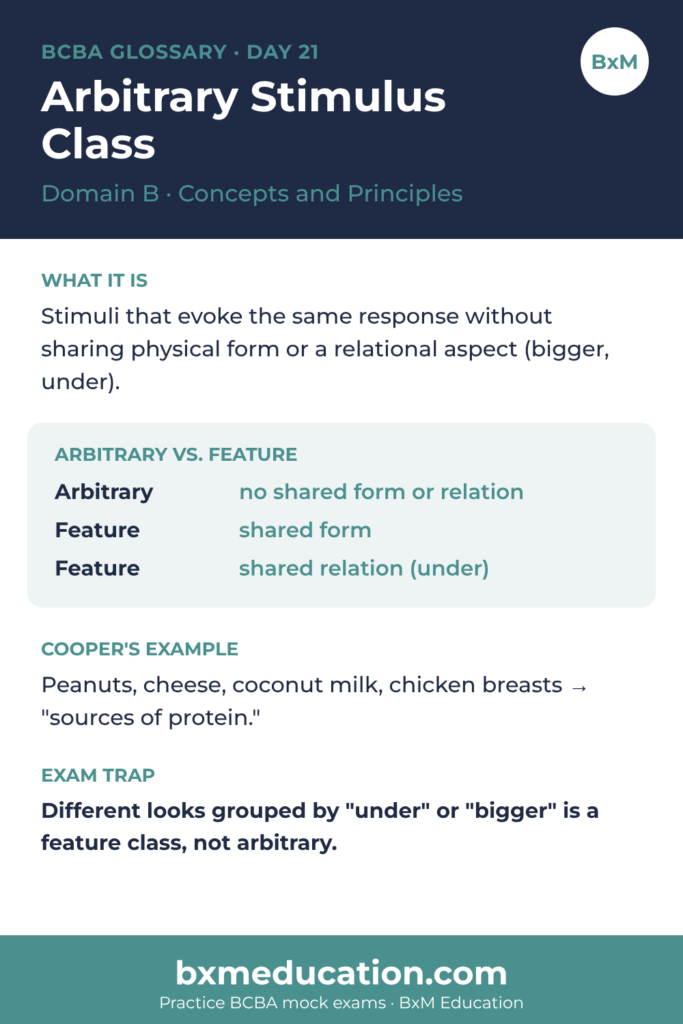
Peanuts, cheese, coconut milk, and chicken breasts do not look, taste, or feel alike. Yet one question, “What are good sources of protein?”, can evoke all four. That is the textbook example of an arbitrary stimulus class, a Domain B (Concepts and Principles) term that BCBA item writers pair with its opposite, the feature stimulus class.
Cooper, Heron, and Heward (2020) describe an arbitrary stimulus class as a group of antecedent stimuli that evoke the same response even though they do not resemble each other in physical form and do not share a relational aspect such as “bigger” or “under.” Their protein example makes the point: the four foods belong together only because a learning history made each one evoke the same response.
This builds directly on two earlier terms. An antecedent stimulus class is any set of stimuli that share a common effect on behavior; the arbitrary kind is the one held together by history rather than by looks. And the history is usually social-verbal, which is why arbitrary classes connect to arbitrary relations and to the derived responding described in arbitrarily applicable relational responding. Equivalence classes are a classic example of arbitrary stimulus classes.
The Mechanics: Arbitrary vs. Feature Stimulus Classes
- Arbitrary stimulus class: same response, no shared physical form, no shared relational aspect. Membership comes from learning history.
- Feature stimulus class: members share physical features (many different-looking dogs all evoke “dog”) or a common relative relationship, such as spatial position (“under,” “bigger than”).
- The relational aspect is the tricky part. Stimuli grouped by “bigger” or “under” are not arbitrary, even if they differ in color and shape. Cooper’s definition rules relational aspects out.
- New members can join. Once a class is established, a new stimulus related to one member can start to evoke the shared response too, which is what equivalence-based instruction tests for.
Clinical Applications
- Workplace categories. Teach adults in vocational programs that a hard hat, goggles, steel-toe boots, and earplugs all evoke “required gear,” then probe a new item (a reflective vest) to see whether the class extends.
- Ways to pay. Cash, a debit card, a credit card, and a phone wallet app form an arbitrary class for “ways to pay” in community-skills programs.
- Safety signals. A fire alarm, a flashing strobe, and a supervisor saying “evacuate” should all evoke leaving the building; check each member, not just one.
- Avoid list memorization. Probe untrained members so you know the learner has a class, not a memorized list.
Research Consulting & APA Citation Reference
Clinical & Methodological Recommendation: When you teach a category, decide first whether it is a feature class or an arbitrary class. For arbitrary classes, list the members you will train, the members you will probe without training, and the response that defines the class. If responding is controlled by an irrelevant shared feature (all training items were red, for example), you have not yet established an arbitrary class.
APA Reference Citation (7th Edition):
Cooper, J. O., Heron, T. E., & Heward, W. L. (2020). Applied behavior analysis (3rd ed.). Pearson.
Advanced Applied Reasoning Quiz
Question 1
A job coach teaches an adult employee that a hard hat, safety goggles, steel-toe boots, and earplugs all evoke “required gear.” The items do not look alike. What does this group of stimuli form?
A) A feature stimulus class
B) An arbitrary stimulus class
C) A response class
D) A single discriminative stimulus
Question 2
An adult learner selects every item that is under the table when asked “What is under?” The items differ in color, size, and shape. What kind of class is this?
A) An arbitrary stimulus class, because the items look different
B) An equivalence class
C) A response class
D) A feature stimulus class, because the items share a relational aspect
Check Your Answers
Replay the video above to review the logic behind each scenario, then test yourself under exam conditions in the BCBA Mock Exam System. Previous term: arbitrary relations. Next term: artifact.