
An adult client has never said “I want the blue mug,” yet she says it the first time a blue mug appears on the break-room shelf. She has said “I want coffee” and she tacts “blue mug,” so where did the new sentence come from? The answer is an autoclitic frame, and Domain B (Concepts & Principles) items test whether you can see the frame separately from the words that fill it.
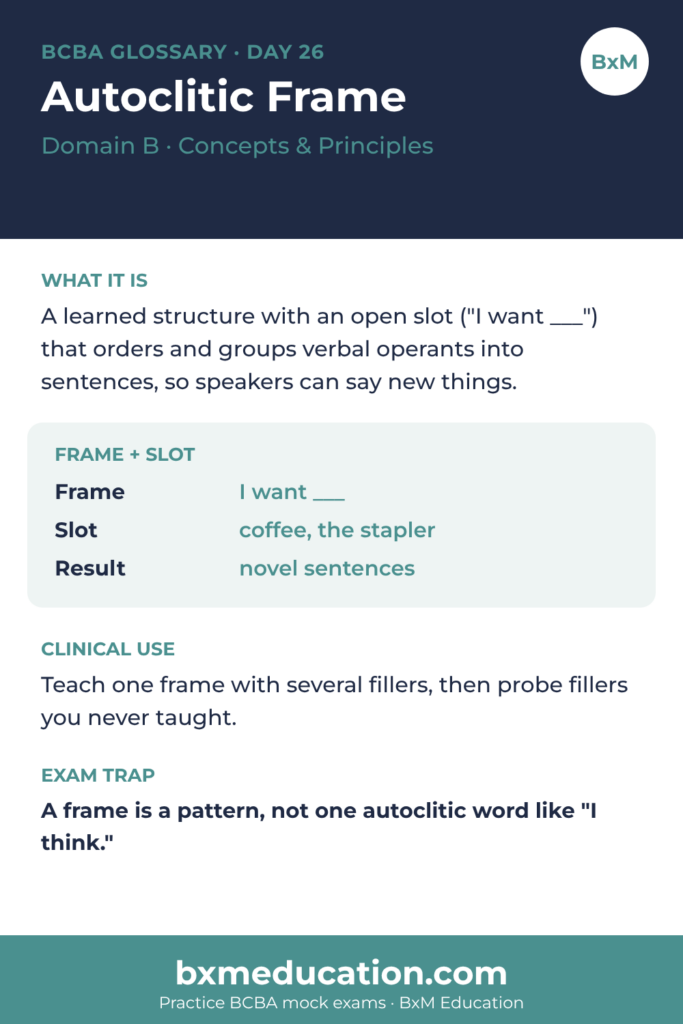
Cooper, Heron, and Heward (2020) describe autoclitic frames as the structure that organizes verbal operants into larger units, such as sentences: the order of the words, how they agree, how they are grouped, and how the pieces are put together (they cite Palmer, 2016). Put simply, a frame is a learned pattern with an open slot, like “I want ___” or “The ___ is ___.” Because the slot can take any response the speaker already has, frames help speakers generate novel sentences they were never directly taught.
This follows the previous term, autoclitic: an autoclitic is the secondary response that rides on a primary operant (“I think” in “I think it’s cold”). The autoclitic frame is the bigger structure those pieces fit into.
The Mechanics: Frame + Slot
- A frame is fixed; the slot varies. “I want ___” stays the same; “coffee,” “a break,” or “the blue mug” fills the slot.
- Structure, not content. The frame controls order, agreement (singular/plural, tense), grouping, and how the parts combine. The primary operants supply the content.
- Learned in a verbal community. Frames are acquired through a history of reinforcement with many different fillers, then extend to new fillers without new teaching.
- Generative. One frame × many primary responses = many sentences never taught directly. This is the payoff for the learner and the exam.
- Not a single word. A frame is a pattern across responses, not one autoclitic word like “not” or “I think.”
Clinical Applications
- From single words to sentences. An adult client who mands with single words (“coffee”) and tacts several items can be taught “I want ___” with a few fillers; then test with untaught fillers to see whether the frame generalizes.
- Programming for generativity. Teach the frame with multiple exemplars (different fillers, settings, and listeners) so it doesn’t stay tied to one phrase. Probe untrained combinations instead of training every sentence.
- Job-site language. Frames like “I need ___ to finish ___” or “Can you show me ___?” let an adult employee ask for many things with one taught structure.
- Supervision. Ask supervisees to describe a learner’s language in terms of frames and fillers: “Which frames are solid, and which slots can the learner fill?” That points directly to the next target.
Research Consulting & APA Citation Reference
Clinical & Methodological Recommendation: Once a learner has reliable mands and tacts, select two or three high-utility frames, teach each with several fillers, and probe with untrained fillers and new listeners. Count novel, correctly structured sentences as the outcome, not just accuracy on trained phrases.
APA Reference Citation (7th Edition):
Cooper, J. O., Heron, T. E., & Heward, W. L. (2020). Applied behavior analysis (3rd ed.). Pearson.
Advanced Applied Reasoning Quiz
Question 1
An adult client was taught to say “I want coffee” and “I want water.” Without further teaching, she says “I want the stapler” at her work station, a word she already tacts. What best explains the new sentence?
A) An autoclitic frame (“I want ___”) combined with a response already in her repertoire
B) An echoic of a coworker’s sentence
C) Stimulus generalization of the tact “coffee”
D) A single descriptive autoclitic, “I want”
Question 2
A BCBA wants an adult learner to produce many new requests with as little direct training as possible. Which plan best fits the concept of autoclitic frames?
A) Train every full sentence the learner will ever need, one at a time
B) Teach one frame with several different fillers across settings and listeners, then probe untaught fillers
C) Teach only single-word mands and wait for sentences to appear
D) Teach the learner to echo full sentences from a staff model
Check Your Answers
Watch the video above for the answer to each question and the reasoning behind it, then test yourself under exam conditions in the BCBA Mock Exam System. Previous term: autoclitic. Next term: autoclitic mand.