
“I think the meeting is at three.” “The meeting is definitely at three.” Same tact, different effect on the listener. The words I think and definitely are autoclitics, and Domain B (Concepts & Principles) items test whether you can tell them apart from the primary verbal operants they ride on.
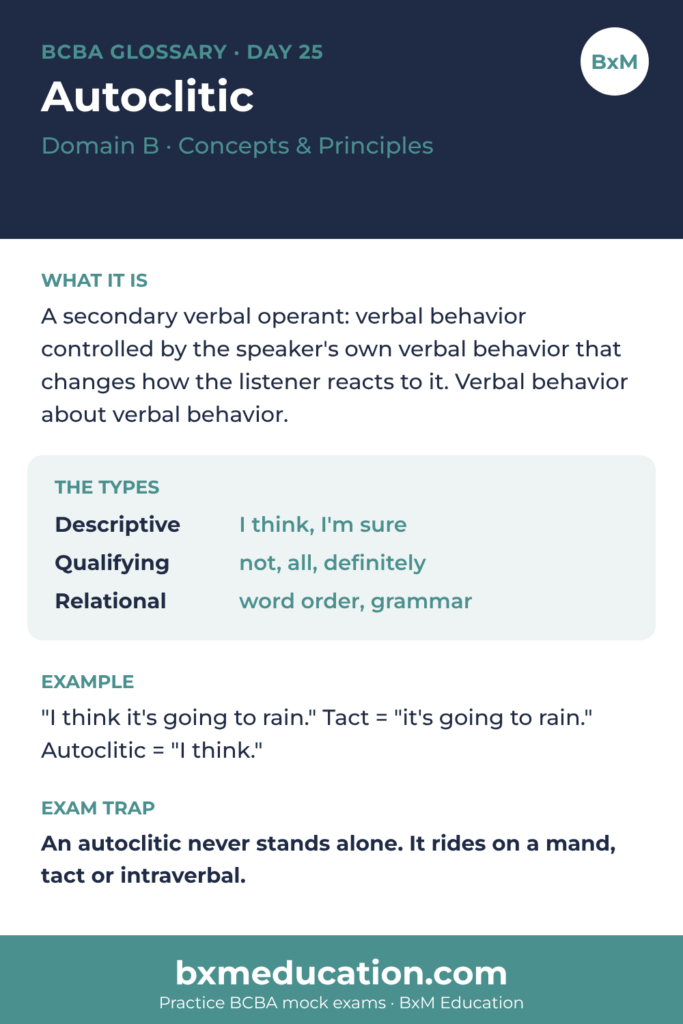
Cooper, Heron, and Heward (2020) describe the autoclitic as a secondary verbal operant: verbal behavior that is controlled by some aspect of the speaker’s own verbal behavior and that modifies how the listener responds to it. Put simply, it is verbal behavior about verbal behavior. It cannot stand alone; it needs a primary operant (a mand, tact, intraverbal, or echoic) to attach to.
This follows the previous term, audience: the audience is an antecedent for what we say, and autoclitics help shape how what we say lands with that audience. It also connects to arbitrary relations, since most autoclitic forms are learned conventions of a verbal community.
The Mechanics: Primary Operant + Autoclitic
- Depends on the speaker’s own verbal behavior. The autoclitic is controlled by other verbal behavior the speaker is emitting (or about to emit), not directly by the environment.
- Changes the listener’s reaction. It tells the listener something about the primary response: how strong it is, what kind it is, or how its parts relate.
- Descriptive autoclitics describe the speaker’s own verbal behavior or its source: “I think,” “I see that,” “I’m sure,” “I was told.”
- Qualifying and quantifying autoclitics change the strength or direction of the response: “not,” “all,” “some,” “definitely,” “maybe.”
- Relational / grammatical autoclitics arrange and connect words: word order, plural markers, tense, and words like “and” or “because.”
- Never alone. An autoclitic with no primary operant is not an autoclitic.
Clinical Applications
- Beyond single words. An adult client who tacts “coffee” can learn “I want coffee, not tea” or “I think it’s cold.” Teaching autoclitics expands primary operants into complex, more useful language.
- Precision for listeners. “I’m sure” vs. “I think” helps a job coach decide how much to trust a client’s report about a task. Teaching certainty markers improves communication at work.
- Assessment. When a learner has strong mands and tacts but speaks in single words, look for missing autoclitic frames (word order, negation, “I want ___”).
- Staff and supervisees. In reports, “data show” vs. “I suspect” are autoclitics that signal the basis of a claim. Model them in supervision.
Research Consulting & APA Citation Reference
Clinical & Methodological Recommendation: Once a learner has a reliable base of mands and tacts, program autoclitics directly: negation, certainty markers, and simple frames attached to responses the learner already has. Verify that the autoclitic changes the listener’s behavior in natural settings, not just in drills.
APA Reference Citation (7th Edition):
Cooper, J. O., Heron, T. E., & Heward, W. L. (2020). Applied behavior analysis (3rd ed.). Pearson.
Advanced Applied Reasoning Quiz
Question 1
An adult client looks at the sky and says, “I think it’s going to rain.” Which part of this response is the autoclitic?
A) “rain,” because it is controlled by the clouds
B) The whole sentence, because it is an intraverbal
C) “I think,” because it modifies how the listener should take the tact
D) None; autoclitics only occur in written language
Question 2
A supervisee writes, “Data show that aggression decreased,” in one report and “I suspect aggression decreased,” in another. What do “data show” and “I suspect” have in common?
A) Both are mands for reinforcement from the supervisor
B) Both are echoics of the BCBA’s words
C) Both are primary tacts of the graph
D) Both are descriptive autoclitics that tell the reader the basis and strength of the claim
Check Your Answers
Replay the video above to review the logic behind each scenario, then test yourself under exam conditions in the BCBA Mock Exam System. Previous term: audience. Next term: autoclitic frame.