
An adult at a day program hums while she sorts mail. Nobody praises the humming, nobody asks her to stop, and still she hums every morning. A maintenance worker learns to lift a heavy box with bent knees because lifting with his back hurts. Nobody taught him. In both cases the behavior is changing, or staying strong, because of consequences that no other person delivered. That is what behavior analysts mean by automatic contingencies, and Domain B (Concepts & Principles) items test whether you can separate them from socially mediated ones.
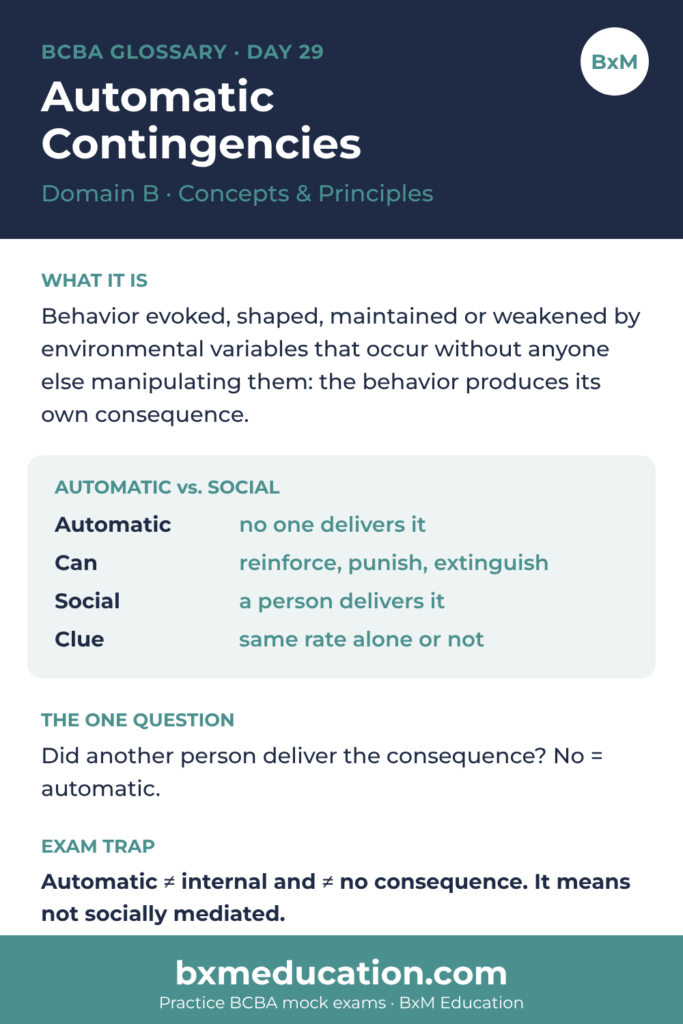
Cooper, Heron, and Heward (2020) note that Skinner (1957) used “automatic” to describe situations in which behavior is evoked, shaped, maintained or weakened by environmental variables that happen without direct manipulation by other people. The same principles apply as always (reinforcement, extinction, punishment); they simply operate automatically. In plain terms: the behavior itself produces the consequence.
This follows the previous glossary term, autoclitic tact. For the side-by-side exam comparison, see automatic vs. socially mediated contingencies.
The Mechanics: The Behavior Produces Its Own Consequence
- No social delivery. The consequence is a direct product of the response (a sound, a sensation, a view, relief from discomfort), not something another person hands over.
- Same principles. Automatic contingencies can reinforce (humming produces sound the person enjoys), punish (touching a hot pan produces pain) or extinguish (pressing a broken switch produces nothing).
- Shaping without a teacher. Skills like balancing, typing faster or finding a comfortable lifting posture can be shaped by automatic consequences alone.
- “Automatic” does not mean “internal” or “unknown.” It means not mediated by others. The consequence is still an environmental event, and you can often identify it.
- Contrast: socially mediated contingencies. Attention, access to items or escape that another person provides are socially mediated, even if the person doesn’t mean to deliver them.
Clinical Applications
- Functional assessment. When a problem behavior continues at similar rates whether or not anyone is present (for example, in an alone condition), an automatic function is a hypothesis to test.
- Treatment selection. Behavior maintained by automatic reinforcement usually won’t respond to withholding attention. Teams look at matched stimulation, enriched environments, or blocking the sensory consequence, as the BCBA designs.
- Skill building. Some skills keep themselves going once they produce natural automatic consequences (reading for enjoyment, playing an instrument), which supports maintenance.
- Safety. Automatic punishment (a painful outcome of a response) can suppress useful behavior too; teams plan for comfort and safety in work tasks.
Research Consulting & APA Citation Reference
Clinical & Methodological Recommendation: Before labeling a function “automatic,” confirm the behavior persists without social consequences across conditions. Then name the likely automatic consequence in observable terms rather than writing “self-stimulatory” and stopping there.
APA Reference Citation (7th Edition):
Cooper, J. O., Heron, T. E., & Heward, W. L. (2020). Applied behavior analysis (3rd ed.). Pearson.
Advanced Applied Reasoning Quiz
Question 1
An adult in a group home rocks in his chair for long periods. Rocking occurs at similar rates when staff are present, absent, attending or ignoring him. Which explanation fits these data best?
A) Rocking is maintained by social positive reinforcement in the form of staff attention
B) Rocking is maintained by social negative reinforcement in the form of escape from tasks
C) Rocking is likely maintained by an automatic contingency, a consequence produced by the response itself
D) Rocking has no maintaining consequence because no one delivers anything
Question 2
Which example best illustrates an automatic contingency weakening a behavior?
A) A supervisor reprimands an employee each time he arrives late, and late arrivals decrease
B) An adult stops pressing the button on a vending machine after it stops dispensing anything
C) A job coach stops praising a client for wiping tables, and wiping decreases
D) A housemate laughs each time a resident tells a joke, and joke-telling increases
Check Your Answers
Watch the video above for the answer to each question and the reasoning behind it, then test yourself under exam conditions in the BCBA Mock Exam System. Previous term: autoclitic tact. Next term: automatic punishment (coming next).