
A night-shift staff member tells the morning nurse, “I think Mr. Okafor slept through the night.” Compare that with “I saw Mr. Okafor sleep through the night.” The main message is identical. What changes is the small add-on in front of it: “I think” versus “I saw.” Each one tells the nurse something about the message itself, how sure the speaker is and where the information came from. That add-on is an autoclitic tact, and Domain B (Concepts & Principles) items test whether you can tell it apart from its close neighbor, the autoclitic mand.
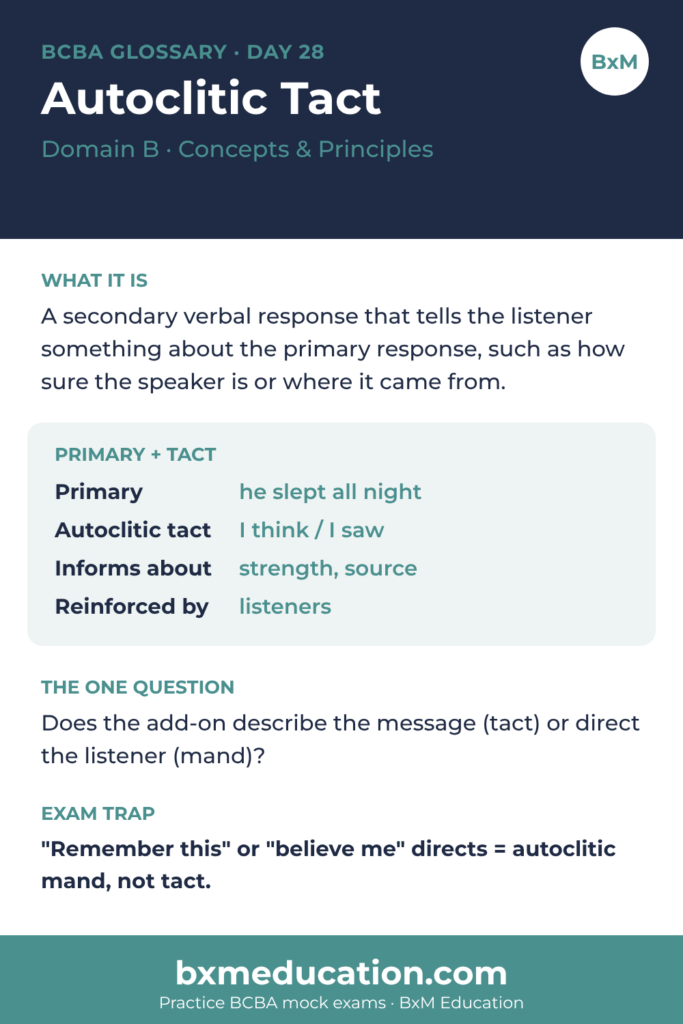
Cooper, Heron, and Heward (2020) describe the autoclitic tact as an autoclitic controlled by some nonverbal feature of the speaker’s primary verbal response or of the variables controlling it. The autoclitic piece informs the listener of that feature, and listeners maintain it with generalized reinforcement. In plain terms: the speaker adds words that describe the message (its strength, its source, its kind) so the listener can react to it appropriately.
This follows the previous term, autoclitic mand, and the parent term autoclitic: an autoclitic is a secondary verbal response that depends on, and modifies the effect of, a primary operant.
The Mechanics: Primary Response + “Here’s Something About It”
- Two layers. The primary response carries the content (“Mr. Okafor slept through the night”). The autoclitic tact (“I think,” “I saw”) rides on it.
- Controlled by a nonverbal feature. Like any tact, it is under the control of something the speaker contacts, here a feature of the primary response or its controlling variables: how strong the response is, whether the speaker saw it or heard about it, whether it is a guess or a fact.
- Informs the listener. “I’m sure,” “I guess,” “I heard,” “I saw,” “probably” tell the listener how much weight to give the message.
- Reinforced by listeners. Listeners provide generalized reinforcement (attention, agreement, acting appropriately on the information), which keeps the autoclitic tact going.
- Not an autoclitic mand. An autoclitic mand (“believe me,” “listen,” “remember this”) tells the listener what to do with the message. An autoclitic tact describes the message.
Clinical Applications
- Advanced verbal repertoires. Adults with strong tacts can be taught to add autoclitic tacts that make their reports more useful: “I saw the bus leave” versus “I think the bus left.”
- Staff reporting. In incident and shift reports, the difference between “I saw” and “I was told” matters. Teaching staff to use accurate autoclitic tacts improves the quality of the information supervisors act on.
- Self-advocacy and health communication. An adult who can say “I’m not sure, but I think the pain started yesterday” gives a nurse more accurate information than a flat statement.
- Programming. Teach autoclitic tacts across several primary responses and listeners, and reinforce accurate ones: “I saw” only when the speaker actually saw it.
Research Consulting & APA Citation Reference
Clinical & Methodological Recommendation: When analyzing a learner’s or a staff member’s verbal behavior, first separate the primary response from any autoclitic. Then ask one question: does the autoclitic describe the response (autoclitic tact) or direct the listener (autoclitic mand)?
APA Reference Citation (7th Edition):
Cooper, J. O., Heron, T. E., & Heward, W. L. (2020). Applied behavior analysis (3rd ed.). Pearson.
Advanced Applied Reasoning Quiz
Question 1
A job coach tells a supervisor, “I heard the warehouse is closing early today.” Which part of the statement is an autoclitic tact?
A) “I heard,” because it tells the listener the source of the primary response
B) “The warehouse is closing early today,” because it is controlled by a nonverbal event
C) “I heard,” because it tells the listener what to do with the message
D) The whole statement, because the speaker wants to leave early
Question 2
Which example is an autoclitic mand rather than an autoclitic tact?
A) “I’m sure the van is outside.”
B) “Remember this: the van is outside.”
C) “I guess the van is outside.”
D) “I saw the van outside.”
Check Your Answers
Watch the video above for the answer to each question and the reasoning behind it, then test yourself under exam conditions in the BCBA Mock Exam System. Previous term: autoclitic mand. Next term: automatic contingencies.