
Test your clinical discrimination skills with these three exam-style questions built specifically around the heavy-hitting domains of the 6th Edition Test Content Outline.
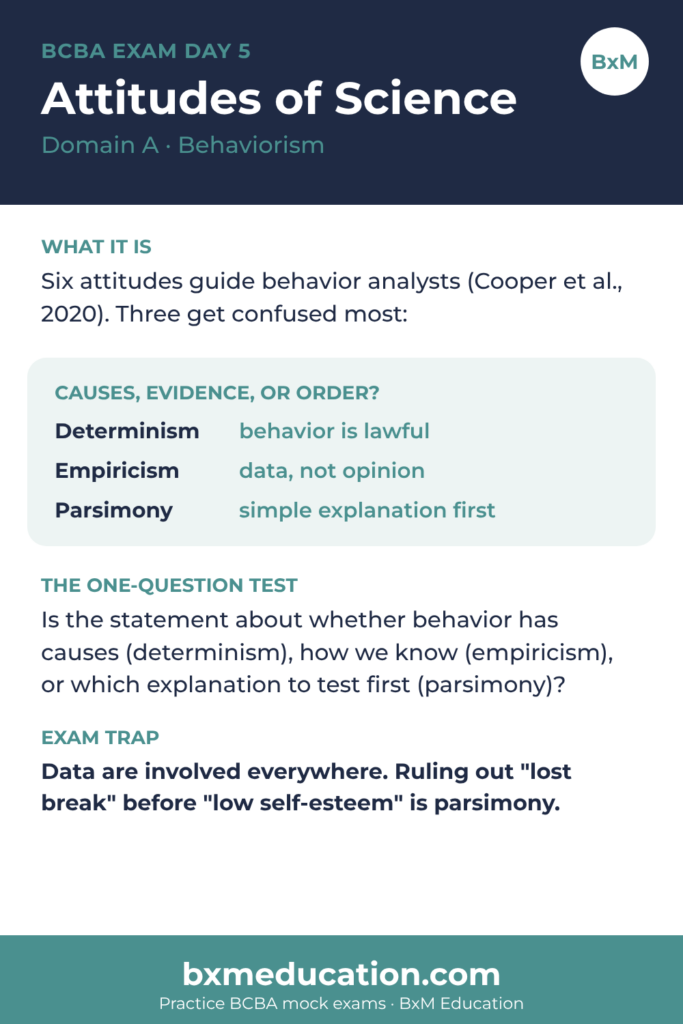
Cooper, Heron, and Heward (2020) describe six attitudes of science that guide behavior analysts: determinism, empiricism, experimentation, replication, parsimony, and philosophic doubt. Exam items describe what a practitioner says or does and ask which attitude it shows. Three are confused most often:
- Determinism: the universe, including behavior, is lawful and orderly. Events happen because of other events, so behavior is related to identifiable variables. Determinism is the assumption that makes a science of behavior possible.
- Empiricism: knowledge comes from objective observation. Decisions rest on data from direct measurement, not on opinion, impressions, or authority.
- Parsimony: simple, logical explanations must be ruled out, experimentally or conceptually, before more complex or abstract explanations are considered.
Quick test: is the statement about whether behavior has causes (determinism), how we know (empiricism), or which explanation to consider first (parsimony)? For how science builds understanding level by level, see the goals of behavior analysis.
Question 1 (Domain A: Attitudes of science)
A behavior analyst trains staff at an adult day program. A staff member says an adult client’s aggression “just comes out of nowhere.” The behavior analyst replies that the aggression is related to events in the client’s environment and that careful observation will identify the variables involved. Which attitude of science does her reply best reflect?
A) Empiricism
B) Determinism
C) Parsimony
D) Philosophic doubt
Question 2 (Domain A: Attitudes of science)
A clinic director tells a supervisor that a new vocational program “is obviously working; everyone can feel the difference.” The supervisor says the program will be judged only after staff collect direct-observation data on the targeted job skills, because staff impressions are not an adequate basis for the decision. Which attitude of science is the supervisor emphasizing?
A) Philosophic doubt
B) Replication
C) Determinism
D) Empiricism
Question 3 (Domain A: Attitudes of science)
An adult employee’s work output drops sharply. The team suggests the cause is “low self-esteem.” The BCBA first checks whether a recent schedule change removed the break that used to follow completed tasks, and tests that explanation before considering anything else. Which attitude of science does the BCBA’s approach best show?
A) Determinism
B) Empiricism
C) Parsimony
D) Experimentation
Written Answer Explained
Question 1 Breakdown (Domain A: Attitudes of science)
Core Scenario Summary: The behavior analyst asserts that the aggression is lawful, related to identifiable environmental events.
Correct Answer: B) Determinism
Clinical Analysis & Distractor Rationales:
- Why A is Incorrect: Empiricism concerns how knowledge is gained: through objective observation and data. Her reply is about whether the behavior has causes at all, not about how to verify them.
- Why B is Correct: Determinism is the assumption that the universe, including behavior, is lawful and orderly, so events occur as a result of other events. “It is related to events in the environment” is a deterministic statement.
- Why C is Incorrect: Parsimony is about ruling out simple explanations before complex ones. No competing explanations are being ranked.
- Why D is Incorrect: Philosophic doubt means continually questioning the truthfulness of what is regarded as fact, including one’s own findings. She is not questioning a finding.
Question 2 Breakdown (Domain A: Attitudes of science)
Core Scenario Summary: The supervisor refuses to accept impressions and requires objective, direct-observation data before deciding.
Correct Answer: D) Empiricism
Clinical Analysis & Distractor Rationales:
- Why A is Incorrect: Philosophic doubt is a continuing readiness to question even well-supported findings. The supervisor’s point is narrower: what counts as evidence (data, not opinion).
- Why B is Incorrect: Replication is repeating experiments or demonstrations to establish reliability. Nothing is being repeated.
- Why C is Incorrect: Determinism is the assumption that behavior is lawful. The scenario is about the basis for judging a program, not whether behavior has causes.
- Why D is Correct: Empiricism is the practice of objective observation; scientific knowledge is built on measured data rather than impressions or authority.
Question 3 Breakdown (Domain A: Attitudes of science)
Core Scenario Summary: The BCBA tests a simple environmental explanation (a lost reinforcer) before an abstract one (self-esteem).
Correct Answer: C) Parsimony
Clinical Analysis & Distractor Rationales:
- Why A is Incorrect: Determinism assumes behavior has causes, which both the team and the BCBA accept. The question is which explanation to examine first.
- Why B is Incorrect: Empiricism concerns basing conclusions on objective observation. The defining feature here is the order in which explanations are considered.
- Why C is Correct: Parsimony requires ruling out simple, logical explanations before more complex or abstract ones. A removed break is simpler and directly testable compared with “low self-esteem.”
- Why D is Incorrect: Experimentation is the controlled manipulation of variables to demonstrate a functional relation. Testing will follow, but the choice of what to test first is parsimony.
Keep studying: go back to Exam Day 4: phylogenic vs. ontogenic vs. cultural selection, compare this with the goals of behavior analysis, review the definition of applied behavior analysis, and see how determinism plays out in positive vs. negative reinforcement. Then test yourself under exam conditions in the BCBA Mock Exam System.
APA Reference Citation (7th Edition):
Cooper, J. O., Heron, T. E., & Heward, W. L. (2020). Applied behavior analysis (3rd ed.). Pearson.