
Developmental milestones are the yardstick every special educator uses first, and the ILTS 290 expects you to know exactly what they can and cannot tell you.
What It Means (in Plain Language)
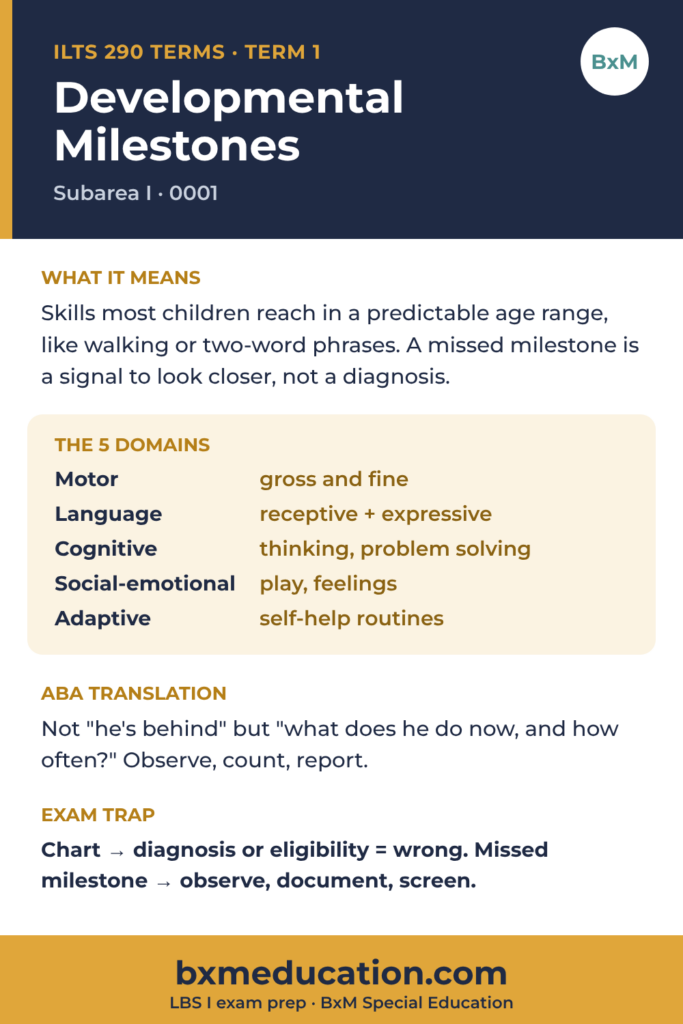
A developmental milestone is a skill that most children reach within a predictable age range, such as walking, using two-word phrases, or taking turns in play. Milestones give teachers and families a shared reference point for asking, “Is this child’s development on track?”
Two ideas do most of the work on the exam:
– Milestones describe ranges, not deadlines. Children reach them at different times, and a short delay in one area is common.
– A missed milestone is a signal to look closer, not a diagnosis. It leads to screening and, when needed, a full evaluation. It never decides eligibility on its own.
Since 2022, the CDC’s “Learn the Signs. Act Early.” checklists list milestones that most children (75% or more) reach by a given age, so missing one is a stronger reason to screen than it used to be.
The Five Domains
Milestones are grouped into five areas. Exam items often describe one and ask you to name it:
1. Gross and fine motor: walking, jumping, holding a pencil, cutting with scissors.
2. Language and communication: understanding words (receptive) and using them (expressive).
3. Cognitive: problem solving, attention, early number and concept skills.
4. Social-emotional: play, sharing, reading other people’s feelings, managing your own.
5. Adaptive (self-help): feeding, dressing, toileting, daily routines.
Classroom Application: Done Right
Ms. Patel, an LBS I teacher in a primary resource room, notices that one of her first graders rarely starts conversations with peers and answers in single words. Instead of labeling him, she collects information: she records how often he initiates during centers for two weeks, checks his records and talks with his family about what they see at home. She shares the data with the team and asks whether a speech-language screening is appropriate.
Why it works: she treats the missed milestone as a reason to gather data and screen, she looks across settings, and she brings the family in early.
Misapplication: Spot the Mistake
In the same building, a teacher reads a milestone chart, sees that a student “should” be reading simple words by now, and tells the parent at pickup, “He’s delayed, he’ll probably qualify for special education.”
Spot the mistake: a milestone chart was used as a diagnosis and an eligibility decision. Eligibility under IDEA comes only from a full and individual evaluation by a team, with parent consent, across all areas of suspected disability. The fix: describe what you observed, share it with the team, and follow the school’s screening and referral process.
How It Shows Up on the ILTS 290
- Items often describe a skill and ask which domain it belongs to. Self-care questions point to adaptive; turn-taking points to social-emotional or language (pragmatics).
- Watch for answer choices that turn a milestone into a diagnosis or an eligibility decision. They are almost always wrong.
- “Variation is normal” and “look across domains and settings” are the safe principles when two answers seem close.
The ABA Translation
Behavior analysts look at the same skills as behaviors in the student’s repertoire that can be observed and measured. Instead of “he’s behind,” they ask, “What does he do now, how often, and under what conditions?” The term is shared, not borrowed: the core of the VB-MAPP is its Milestones Assessment, 170 language, social and learning milestones across three developmental levels, each scored by direct observation or testing. For the classroom, this means turning a worry into data.
Quick Check (2 Questions)
Question 1. A kindergarten teacher notes that a student cannot yet zip his coat or open his lunch containers without help, while his classmates can. Which developmental domain do these skills belong to?
A) Cognitive
B) Fine motor only
C) Adaptive (self-help)
D) Social-emotional
Show answer
C. Zipping a coat and opening containers are daily-living, self-help skills, which belong to the adaptive domain. Fine motor skills are involved, but the skills described are self-care routines, so adaptive is the best answer. Cognitive and social-emotional do not fit the skills described.
Question 2. A first-grade teacher sees that a student is not yet combining words the way most peers do. What is the most appropriate next step?
A) Tell the family the child has a language disability
B) Document observations across settings and share them with the team to consider screening
C) Place the student in a special education classroom right away
D) Wait two years to see if the skill appears
Show answer
B. A missed milestone is a signal to gather data and consider screening through the school’s process. A diagnoses without an evaluation. C makes a placement decision without an evaluation or IEP. D ignores the value of early identification.
Keep Studying
- Full ILTS 290 prep: https://bxmeducation.com/ilts-290-exam-prep/
- Study Guide, Flashcards and Graphic Organizers: https://bxmeducation.com/ilts-290-study-materials/
- How this looks with a classroom assistant: Developmental Milestones in the Classroom: How to Train Your SECA
References
Centers for Disease Control and Prevention. (2022). Learn the Signs. Act Early. developmental milestone checklists. https://www.cdc.gov/ncbddd/actearly/
Zubler, J. M., et al. (2022). Evidence-informed milestones for developmental surveillance tools. Pediatrics, 149(3).
Illinois Licensure Testing System. Test 290 framework, objective 0001.
Independent BxM study material. Not affiliated with ILTS, ISBE, Pearson or ETS. Created by an Illinois LBS I.