
Your classroom assistant sees your students more minutes a day than anyone else. Teach them to describe what they see, and every milestone concern turns into useful data.
Why This Matters for the SECA
Special education classroom assistants (SECAs, paraprofessionals) often notice first when a student is not doing what peers do. The risk is in the words: “he’s behind,” “she’s lazy,” “he can’t talk.” Those words carry judgment and give the team nothing to work with. An LBS I teacher who has also studied ABA can give the assistant a better habit: describe the behavior, count it, and report it.
Same Word in Both Worlds
“Developmental milestones” is not only a teacher term. ABA uses it too: the VB-MAPP, one of the most common ABA assessments, is built around a Milestones Assessment of 170 skills across three developmental levels. The difference is how each field talks about it. Teachers tend to say a child is “on track” or “behind.” Behavior analysts ask what the child does, how often, and with how much help, and they measure it. That second habit is the one to teach your SECA.
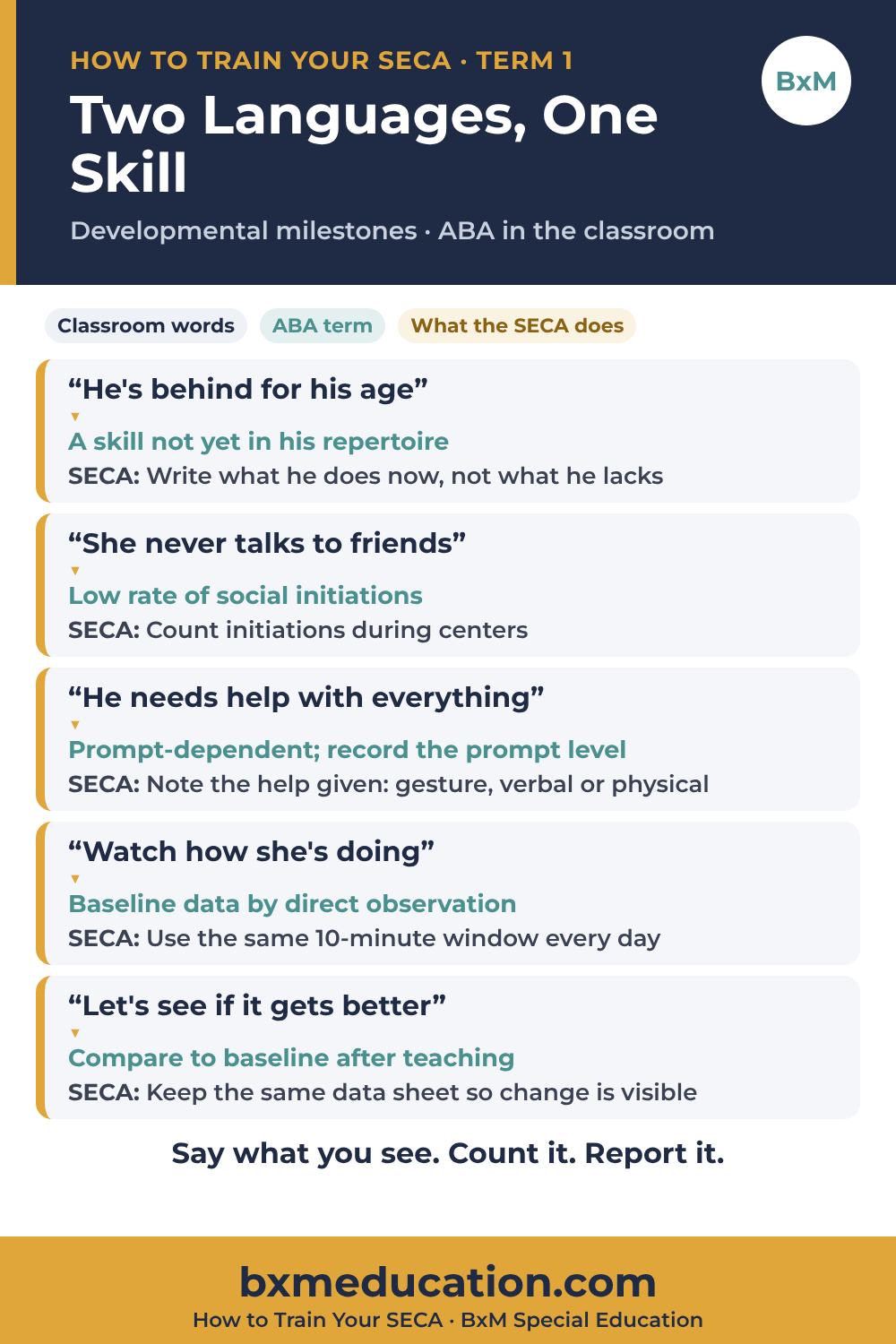
Two Languages, One Skill
| What we say in the classroom | What ABA calls it | What the SECA does |
|---|---|---|
| “He’s behind for his age” | A skill not yet in his repertoire | Write what he does now, not what he lacks |
| “She never talks to friends” | Low rate of social initiations (mands/intraverbals to peers) | Count initiations during centers |
| “He needs help with everything” | Prompt-dependent; needs a prompt level recorded | Note the help given: gesture, verbal or physical |
| “Watch how she’s doing” | Baseline data by direct observation | Use the same 10-minute window every day |
| “Let’s see if it gets better” | Compare to baseline after teaching | Keep the same data sheet so change is visible |
Classroom Scenario: The Morning Centers Check
Ms. Patel, the LBS I, asks her SECA, Mr. Daniel, about a first grader who rarely plays with others.
Before training: Mr. Daniel says, “He’s just shy. He’s behind socially.” That is a label. It gives the team nothing to act on.
The teacher’s coaching (behavioral skills training):
1. Instruction: “For the next two weeks, during centers, just count each time he starts talking or playing with a peer. One tally per start.”
2. Model: Ms. Patel shows him for five minutes, saying out loud, “He handed blocks to Ava, that’s one.”
3. Rehearsal: Mr. Daniel tallies the next five minutes while she watches.
4. Feedback: “Great, you caught the gesture too. Next time, also mark when you prompted him.”
After training: Mr. Daniel reports, “Over ten days he started 20 interactions, about 2 per 20-minute center, and 6 of those 20 came after I prompted him.” Now the team has a baseline, a clear picture across days, and a reason to discuss screening with the family. Nobody was labeled.
What to Teach Your SECA (Quick List)
- Say what you see. “He sat alone for 15 minutes,” not “he’s antisocial.”
- Count one thing at a time, in the same activity, at the same time of day.
- Write down the help you gave. A skill done with prompts is not yet independent.
- Report to the teacher, not the family. Concerns go to the team first; the teacher decides next steps with the family.
The Takeaway for the ILTS 290 and the Classroom
On the exam, a missed milestone means observe, document and screen, never diagnose. In the classroom, ABA gives you the tools to do exactly that through your assistant: clear definitions, simple counts and behavioral skills training.
👉 Study the exam side: Developmental Milestones | ILTS 290 Term 1
👉 Full ILTS 290 prep: https://bxmeducation.com/ilts-290-exam-prep/
Scenario is a fictional composite. Independent BxM study material. Not affiliated with ILTS, ISBE, Pearson or ETS. Created by an Illinois LBS I.