
Test your clinical discrimination skills with these three exam-style questions built specifically around the heavy-hitting domains of the 6th Edition Test Content Outline.
Cooper, Heron, and Heward (2020) list six attitudes of science. Exam Day 5 covered determinism, empiricism, and parsimony. Today we finish the set with the three that candidates blur together:
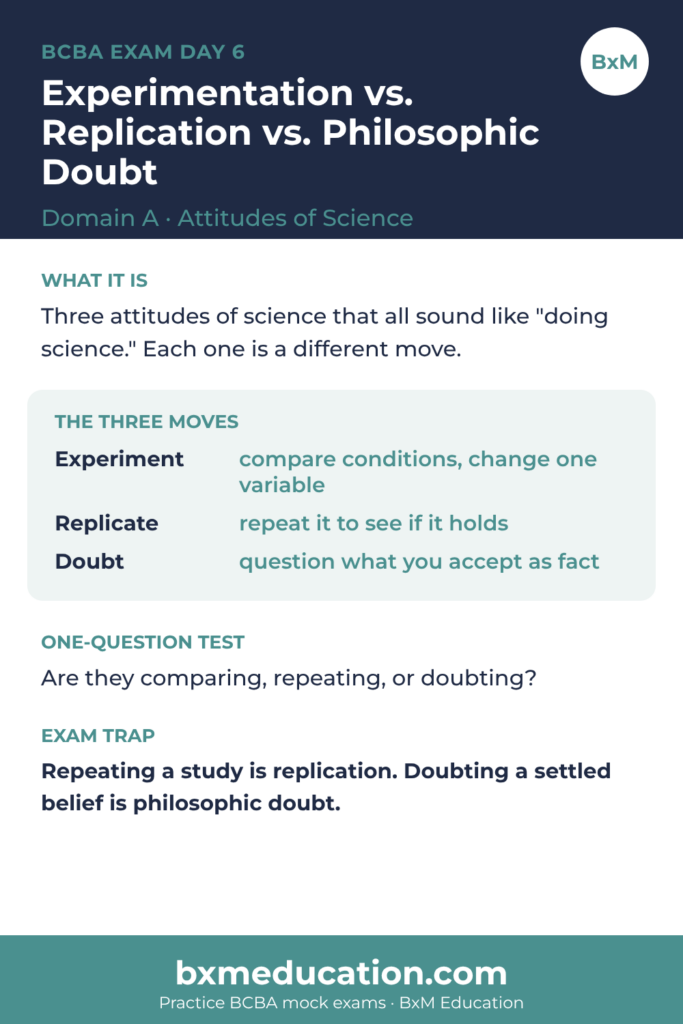
- Experimentation: the controlled comparison of a measure of behavior under two or more conditions that differ in only one factor, the independent variable. It is how a science shows a functional relation instead of just a correlation.
- Replication: repeating an experiment, or repeating conditions within an experiment, to find out whether a result is reliable and how far it generalizes. One good result is a start; repeated results are evidence.
- Philosophic doubt: continually questioning the truthfulness of what is regarded as fact, including your own findings and favorite methods. Scientific knowledge is held tentatively and stays open to new data.
Quick test: is the practitioner comparing conditions that differ in one variable (experimentation), repeating a demonstration to check it holds (replication), or questioning a conclusion already accepted (philosophic doubt)?
Question 1 (Domain A: Attitudes of science)
A BCBA wants to know whether a picture schedule reduces an adult employee’s off-task behavior at a packaging job. She records off-task behavior during work periods with the schedule and work periods without it, keeping the tasks, time of day, and job coach the same, so the schedule is the only thing that differs. Which attitude of science does this approach best show?
A) Replication
B) Experimentation
C) Empiricism
D) Parsimony
Question 2 (Domain A: Attitudes of science)
The picture schedule reduces off-task behavior for the first employee. The BCBA then removes and reintroduces the schedule twice with that employee, and later tests it with two other employees at different worksites, to see whether the same effect appears each time. Which attitude of science is she emphasizing?
A) Philosophic doubt
B) Determinism
C) Experimentation
D) Replication
Question 3 (Domain A: Attitudes of science)
A BCBA has used a token economy with an adult client for two years and has always described it as “the intervention that works for him.” During a case review she tells her team, “What we think we know about this program could be wrong. Let’s treat that conclusion as tentative and look at it again with fresh data.” Which attitude of science does her statement best reflect?
A) Philosophic doubt
B) Replication
C) Empiricism
D) Determinism
Written Answer Explained
Question 1 Breakdown (Domain A: Attitudes of science)
Core Scenario Summary: The BCBA compares behavior across conditions that differ in only one factor, the picture schedule.
Correct Answer: B) Experimentation
Clinical Analysis & Distractor Rationales:
- Why A is Incorrect: Replication is repeating a demonstration to check its reliability. This is the first comparison; nothing is being repeated yet.
- Why B is Correct: Experimentation is the controlled comparison of behavior under conditions that differ in one variable (the independent variable) while everything else is held constant. That is exactly what she arranged.
- Why C is Incorrect: Empiricism is relying on objective observation and data rather than opinion. She does collect data, but the defining feature here is the controlled manipulation of one variable.
- Why D is Incorrect: Parsimony is ruling out simple explanations before complex ones. No competing explanations are being ranked.
Question 2 Breakdown (Domain A: Attitudes of science)
Core Scenario Summary: The BCBA repeats the demonstration within the same employee and with new employees to see whether the effect holds.
Correct Answer: D) Replication
Clinical Analysis & Distractor Rationales:
- Why A is Incorrect: Philosophic doubt is questioning what is already regarded as fact. She is not questioning an accepted conclusion; she is testing whether a new finding is reliable.
- Why B is Incorrect: Determinism is the assumption that behavior is lawful and has causes. It underlies the study but is not what the repeated tests show.
- Why C is Incorrect: Experimentation is the controlled comparison itself. Each phase is an experimental comparison, but repeating them across phases and people is what makes this replication.
- Why D is Correct: Replication is repeating experiments, or conditions within an experiment, to determine the reliability (and generality) of a finding. Withdrawing and reintroducing the schedule, and testing new employees, are both replication.
Question 3 Breakdown (Domain A: Attitudes of science)
Core Scenario Summary: The BCBA openly questions a conclusion her team has treated as settled and asks to hold it tentatively.
Correct Answer: A) Philosophic doubt
Clinical Analysis & Distractor Rationales:
- Why A is Correct: Philosophic doubt is continually questioning the truthfulness of what is regarded as fact, including one’s own findings. Treating “it works” as tentative and open to new data is the definition.
- Why B is Incorrect: Replication is repeating a demonstration. She has not repeated anything; she is questioning a belief.
- Why C is Incorrect: Empiricism is basing conclusions on objective data. She will use data, but the key feature of her statement is the willingness to doubt an accepted conclusion.
- Why D is Incorrect: Determinism assumes behavior has causes. Her statement is about how certain the team should be, not about whether behavior is lawful.
Keep studying: go back to Exam Day 5: determinism vs. empiricism vs. parsimony, see how replication works inside a design in A-B vs. A-B-A vs. A-B-A-B designs, and review why experimentation is part of the definition of applied behavior analysis. Then test yourself under exam conditions in the BCBA Mock Exam System.
APA Reference Citation (7th Edition):
Cooper, J. O., Heron, T. E., & Heward, W. L. (2020). Applied behavior analysis (3rd ed.). Pearson.