
Test your clinical discrimination skills with these three exam-style questions built specifically around the heavy-hitting domains of the 6th Edition Test Content Outline.
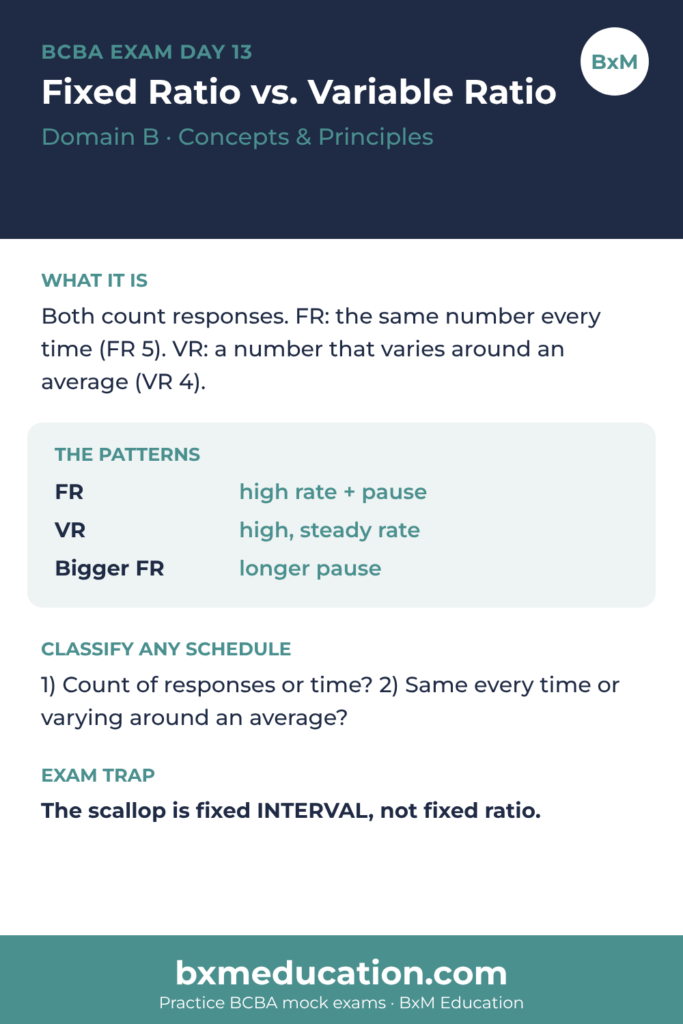
Day 12 split continuous from intermittent reinforcement. Day 13 opens the intermittent side with the two ratio schedules, where reinforcement depends on the number of responses, not on time:
- Fixed ratio (FR): reinforcement follows a set, unchanging number of responses (FR 5 = every 5th response). Typical pattern: a high rate of responding with a postreinforcement pause after each reinforcer (“break and run”). Larger ratios produce longer pauses.
- Variable ratio (VR): reinforcement follows a number of responses that changes from one reinforcer to the next around an average (VR 5 = on average every 5th response). Typical pattern: a high, steady rate with little or no postreinforcement pause, because the very next response might pay off.
The test is two questions: Is it a count of responses (ratio) or time (interval)? Then: Is the count the same every time (fixed) or does it vary around an average (variable)?
Question 1 (Domain B: Schedules of reinforcement)
At a supported-employment site, an adult employee earns a token exactly after every fifth completed assembly, every time. Which schedule is in effect?
A) Variable ratio 5 (VR 5)
B) Fixed ratio 5 (FR 5)
C) Fixed interval 5 minutes (FI 5)
D) Continuous reinforcement (CRF)
Question 2 (Domain B: Schedules of reinforcement)
A behavior analyst reviews cumulative records for an adult client on a fixed-ratio schedule. Which response pattern is most characteristic of FR schedules?
A) A high, steady rate with no pauses
B) A scalloped pattern that speeds up as the end of the interval approaches
C) A low-to-moderate, steady rate
D) A high rate with a pause right after each reinforcer
Question 3 (Domain B: Schedules of reinforcement)
A job coach praises an adult employee after an unpredictable number of correctly filed folders, sometimes after 2, sometimes after 7, averaging 4. Which schedule is this, and what pattern does it usually produce?
A) VR 4, producing a high, steady rate with little pausing
B) FR 4, producing a break-and-run pattern
C) Variable interval 4, producing a moderate, steady rate
D) Differential reinforcement of low rates (DRL), producing slow, spaced responding
Written Answer Explained
Question 1 Breakdown (Domain B: Schedules of reinforcement)
Core Scenario Summary: A token follows exactly every fifth assembly.
Correct Answer: B) Fixed ratio 5 (FR 5)
Clinical Analysis & Distractor Rationales:
- Why A is Incorrect: VR 5 reinforces after a number of responses that varies around an average of 5. Here the requirement never changes.
- Why B is Correct: Reinforcement depends on a fixed count of responses (5), so it is FR 5.
- Why C is Incorrect: FI 5 reinforces the first response after 5 minutes have passed. The scenario counts responses, not time.
- Why D is Incorrect: CRF reinforces every response (FR 1). Four of every five assemblies go unreinforced here.
Question 2 Breakdown (Domain B: Schedules of reinforcement)
Core Scenario Summary: Identify the typical FR response pattern.
Correct Answer: D) A high rate with a pause right after each reinforcer
Clinical Analysis & Distractor Rationales:
- Why A is Incorrect: A high, steady rate with little pausing is typical of variable-ratio schedules.
- Why B is Incorrect: The scallop (slow after reinforcement, faster near the end of the interval) is typical of fixed-interval schedules.
- Why C is Incorrect: Low-to-moderate steady responding is typical of variable-interval schedules.
- Why D is Correct: FR schedules produce high rates with a postreinforcement pause (“break and run”); the pause tends to grow with the size of the ratio.
Question 3 Breakdown (Domain B: Schedules of reinforcement)
Core Scenario Summary: Praise follows an unpredictable number of folders averaging 4.
Correct Answer: A) VR 4, producing a high, steady rate with little pausing
Clinical Analysis & Distractor Rationales:
- Why A is Correct: The response requirement varies around an average of 4, which is VR 4. VR schedules produce high, steady rates with few postreinforcement pauses.
- Why B is Incorrect: FR 4 would require exactly 4 responses every time; the requirement here changes.
- Why C is Incorrect: A variable-interval schedule depends on varying amounts of time, not on the number of folders filed.
- Why D is Incorrect: DRL reinforces a response only when it follows a minimum time since the last response, to lower the rate. Nothing in the scenario requires spacing.
Keep studying: Review Exam Day 12: continuous vs. intermittent reinforcement and Exam Day 9: positive vs. negative reinforcement, then test yourself on the full item bank in the BxM Mock Exam System.