
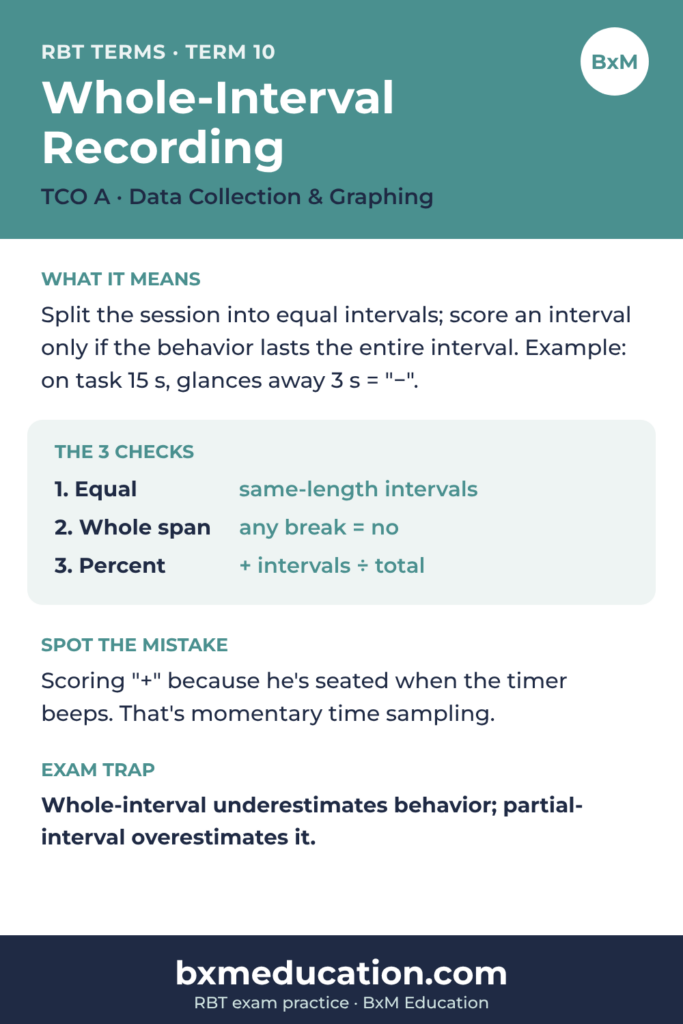
In whole-interval recording, an interval only counts if the behavior lasted the entire interval, from the first second to the last. Stop for a moment and the interval is a “no.”
What It Means (in Plain Language)
Whole-interval recording is a discontinuous way to collect data. The observation period is split into short, equal intervals, and the technician marks an interval only when the target behavior happened without a break for the whole interval. The result is reported as the percentage of intervals with the behavior.
The words do the work:
- Interval = the session is cut into equal blocks of time, and you score each block.
- Whole = the behavior has to fill the whole block. Part of the interval isn’t enough.
The 3 Checks
Before you score an interval, run three checks:
- Equal intervals: is the session divided into the interval length the plan specifies, with a timer or app cueing each one?
- Start to finish: did the behavior continue through the entire interval with no break? Any gap = “no.”
- Percent of intervals: at the end, report intervals scored “yes” divided by total intervals.
Whole-interval tends to underestimate how much the behavior happens, which is why supervisors often choose it for ongoing behaviors they want to increase (like time on task).
Application: Done Right
Rosa is a 42-year-old adult in a day program. Her plan targets on-task work (hands on the sorting materials, eyes on the task) during a 10-minute mail-sorting activity. The BCBA chose whole-interval recording with 20-second intervals (30 intervals).
The RBT, Marcus, watches each interval. In interval 7, Rosa sorts for 15 seconds, looks out the window for 3 seconds, then goes back to sorting; Marcus scores interval 7 as “−.” Session total: 18 of 30 intervals scored “+” = 60%. He records the interval length and enters the data the same day.
Why it works: Marcus used equal intervals, scored “+” only when Rosa was on task from start to finish, and reported the percent of intervals.
Misapplication: Spot the Mistake
Same program, different client. Edward, 55, has a plan for whole-interval recording of staying seated during a 15-minute meal, 30-second intervals. A new RBT, Tina, scores an interval “+” whenever Edward is seated when the timer beeps, even if he stood up and walked to the window during the interval.
Spot the mistake: Tina is scoring like momentary time sampling (checking only at the end of the interval). In whole-interval recording, Edward has to be seated for the entire 30 seconds. Her data will overstate how much he stays seated, and the BCBA may think the plan is working when it isn’t.
The fix: watch the whole interval and score “+” only if the behavior lasted from start to finish. If watching every second isn’t possible, tell the supervisor; don’t switch methods on your own.
How It Shows Up on the RBT Exam
- Entire interval = scored. If the item says “throughout the whole interval,” it’s whole-interval.
- Underestimates behavior; partial-interval (Term 9) overestimates it.
- Checking only at the moment the interval ends is momentary time sampling (Term 11), not whole-interval.
Keep Studying
- Previous term: Partial-Interval Recording Explained
- Go deeper (BCBA level): Discontinuous Measurement: Overestimation and Underestimation
- Start or finish your hours: RBT 40-Hour Training
Quick Check (2 Questions)
Question 1. An adult client is on task for the first 25 seconds of a 30-second interval, then stops. Using whole-interval recording, how is the interval scored?
A) As an occurrence, because she was on task most of the interval
B) As a non-occurrence, because the behavior did not last the entire interval
C) As 25 seconds of duration
D) As an occurrence only if she is on task when the interval ends
Show answer
B. Whole-interval requires the behavior for the entire interval; any break makes it a non-occurrence. A is wrong: “most of the interval” isn’t enough. C is wrong: recording seconds is duration recording, a continuous method. D is wrong: checking at the end of the interval is momentary time sampling.
Question 2. Which statement about whole-interval recording is true?
A) It tends to overestimate the behavior
B) It counts every instance of the behavior
C) It tends to underestimate the behavior
D) It is a continuous measurement method
Show answer
C. Because short breaks turn an interval into a “no,” whole-interval tends to underestimate behavior. A is wrong: partial-interval overestimates. B is wrong: interval methods score yes/no per interval, not every instance. D is wrong: whole-interval is a discontinuous method.
Reference
Miltenberger, R. G. (2016). Behavior modification: Principles and procedures (6th ed.). Cengage Learning.
Behavior Analyst Certification Board. (2024). RBT Test Content Outline (3rd ed.). https://www.bacb.com