
A red octagon and the word STOP look nothing alike, yet every driver responds to them as the same thing. That everyday fact is a BCBA exam concept. Arbitrary relations sit in Domain B (Concepts and Principles), and item writers test whether you can tell a relation based on physical features from one built by the verbal community.
Cooper, Heron, and Heward (2020) describe arbitrary relations as relations among stimuli that people respond to in interlocked ways, not because the stimuli are physically similar, but because social-verbal reinforcement contingencies have taught them to respond that way. The key idea is the source of control: the relation comes from a person’s learning history with other people and with language, not from size, color, shape, or weight.
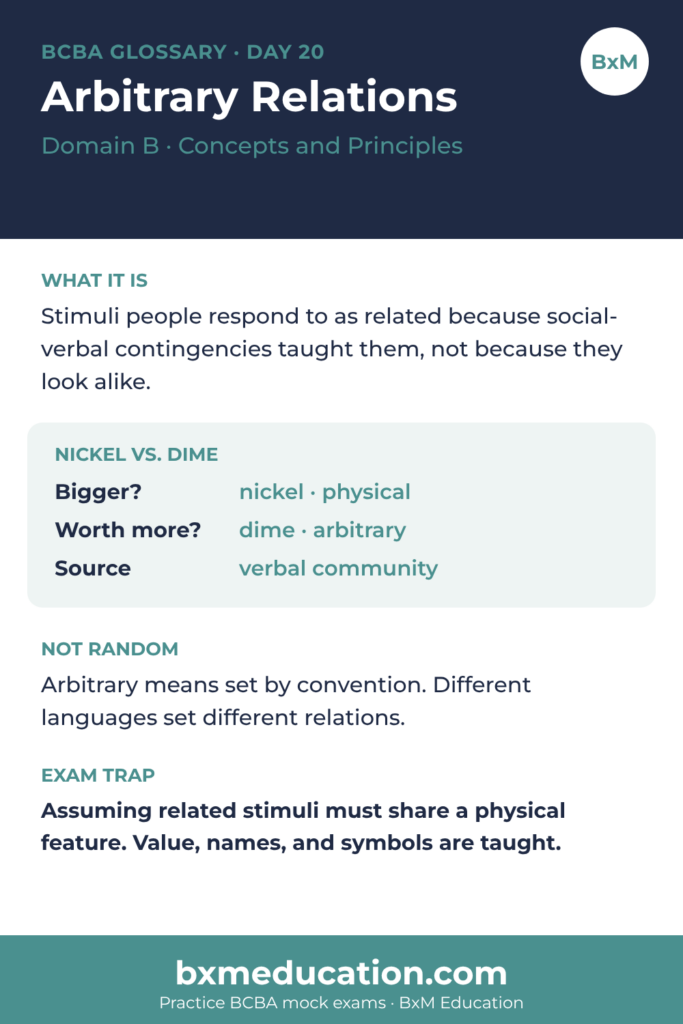
The contrast is with nonarbitrary (physical) relations. Choosing the larger of two coins because it is physically larger is a nonarbitrary relation. Choosing the dime as “worth more” than the nickel, even though the nickel is bigger, is an arbitrary relation: coin value is something the verbal community taught. Arbitrary relations are the raw material of language, and deriving new ones with little or no practice is arbitrarily applicable relational responding. Compare this with an antecedent stimulus class, whose members can be grouped by shared physical features.
The Mechanics: Arbitrary vs. Nonarbitrary
- Nonarbitrary (physical) relation: controlled by a physical property of the stimuli. Bigger, heavier, darker, same shape.
- Arbitrary relation: controlled by social-verbal history. The printed numeral 7, the spoken word “seven,” and seven tally marks; a company logo and the company’s name; the word EXIT and a green running-figure sign.
- “Arbitrary” does not mean random. It means set by social convention rather than by physical form. Different verbal communities can set different arbitrary relations; the same object has different names in different languages.
- Context decides. “Which is bigger?” calls for a physical relation; “Which is worth more?” calls for an arbitrary one, even with the same two coins.
Clinical Applications
- Money skills for adults. Coin and bill value are arbitrary relations; teach them directly and do not assume that size or color will carry the learner.
- Safety signs and symbols. Workplace symbols relate to actions only through training. Check that adult employees respond to the symbol, the word, and the spoken instruction alike.
- Second-language learners. Expect different arbitrary relations across languages and verbal communities, and build programs around the client’s own.
- Equivalence-based instruction. Because arbitrary relations can be derived, teach a few and test for the rest before adding more targets.
Research Consulting & APA Citation Reference
Clinical & Methodological Recommendation: When writing a target, state which relation you are teaching and whether it is physical or arbitrary. For arbitrary relations, design the instruction around the cue that sets the relation (“worth more,” “means,” “goes with”) and check that responding is not actually controlled by an irrelevant physical feature, such as position or color.
APA Reference Citation (7th Edition):
Cooper, J. O., Heron, T. E., & Heward, W. L. (2020). Applied behavior analysis (3rd ed.). Pearson.
Advanced Applied Reasoning Quiz
Question 1
An adult client learning to budget chooses the nickel when asked “Which coin is bigger?” and the dime when asked “Which coin is worth more?” Which statement is correct?
A) Both responses are controlled by physical size
B) The first response reflects a nonarbitrary relation; the second reflects an arbitrary relation taught by the verbal community
C) Both responses are arbitrary relations
D) The second response is stimulus generalization from the first
Question 2
Which pair of stimuli is related arbitrarily?
A) A large box and a small box compared by size
B) Two shades of blue grouped by color
C) The printed word EXIT and a green running-figure sign
D) Two identical keys matched by shape
Check Your Answers
Replay the video above to review the logic behind each scenario, then test yourself under exam conditions in the BCBA Mock Exam System. Previous term: arbitrarily applicable relational responding. Next term: arbitrary stimulus class.