
Test your clinical discrimination skills with these three exam-style questions built specifically around the heavy-hitting domains of the 6th Edition Test Content Outline.
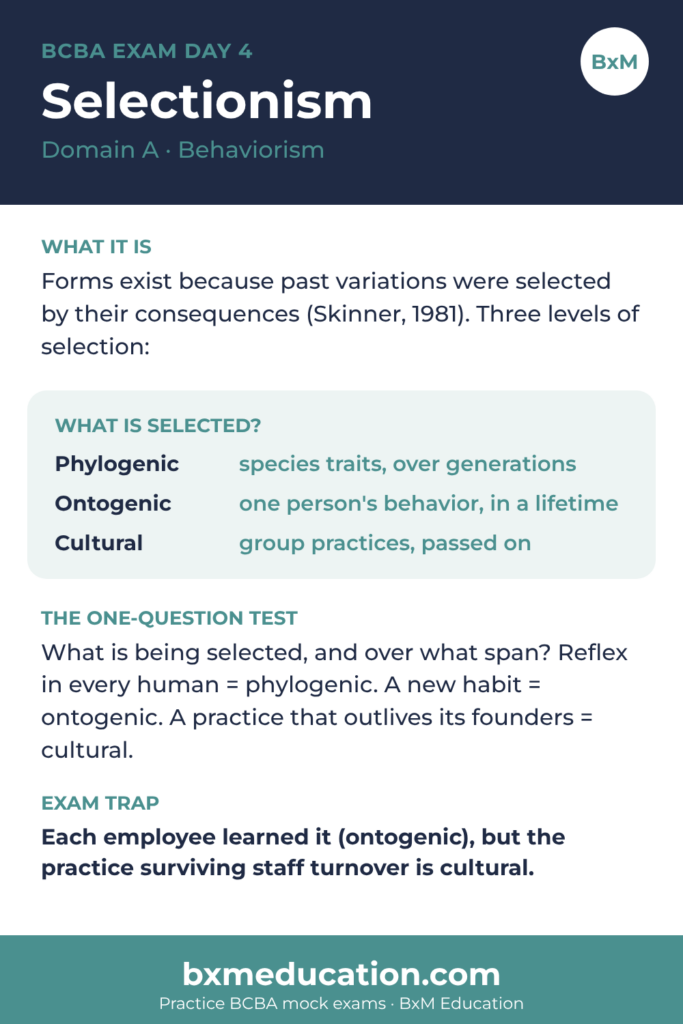
Selectionism is the idea that the forms we see, whether body structures, individual behavior, or group practices, exist because past variations were selected by their consequences. Skinner (1981) described three levels of this “selection by consequences,” and exam items usually describe one example and ask which level explains it:
- Phylogenic selection: natural selection of a species’ characteristics across many generations. It explains features that every member of the species shares without learning, such as unconditioned reflexes.
- Ontogenic selection: selection of behavior by its consequences within one individual’s lifetime. This is operant learning.
- Cultural selection: selection of practices that are passed from one group member to another and survive because they benefit the group, even after the people who started them are gone.
The fastest test is to ask what is being selected, and over what span: a species trait over generations (phylogenic), one person’s behavior during a lifetime (ontogenic), or a group practice transmitted between people (cultural).
Question 1 (Domain A: Selectionism)
A newly hired adult receptionist rarely greets visitors by name. Each time she does, the clinic director thanks her, and over several weeks greeting visitors by name becomes the receptionist’s usual behavior. Which level of selection best explains this change?
A) Phylogenic selection
B) Cultural selection
C) Ontogenic selection
D) Respondent conditioning
Question 2 (Domain A: Selectionism)
A behavior-analytic clinic adopted daily graphing of client data fifteen years ago. Every new employee is taught the practice by coworkers, and it continues long after all of the original staff have left, because clinics that graph daily make faster treatment decisions and keep their funding contracts. Which level of selection best explains the survival of this practice?
A) Cultural selection
B) Ontogenic selection
C) Phylogenic selection
D) Stimulus generalization
Question 3 (Domain A: Selectionism)
An adult blinks when a puff of air strikes the eye. The response appears in virtually every human, requires no learning history, and occurs the first time the stimulus is presented. Which level of selection accounts for the existence of this response?
A) Ontogenic selection
B) Cultural selection
C) Stimulus-stimulus pairing
D) Phylogenic selection
Written Answer Explained
Question 1 Breakdown (Domain A: Selectionism)
Core Scenario Summary: One person’s behavior (greeting visitors by name) increases during her own lifetime because it is followed by a consequence (the director’s thanks).
Correct Answer: C) Ontogenic selection
Clinical Analysis & Distractor Rationales:
- Why A is Incorrect: Phylogenic selection operates on species characteristics across generations. A single employee’s new greeting habit is not inherited.
- Why B is Incorrect: Cultural selection operates on practices transmitted among group members. Nothing here shows the greeting being passed on to others or surviving because it benefits the group.
- Why C is Correct: Ontogenic selection is selection of an individual’s behavior by its consequences during that individual’s lifetime, which is operant reinforcement. The greeting was followed by thanks and increased.
- Why D is Incorrect: Respondent conditioning is the pairing of a neutral stimulus with an unconditioned stimulus so that the neutral stimulus comes to elicit a response. The greeting is operant behavior that increased because of what followed it, not elicited behavior.
Question 2 Breakdown (Domain A: Selectionism)
Core Scenario Summary: A practice is taught from employee to employee and persists after its originators leave, because it benefits the organization.
Correct Answer: A) Cultural selection
Clinical Analysis & Distractor Rationales:
- Why A is Correct: Cultural selection is the selection of practices that are transmitted among members of a group and survive because of their consequences for the group. The practice outlived the people who started it.
- Why B is Incorrect: Ontogenic selection explains how each employee’s graphing is reinforced during that person’s career, but it does not explain why the practice survives across successive generations of staff.
- Why C is Incorrect: Phylogenic selection concerns genetically transmitted characteristics of a species. Daily graphing is not inherited.
- Why D is Incorrect: Stimulus generalization is the spread of a response to stimuli that share features with the training stimulus. It does not describe a practice being passed between people and maintained by group-level outcomes.
Question 3 Breakdown (Domain A: Selectionism)
Core Scenario Summary: An unlearned reflex shared by the whole species appears without any learning history.
Correct Answer: D) Phylogenic selection
Clinical Analysis & Distractor Rationales:
- Why A is Incorrect: Ontogenic selection requires a history of consequences within the person’s lifetime. The blink occurs on the first presentation with no learning history.
- Why B is Incorrect: Cultural selection concerns practices passed among group members. A reflex is not taught or transmitted socially.
- Why C is Incorrect: Stimulus-stimulus pairing produces conditioned responses, which require a learning history. The blink to a puff of air is an unconditioned reflex.
- Why D is Correct: Phylogenic selection is natural selection across generations. Unconditioned reflexes such as the eye blink are part of the species’ inherited repertoire because they had survival value for ancestors.
Keep studying: go back to Exam Day 3: technological vs. conceptually systematic vs. analytic, review the goals of behavior analysis, revisit the definition of applied behavior analysis, and compare positive vs. negative reinforcement, the core of ontogenic selection. Then test yourself under exam conditions in the BCBA Mock Exam System.
APA Reference Citation (7th Edition):
Skinner, B. F. (1981). Selection by consequences. Science, 213(4507), 501–504.