
Test your clinical discrimination skills with these three exam-style questions built specifically around the heavy-hitting domains of the 6th Edition Test Content Outline.
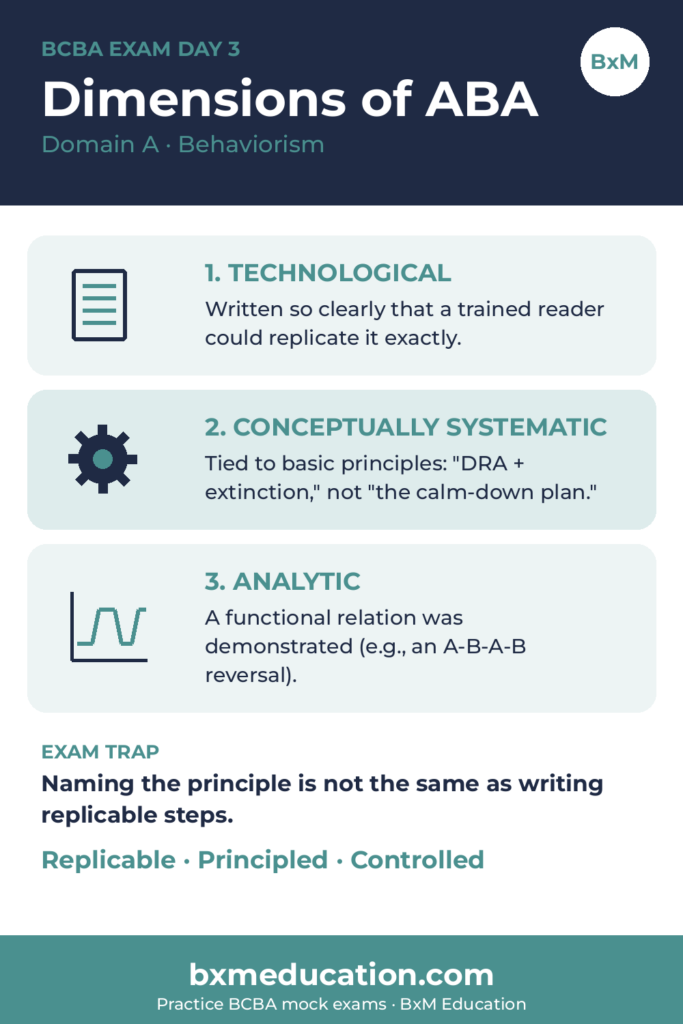
Baer, Wolf, and Risley (1968) named seven dimensions that a study or program must show to count as applied behavior analysis: applied, behavioral, analytic, technological, conceptually systematic, effective, and generality. Exam items rarely ask you to list them. They describe one feature of a program and ask which dimension it shows. Three dimensions get confused most often: technological (the procedure is described clearly enough to replicate), conceptually systematic (the procedure is tied to basic behavioral principles), and analytic (a functional relation has been demonstrated).
Question 1 (Domain A: Dimensions of applied behavior analysis)
A BCBA writes a skill-acquisition protocol for an adult client learning to use a bus pass. The protocol states the exact instruction to give, the prompt to use after 5 seconds, how to fade the prompt, what to deliver after a correct response, and how to record data. A newly hired technician runs the program exactly as the original therapist did after reading it once. Which dimension does the protocol best demonstrate?
A) Conceptually systematic
B) Effective
C) Technological
D) Generality
Question 2 (Domain A: Dimensions of applied behavior analysis)
In a case presentation, a supervisee calls her intervention “the calm-down plan.” Her supervisor asks her to rewrite the description as “differential reinforcement of an alternative behavior (requesting a break) combined with extinction of elopement,” and to explain how each part relates to the function of the behavior. Which dimension is the supervisor strengthening?
A) Conceptually systematic
B) Technological
C) Applied
D) Behavioral
Question 3 (Domain A: Dimensions of applied behavior analysis)
A team uses an A-B-A-B design to evaluate a self-monitoring package for an adult employee’s on-task behavior. On-task behavior rises each time the package is introduced and falls each time it is withdrawn. Which dimension do these data most directly demonstrate?
A) Effective
B) Generality
C) Technological
D) Analytic
Written Answer Explained
Question 1 Breakdown (Domain A: Dimensions of applied behavior analysis)
Core Scenario Summary: The protocol is written in enough detail that a new, trained reader can replicate the procedure exactly.
Correct Answer: C) Technological
Clinical Analysis & Distractor Rationales:
- Why A is Incorrect: Conceptually systematic means the procedure is described and explained in terms of basic principles of behavior. The scenario is about replicable detail, not links to principles.
- Why B is Incorrect: Effective means the behavior change is large enough to have practical value for the client. No outcome data are described.
- Why C is Correct: Technological means all operative procedures are identified and described so completely that a typically trained reader could replicate them. That is exactly what the new technician did.
- Why D is Incorrect: Generality means the behavior change lasts over time, appears in other settings, or spreads to other behaviors. Nothing in the scenario tests whether the skill transfers or maintains.
Question 2 Breakdown (Domain A: Dimensions of applied behavior analysis)
Core Scenario Summary: The supervisor replaces an informal label with a description in terms of behavioral principles and asks how each part connects to function.
Correct Answer: A) Conceptually systematic
Clinical Analysis & Distractor Rationales:
- Why A is Correct: Conceptually systematic means procedures are described and interpreted in terms of the basic principles from which they come (here, differential reinforcement and extinction), rather than as a collection of tricks.
- Why B is Incorrect: Technological is about replicable, step-by-step detail. Naming DRA and extinction ties the plan to principles, but it does not yet tell a reader exactly what to do, when, and how. That is the trap.
- Why C is Incorrect: Applied means the target behavior is socially significant for the client. The rewrite does not change which behavior is targeted.
- Why D is Incorrect: Behavioral means the target is observable, measurable behavior and the measure is reliable. The scenario is about how the intervention is described, not how behavior is measured.
Question 3 Breakdown (Domain A: Dimensions of applied behavior analysis)
Core Scenario Summary: Behavior changes each time the independent variable is introduced or withdrawn, a replicated demonstration of control.
Correct Answer: D) Analytic
Clinical Analysis & Distractor Rationales:
- Why A is Incorrect: Effective asks whether the change was large enough to matter in the client’s life. The data show control, not necessarily practical size. A small, reliable change can be analytic without being effective.
- Why B is Incorrect: Generality asks whether the change lasts or spreads beyond the training conditions. Behavior falling when the package is withdrawn is the opposite of maintenance, and here it is the point of the design.
- Why C is Incorrect: Technological is about how completely the procedure is written up. The data say nothing about the write-up.
- Why D is Correct: Analytic means the analyst has demonstrated a functional relation between the intervention and the behavior. Reliable change with each introduction and withdrawal in a reversal design is a classic demonstration.
Keep building the foundation: review radical vs. methodological behaviorism from Exam Day 2 and the three levels of scientific understanding from Exam Day 1, see why baseline logic is what makes a program analytic, then test yourself under exam conditions in the BCBA Mock Exam System.
APA Reference Citation (7th Edition):
Baer, D. M., Wolf, M. M., & Risley, T. R. (1968). Some current dimensions of applied behavior analysis. Journal of Applied Behavior Analysis, 1(1), 91–97.