
A graph can look convincing and still be wrong. When a result shows up only because of the way behavior was measured, behavior analysts call it an artifact, and Domain C (Measurement, Data Display, and Interpretation) items use it to test whether you trust the data or check how they were collected.
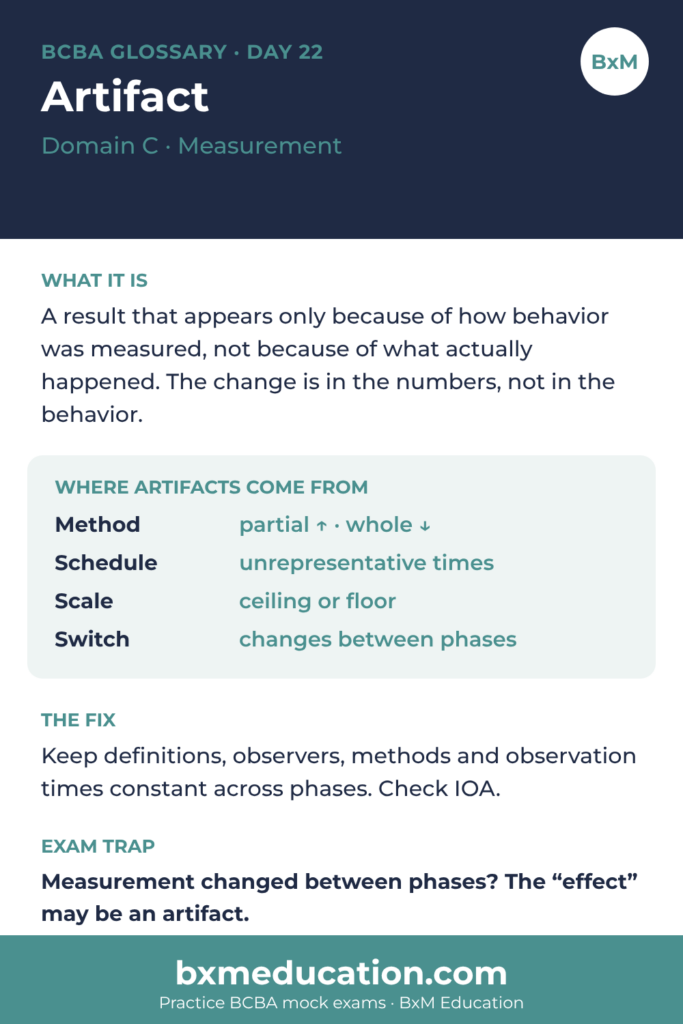
Cooper, Heron, and Heward (2020) define an artifact as an outcome that seems to exist because of the measurement method but does not match what actually occurred. In other words, the change is in the numbers, not in the behavior. An artifact is a validity problem: the data are no longer telling you about the behavior you meant to measure.
This term builds on accuracy of measurement, which asks whether observed values match true values. An artifact is what an accuracy or validity failure looks like on the graph. It also connects to anecdotal observation, where loose recording rules make artifacts easy to create.
The Mechanics: Where Artifacts Come From
- Discontinuous measurement. Partial-interval recording tends to overestimate behavior and whole-interval recording tends to underestimate it. Momentary time sampling can miss behavior that happens between checks. A “change” can be produced by the recording method alone.
- Poorly scheduled observations. Observing only at times when the behavior is unlikely (or very likely) produces data that don’t represent the person’s day.
- Insensitive or limited scales. A scale with a ceiling or floor can hide real change or make change look flat; for example, counting only up to a cap.
- Changing the measurement mid-stream. Switching observers, definitions, interval length, or session length between phases can create a “treatment effect” that is really a measurement effect.
- Observer drift and reactivity. Observers gradually shifting their use of the definition, or the person behaving differently because they are being watched, can bend the data.
Clinical Applications
- Keep the measurement constant across phases. Same definition, same interval length, same session length, same observation times in baseline and intervention.
- Match the measure to the behavior. Use continuous measurement (event recording, duration) when feasible; if you use interval methods, know which way each one biases the data.
- Schedule observations to represent the day. Sample across the times and settings where the behavior matters for the adult client, not just the convenient ones.
- Check with IOA and retraining. Interobserver agreement checks and periodic observer retraining catch drift before it becomes a fake trend.
Research Consulting & APA Citation Reference
Clinical & Methodological Recommendation: Before you interpret any change in level, trend, or variability, ask one question: “Could the way we measured this produce the same picture even if the behavior didn’t change?” If the answer is yes, fix the measurement system first. Document every change to definitions, observers, or recording procedures on the graph so readers can rule artifacts in or out.
APA Reference Citation (7th Edition):
Cooper, J. O., Heron, T. E., & Heward, W. L. (2020). Applied behavior analysis (3rd ed.). Pearson.
Advanced Applied Reasoning Quiz
Question 1
A BCBA measures an adult employee’s off-task behavior with 10-second partial-interval recording in baseline. When the self-monitoring intervention starts, a new observer switches to 10-second whole-interval recording. Off-task behavior drops from 60% to 20% of intervals. What is the best interpretation?
A) The intervention clearly reduced off-task behavior
B) The drop may be an artifact of changing the measurement method
C) The data show observer reactivity
D) The data show a descending baseline
Question 2
Staff record an adult client’s vocal outbursts only during a 15-minute quiet reading period each afternoon, when outbursts rarely occur. Reports describe the outbursts as “near zero,” but staff on other shifts report frequent outbursts. Which measurement problem best explains the discrepancy?
A) Poorly scheduled observations producing an artifact
B) An insensitive scale with a ceiling effect
C) Low interobserver agreement
D) Whole-interval recording underestimating the behavior
Check Your Answers
Replay the video above to review the logic behind each scenario, then test yourself under exam conditions in the BCBA Mock Exam System. Previous term: arbitrary stimulus class. Next term: ascending baseline.