
Before an intervention starts, the baseline has to tell you where behavior is headed. When the baseline data are already climbing, you have an ascending baseline, and Domain D (Experimental Design) items test whether you know when that trend lets you move forward and when it ruins your conclusion.
Cooper, Heron, and Heward (2020) define an ascending baseline as a data path showing an increasing trend in the response measure over time, and they contrast it with a descending baseline, which trends downward. The term is simple. The decision it forces is not: does the direction of the trend match the direction you expect the intervention to push the behavior?
This builds on the baseline logic behind the A-B design and the reversal logic of the A-B-A design, where prediction from baseline is the whole point. It also connects to the previous term, artifact: before you read a trend, make sure the measurement didn’t create it.
The Mechanics: Direction of Trend vs. Direction of Expected Change
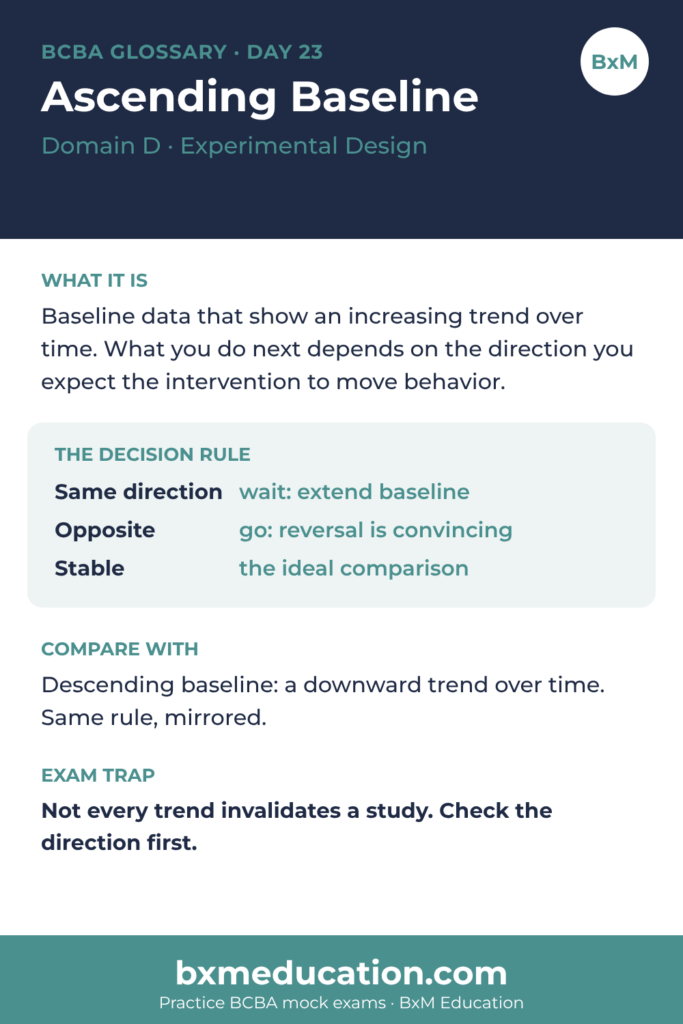
- Same direction = problem. If the baseline is already ascending and the intervention is meant to increase the behavior, any further increase could just be the trend continuing. You can’t credit the intervention.
- Opposite direction = acceptable. If the baseline is ascending and the intervention is meant to decrease the behavior, a clear reversal of the trend after the intervention starts is convincing evidence of an effect.
- The usual move: keep collecting baseline. When the trend runs in the direction of the expected change, extend baseline until the data stabilize, if it is ethical and practical to wait.
- Stable baseline is the ideal. A baseline with little variability and no trend gives the clearest prediction to compare against.
Clinical Applications
- Skill acquisition with an upward trend. An adult learner’s independent clock-ins are already rising in baseline (practice effects, new routine). Wait for stability before starting the prompting package, or the “gains” may not be yours.
- Problem behavior that’s escalating. An adult client’s property destruction is ascending in baseline. Intervening now is both ethical and analyzable: if the trend reverses, the change is convincing.
- Document the decision. Note on the graph why you extended baseline or why you started treatment despite the trend.
- Rule out artifacts. Check that the climb isn’t caused by a change in observers, definitions, or measurement method.
Research Consulting & APA Citation Reference
Clinical & Methodological Recommendation: Before you introduce the independent variable, compare the baseline trend with the direction of the change you expect. If they match, extend baseline until the data stabilize, unless safety or ethics require you to act now. If they’re opposite, you can proceed, and a reversal of the trend will carry your argument.
APA Reference Citation (7th Edition):
Cooper, J. O., Heron, T. E., & Heward, W. L. (2020). Applied behavior analysis (3rd ed.). Pearson.
Advanced Applied Reasoning Quiz
Question 1
A BCBA plans a token system to increase an adult employee’s completed work tasks. Over seven baseline sessions, completed tasks rise steadily from 4 to 11 per shift. What is the best next step?
A) Start the token system now, because baseline shows the behavior can change
B) Switch to a descending baseline
C) Start the intervention and use a variable-ratio schedule
D) Continue collecting baseline data until the trend levels off, if it is ethical to wait
Question 2
An adult client’s property destruction has been rising across six baseline sessions. The team starts a differential reinforcement procedure, and destruction immediately begins to fall. How should this ascending baseline be viewed?
A) It is acceptable, because the intervention is meant to decrease the behavior and the trend clearly reversed
B) It invalidates the results, because any trend in baseline does
C) It is a descending baseline because the behavior is problematic
D) It shows an artifact, because the behavior changed direction
Check Your Answers
Replay the video above to review the logic behind each scenario, then test yourself under exam conditions in the BCBA Mock Exam System. Previous term: artifact. Next term: audience.