
“He looks tired.” “She’s losing focus.” “They lack heart.” None of these can be counted, so none of them can be coached.
What It Means (in Plain Language)
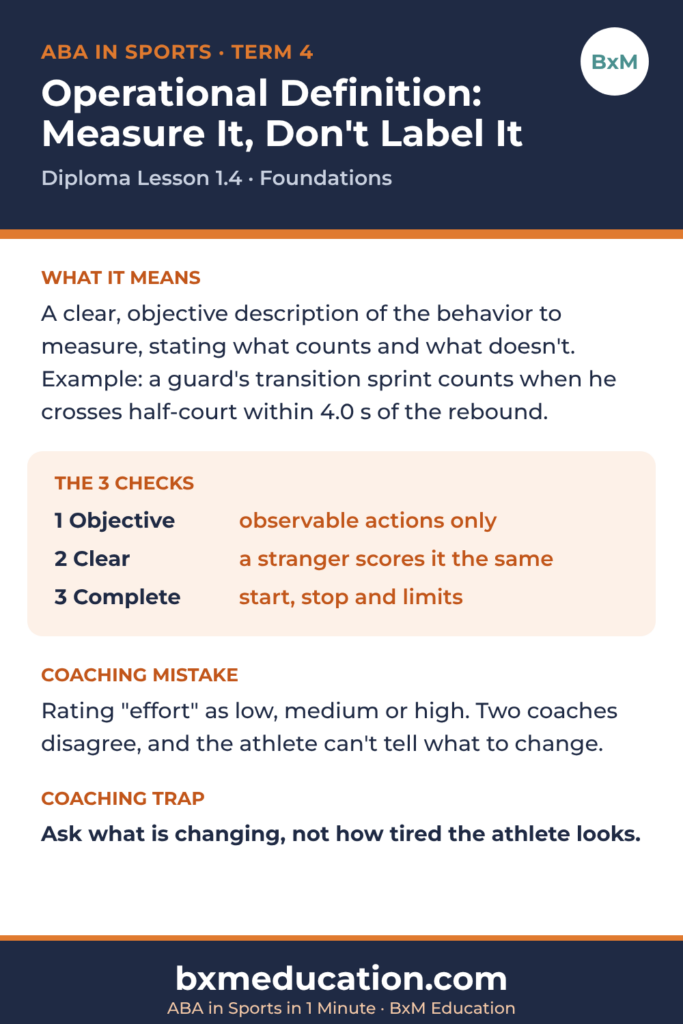
An operational definition is a clear, objective and concise description of the behavior you’re going to measure. It describes what the behavior looks like and spells out what counts as an occurrence and what doesn’t.
Two ideas do the work:
- Swap the label for an action: “looks tired” becomes “crossed half-court in more than 4.0 seconds after a defensive rebound.”
- Draw the line: anyone watching should agree on which reps count and which don’t.
The BxM diploma puts it as a shift in the coach’s question. Instead of “How tired is the athlete?”, ask “What specific behaviors are changing?” Fatigue can’t be seen directly. You infer it from behavior you can measure: slower first steps, lower accuracy, later decisions.
The 3 Checks
The study guide gives three criteria for a good definition. Run them on every behavior you track:
- Objective: only observable actions. No “lazy,” “unfocused” or “soft.”
- Clear: a stranger could read it and measure it exactly the way you do.
- Complete: it says where the behavior starts and stops, and what is not included.
Three yeses → you have something you can count, graph and coach.
Application: Done Right
Marcus, 21, is a shooting guard on a college men’s basketball team. His coach, Dana, kept saying he “dies late in practice.” Instead of repeating the label, she wrote a definition: a transition sprint counts when Marcus crosses half-court within 4.0 seconds of a teammate securing the defensive rebound. The clock starts when the rebounder has both hands on the ball and stops when Marcus’s lead foot crosses the half-court line.
A graduate assistant timed every transition rep in the 16-rep end-of-practice drill. Baseline over one week: Marcus met the criterion on 15 of 16 early reps but only 5 of 16 reps after rep 12 (31%). That told Dana when the behavior changed, not just that something was off. She moved a 45-second water break to after rep 10 and cut one full-court rep from the block. Two weeks later, Marcus met the 4.0-second criterion on 13 of 16 late reps (81%), and a second coach timing the same video agreed on 15 of 16 reps.
Why it works: the definition is objective (a timed action), clear (two coaches scored it the same way) and complete (exact start, stop and criterion). The data then pointed to a change in the practice design.
Misapplication: Spot the Coaching Mistake
Same team, different drill. Assistant coach Ray rates each player’s “effort” on a clipboard as low, medium or high. He gives Marcus’s teammate Jordan, 24, a “low” for the closing defensive drill. Dana watched the same reps and would have marked “medium.” Jordan hears “you need to try harder” and has no idea what to change.
Spot the mistake: “effort” isn’t a behavior. It fails the stranger test, so two coaches watching the same reps disagree, and the athlete gets no actionable target. The fix: define the action. For example: “a close-out counts when Jordan has a hand up within an arm’s length of the shooter before the ball is released.” Then count it, and give feedback on that action.
How It Shows Up in Practice and on Exams
- Coaching trap: “He’s not trying.” Ask what you’d see if he were trying, then write that down as the definition.
- BCBA/RBT exam angle: the right answer avoids mentalistic words (“frustrated,” “unmotivated”) and includes onset, offset and boundaries. Watch for the Dead Man’s Test trap (Study Guide C.1): “not standing still on defense” fails, because a dead man can do it. Define what the athlete does.
- Topography vs. function: a topography-based definition describes the form of the movement (hand up within an arm’s length); a function-based one describes its effect (any action that blocks the shooter’s view). Pick the one that fits what you need to change.
Go Deeper
This is Lesson 1.4 of the BxM Professional Diploma in Behavioral Sport Training. The full lesson goes further: separating the demands you set from the behavior athletes produce, a behavioral measurement matrix and the six questions a behavior-analytic coach asks after every session.
Keep Studying
- Term 1 of this series: Behavior in Sports Explained
- Term 3 of this series: Stimulus Control in Sports Explained
- BCBA series: Radical vs. Methodological Behaviorism
- Watch every sports term: ABA in Sports in 1 Minute playlist
Quick Check (2 Questions)
Question 1. A volleyball coach wants to track “hustle” in an adult women’s league team. Which is the best operational definition?
A) The player shows strong motivation to reach every ball
B) The player doesn’t give up on plays
C) The player takes at least one step toward the ball within 1 second of an opponent’s attack contact
D) The player looks energetic during rallies
Show answer
C. It names an observable action, a clear start point and a time criterion, so two observers would score it the same way. A uses a mentalistic term (motivation) that can’t be seen. B is stated as something the player doesn’t do, which fails the Dead Man’s Test. D depends on the observer’s impression, so it fails the stranger test.
Question 2. A soccer coach defines a target behavior for an adult midfielder as “not standing still when the team loses the ball.” What is the main problem?
A) It is a function-based definition
B) It has no measurement procedure for interobserver agreement
C) It describes a consequence instead of a behavior
D) It fails the Dead Man’s Test
Show answer
D. The definition is built around what the player should not do (stand still), and a dead man can stand still, so it fails the test. A good definition states what the athlete does, e.g., “sprints toward the ball within 2 seconds of losing possession.” A is wrong: it describes no effect on the environment. B: IOA is collected after defining, it isn’t part of the wording problem. C: losing the ball is an antecedent, and no consequence is described.
Reference
BxM Education & Consulting. (2026). Professional Diploma in Behavioral Sport Training, Lesson 1.4: Measuring performance through behavioral observation. BxM Education.
BxM Education. (2024). BxM Education BCBA 6th Edition Study Guide (Domain C, C.1). BxM Education.
Cooper, J. O., Heron, T. E., & Heward, W. L. (2020). Applied behavior analysis (3rd ed.). Pearson.