
Test your clinical discrimination skills with these three exam-style questions built specifically around the heavy-hitting domains of the 6th Edition Test Content Outline.
Radical behaviorism is B. F. Skinner’s philosophy of the science of behavior, and it is the philosophy behind applied behavior analysis. Its defining move is what it does with private events: thinking, feeling, and other behavior that only the person behaving can observe. Methodological behaviorism accepts that such events exist but leaves them out of science because they can’t be publicly observed. Radical behaviorism includes them as behavior, governed by the same principles as public behavior, while rejecting mentalistic explanations that place the causes of behavior in an inner mind. Cooper, Heron, and Heward (2020) treat this distinction as foundational, and Domain A items test it directly.
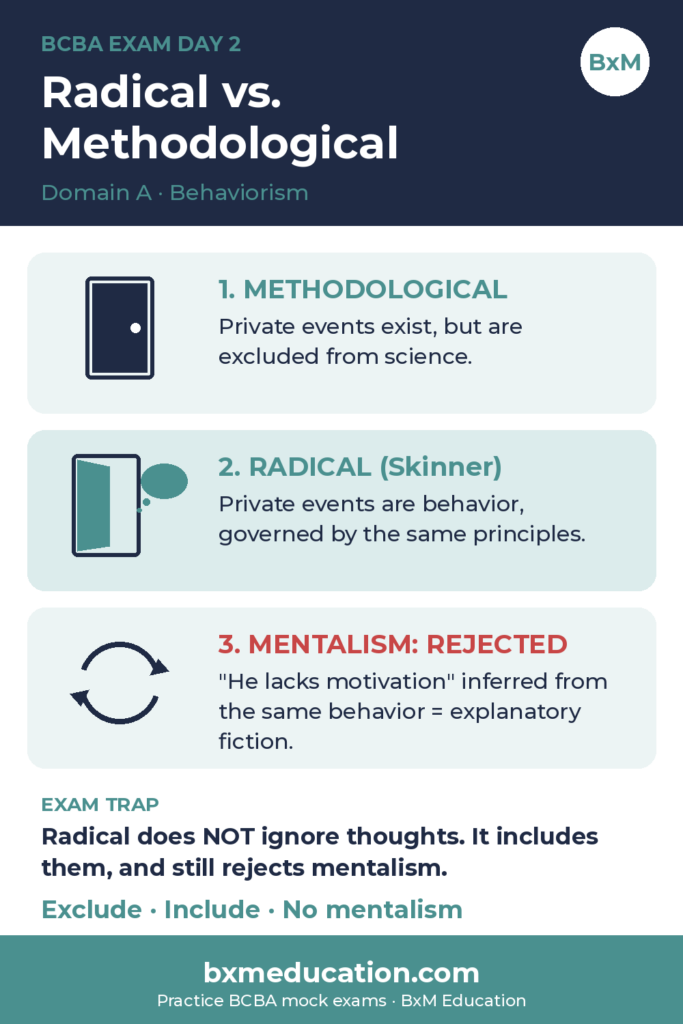
Question 1 (Domain A: Radical behaviorism and private events)
An adult client tells his BCBA, “I keep thinking I’m going to mess up the presentation.” The BCBA treats these self-statements as behavior that can be influenced by the same environmental variables as the client’s public behavior, and includes them in the analysis. Which philosophical position does this reflect?
A) Methodological behaviorism
B) Radical behaviorism
C) Mentalism
D) Experimental analysis of behavior
Question 2 (Domain A: Methodological behaviorism)
A researcher states: “Thoughts and feelings certainly exist, but because they cannot be publicly observed and measured, they have no place in a scientific analysis of behavior.” Which position does this statement represent?
A) Radical behaviorism
B) Mentalism
C) Parsimony
D) Methodological behaviorism
Question 3 (Domain A: Mentalism and explanatory fictions)
A manager says an adult employee rarely finishes weekly reports “because he lacks motivation.” When asked how she knows he lacks motivation, she answers, “Because he never finishes his reports.” From a radical behaviorist perspective, “lacks motivation” in this account is best described as:
A) An explanatory fiction
B) A private event
C) A functional relation
D) An operational definition
Written Answer Explained
Question 1 Breakdown (Domain A: Radical behaviorism and private events)
Core Scenario Summary: The BCBA treats the client’s covert self-statements as behavior subject to the same environmental variables as public behavior.
Correct Answer: B) Radical behaviorism
Clinical Analysis & Distractor Rationales:
- Why B is Correct: Radical behaviorism includes private events (thinking, feeling) in the subject matter of behavior analysis and holds that they follow the same principles as public behavior. “Radical” here means thoroughgoing, not extreme.
- Why A is Incorrect: Methodological behaviorism acknowledges private events but excludes them from scientific analysis because they cannot be publicly observed. Including them in the analysis is the opposite of that position.
- Why C is Incorrect: Mentalism explains behavior by appealing to an inner mental dimension (mind, will, personality) as its cause. The BCBA is not saying the thoughts come from a separate mental realm; she treats them as behavior with environmental causes.
- Why D is Incorrect: The experimental analysis of behavior is the basic research branch of behavior analysis, not a philosophical position on private events.
Question 2 Breakdown (Domain A: Methodological behaviorism)
Core Scenario Summary: The researcher accepts that private events exist but rules them out of science because they are not publicly observable.
Correct Answer: D) Methodological behaviorism
Clinical Analysis & Distractor Rationales:
- Why D is Correct: Methodological behaviorism restricts scientific study to publicly observable events. It does not deny that thoughts and feelings exist; it sets them aside on methodological grounds. That is exactly this statement.
- Why A is Incorrect: Radical behaviorism includes private events in the analysis of behavior, which the researcher refuses to do.
- Why B is Incorrect: Mentalism would treat thoughts and feelings as causes of behavior located in a mental dimension. The researcher is excluding them, not using them as explanations.
- Why C is Incorrect: Parsimony is one of the attitudes of science: prefer the simplest explanation that fits the data before considering more complex ones. It is not a position about whether private events belong in science.
Question 3 Breakdown (Domain A: Mentalism and explanatory fictions)
Core Scenario Summary: “Lacks motivation” is inferred from the very behavior it is supposed to explain, so the explanation is circular.
Correct Answer: A) An explanatory fiction
Clinical Analysis & Distractor Rationales:
- Why A is Correct: An explanatory fiction is a fictitious variable that is really just another name for the behavior it claims to explain. It produces circular reasoning: he doesn’t finish reports because he lacks motivation, and we know he lacks motivation because he doesn’t finish reports. Radical behaviorism rejects this kind of mentalistic explanation and looks instead for environmental variables.
- Why B is Incorrect: A private event is behavior that only the behaving person can observe, such as thinking. “Lacks motivation” is not a response the employee emits; it is a label inferred from his public behavior.
- Why C is Incorrect: A functional relation is demonstrated when manipulating an environmental variable reliably changes behavior. Nothing was manipulated here.
- Why D is Incorrect: An operational definition describes a behavior in observable, measurable terms. “Lacks motivation” is the opposite: a vague construct with no measurable referent of its own.
Keep building the foundation: start with the three levels of scientific understanding in Exam Day 1: Description vs. Prediction vs. Control, see what makes applied behavior analysis a science of socially significant change, and see private events at work in Acceptance and Commitment Therapy in Behavior Care. Then test yourself under exam conditions in the BCBA Mock Exam System.
Next: Exam Day 3: Technological vs. Conceptually Systematic vs. Analytic.