
Your athlete’s squat went up 20 kilos. Great. But the game doesn’t score squats. It scores what the athlete does on the field.
What It Means (in Plain Language)
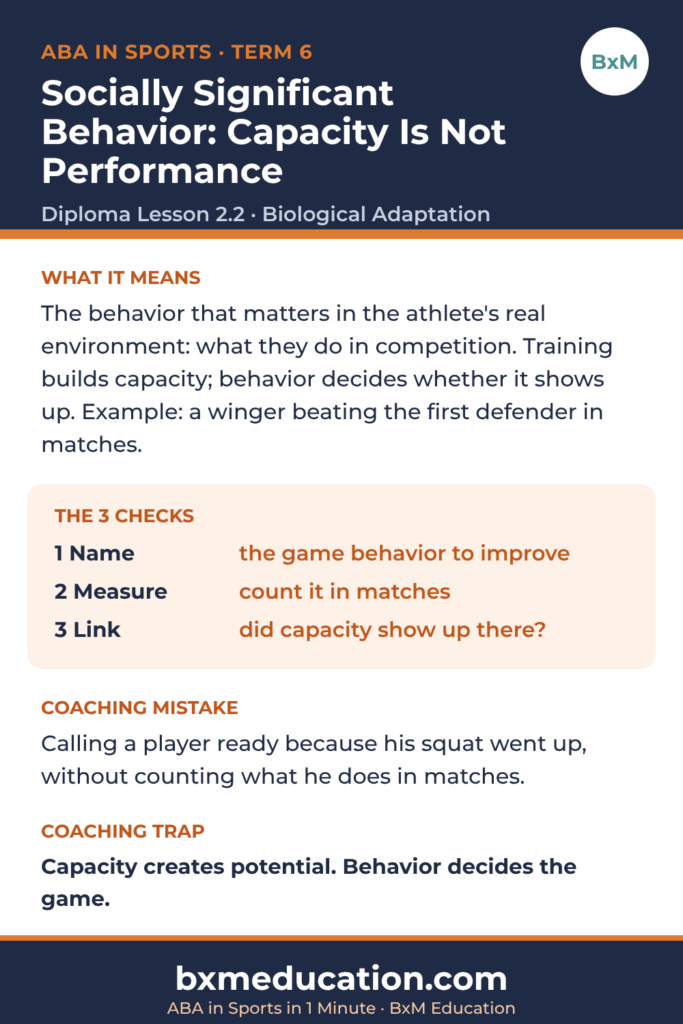
In ABA, the applied dimension means we target socially significant behavior: behavior that actually matters in the person’s life. In sport, that’s the athlete’s performance in competition: the line break, the clean tackle, the shot made under pressure. A gym number can support that behavior, but it isn’t the goal.
Lesson 2.2 of the BxM diploma frames it as two different things:
- Capacity (biological adaptation): what training builds in the body: force, work capacity, a faster heart-rate recovery. It’s potential.
- Performance (behavior): what the athlete actually does in the game. It’s the potential realized, or not.
Capacity creates potential. Behavior decides whether that potential shows up on game day.
The 3 Checks
Before you call a training block a success, run three checks:
- Name: which game behavior is this block supposed to improve?
- Measure: count that behavior in matches or match-like drills, before and after.
- Link: did the gain in capacity show up in that behavior? If not, look at technique, timing and practice design, not only at the training load.
Three yeses → you’re coaching for the behavior that matters.
Application: Done Right
Kemi, 27, plays wing for a women’s club rugby team. Her coach, Marcus, starts an 8-week strength and acceleration block. He expects her 10-meter sprint test to improve, and it does: 1.92 s to 1.84 s. That’s a capacity measure.
But Marcus named the game behavior before the block started: beating the first defender within 10 meters when she gets the ball with space. He counted it from match video across 4 games before the block: 3 of 10 chances. During the block he also added game-speed drills where she receives the ball on the run against a live defender. Over the 4 games after the block: 6 of 10 chances.
Why it works: he named the socially significant behavior, measured it in matches before and after, and checked the link between the faster sprint test and what Kemi actually did on the field.
Misapplication: Spot the Coaching Mistake
Same club, men’s team. Coach Dana runs a heavy strength block for Luis, 31, a back-rower. His squat goes from 140 kg to 160 kg, and Dana tells the team Luis is “ready for the season.” Nobody counted his carries in matches. On match video, Luis still crosses the gain line on about 1 of 8 carries, the same as last season.
Spot the mistake: Dana treated a capacity number as the goal. The squat change is real, but the game behavior didn’t change. In ABA terms, the result was effective in the gym but not yet applied.
The fix: name the game behavior first (carries that cross the gain line per match), measure it at baseline, and if capacity rises while the behavior stays flat, look at body position, timing at contact and practice design.
How It Shows Up in Practice and on Exams
- Coaching trap: “He’s stronger, so he’s better.” Stronger is capacity. Better is behavior, and you only know it by measuring the game.
- BCBA/RBT exam angle: the Applied vs. Effective trap (Study Guide A.5). Applied is about the importance of the goal; effective is about the size of the change. A skill taught perfectly that the person doesn’t need is effective but not applied.
- Prioritizing goals: when choosing targets, pick the behavior that gives the athlete the most access to success in their real environment (Study Guide F.8), not the easiest number to move.
Go Deeper
This is Lesson 2.2 of the BxM Professional Diploma in Behavioral Sport Training. The full lesson covers the four-stage adaptation loop, why recovery makes adaptation possible, and how to measure training with both biological and behavioral indicators.
Keep Studying
- Term 5 of this series: Dependent Variable in Sports Explained
- Term 1 of this series: Behavior in Sports Explained
- BCBA series: Technological vs. Conceptually Systematic vs. Analytic
- Watch every sports term: ABA in Sports in 1 Minute playlist
Quick Check (2 Questions)
Question 1. After a strength block, an adult rugby player’s squat rises by 15%, but the number of tackles he breaks per match hasn’t changed. Which statement fits the ABA view?
A) The block was applied because his strength increased
B) Capacity improved, but the socially significant game behavior hasn’t changed yet
C) The squat is the target behavior, so the block succeeded
D) Match data aren’t needed once gym tests improve
Show answer
B. The squat shows a change in capacity; the behavior that matters is what he does in matches, and it hasn’t moved. A confuses a gym change with an applied outcome. C treats the capacity measure as the target behavior. D skips the measurement that answers the real question.
Question 2. Which target best meets the “applied” dimension for an adult rugby winger?
A) The percentage of match chances in which she beats the first defender
B) Her one-rep-max squat
C) The coach’s rating of how “explosive” she looks
D) The number of gym sessions she attends each week
Show answer
A. It’s an observable game behavior that matters for her and her team. B is a capacity measure that can support the behavior but isn’t the goal. C is a subjective label, not a measured behavior. D measures attendance, not performance.
Reference
BxM Education & Consulting. (2026). Professional Diploma in Behavioral Sport Training, Lesson 2.2: Biological adaptation: Building the capacity for athletic behavior. BxM Education.
BxM Education. (2024). BxM Education BCBA 6th Edition Study Guide (Domain A, A.5; Domain F, F.8). BxM Education.
Cooper, J. O., Heron, T. E., & Heward, W. L. (2020). Applied behavior analysis (3rd ed.). Pearson.